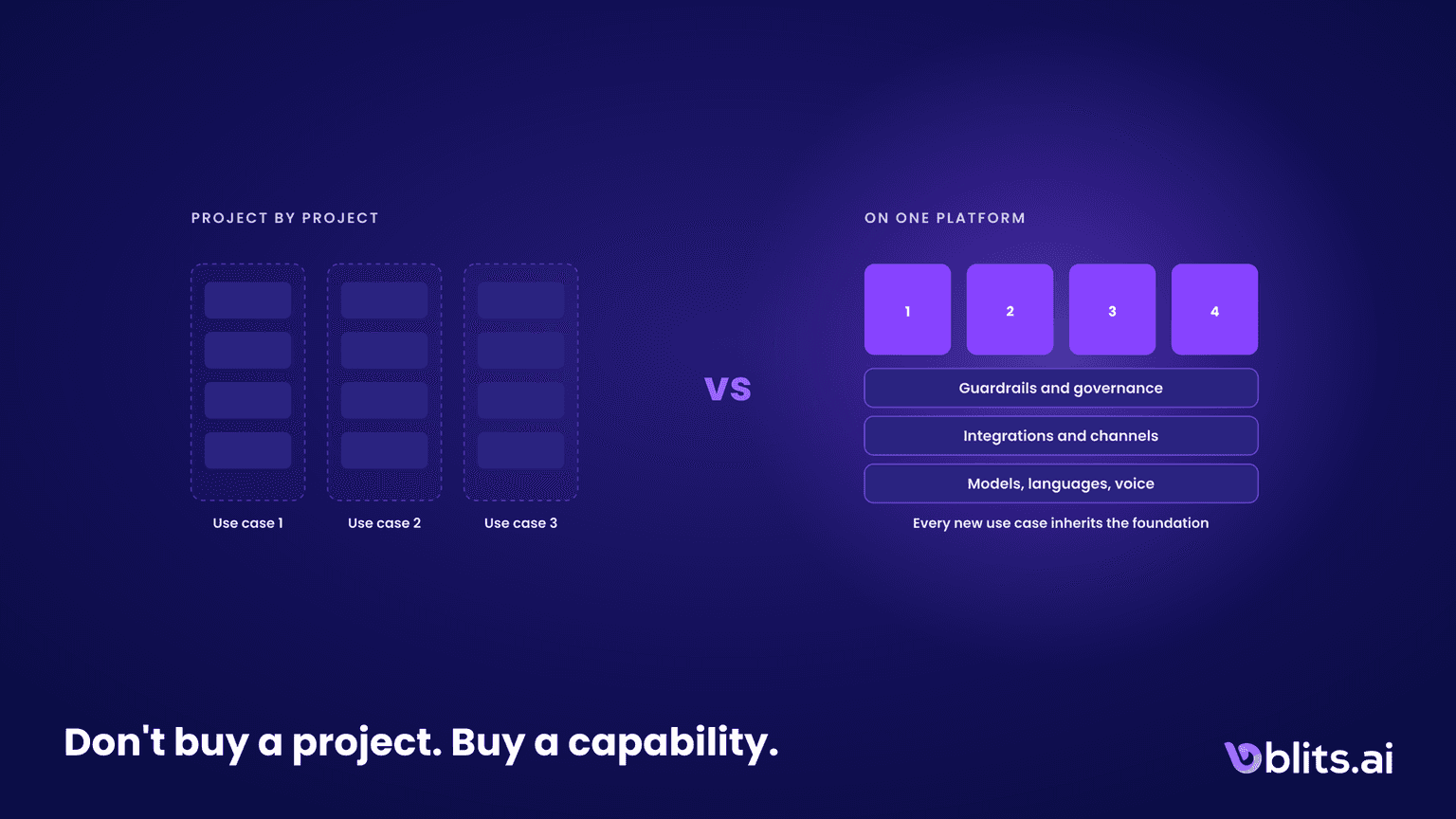
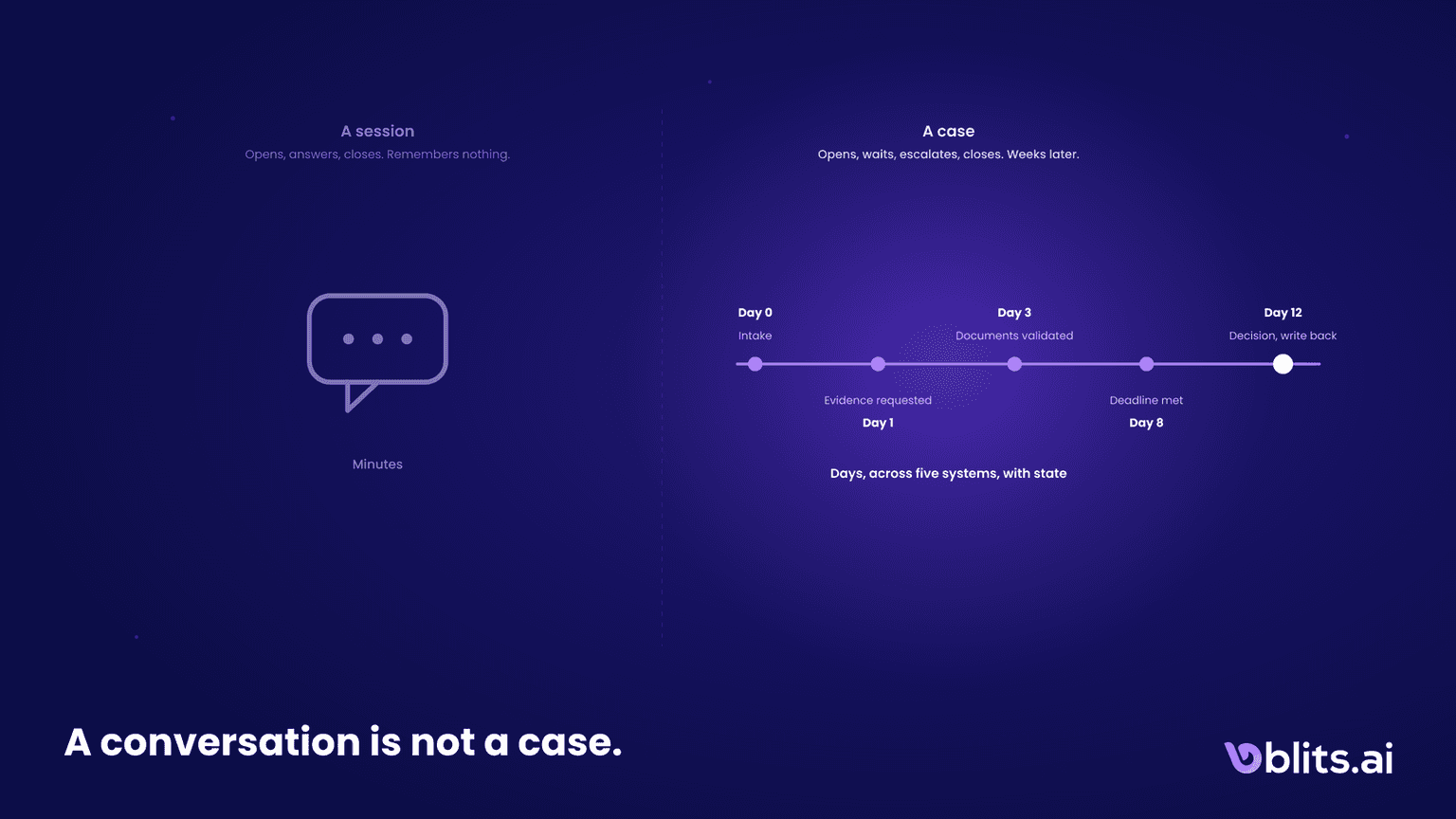
Most enterprises don't need an AI agency. They need AI that still works, and still gets better, two years after the agency has left. That's no knock on agencies: a good AI agency is great at what it does: workshops, a proof of concept, a custom build for a specific problem. The trouble starts when a company buys a project but actually needed a capability. Then every new use case becomes a new project, with a new team, a new codebase and a new invoice.
So how do you choose? There are really four options, and the data is starting to show which ones reach production.
Fully custom, built around your process. Fast to start, often impressive in the demo. But you own a codebase you didn't write, the knowledge leaves with the team, and the next use case starts from scratch.
Quick, predictable, well supported. Until you need it to work your way, with your systems, in your language, under your regulator. Then you find out where the product ends.
Full control, if you can hire the people. AI skills are now the hardest skills for employers to find, according to ManpowerGroup's 2026 talent shortage survey, across more than 39,000 employers in 41 countries. Good luck building a team of twenty, and keeping it.
A product you configure for your use cases, with people who know your industry helping you get it live. That's where we sit, and I wrote about why we chose that position in We're Not SaaS. We're Not an Integrator. On Purpose.
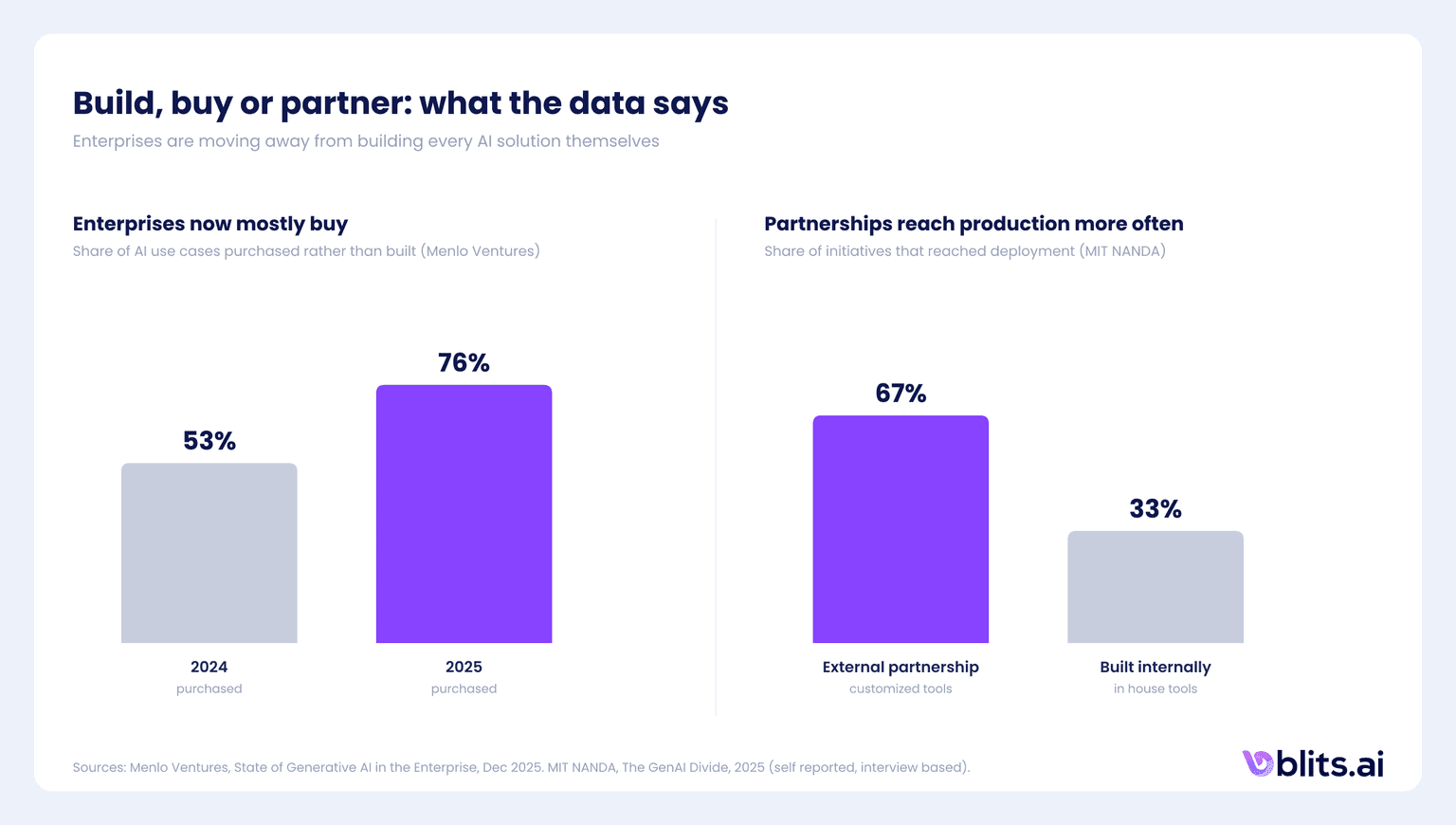
Two numbers stand out. First, enterprises have largely stopped building everything themselves. Menlo Ventures found that 76 percent of AI use cases are now purchased rather than built internally, up from 53 percent in 2024.
Second, what you buy matters. MIT's GenAI Divide research found that external partnerships with learning capable, customized tools reached deployment about 67 percent of the time, against about 33 percent for tools built internally. That's self reported and based on interviews, so take the exact numbers with some salt. The direction is hard to ignore: customized, but not built from scratch, wins.
Here's the one that should worry every company that just signed a big custom AI project. Gartner predicts that by 2028, 70 percent of enterprises will abandon agentic AI built by vendor forward deployed engineering teams. The reason, according to the same research: fewer than 20 percent of those engagements turn recurring customer needs into capabilities in the vendor's core product.
That is the whole argument. When engineers build your AI as a one off, nothing they learn ends up in a product. Nobody else maintains it. Nobody upgrades it when the model changes. And models change every quarter, as I explained in The Best AI Model Doesn't Exist. Two years later you own a custom system that nobody wants to touch, running on a model that's been deprecated.
The story isn't new. Gartner already predicted in 2024 that at least 30 percent of generative AI projects would be abandoned after proof of concept. Proofs of concept are easy, and production is hard, especially production for five years.
With an AI agency, a SaaS vendor or a platform, these questions separate a project from a capability:
- What happens when the model we use gets deprecated? Is it a configuration change or a new project?
- Who maintains this in two years, and what will it cost?
- Does what you build for us improve your product, or does it stay a one off?
- What do we own, and what happens if we want to leave? Gartner explicitly advises contracts that cover intellectual property and exit responsibilities. Ask for them.
- How fast is the second use case? If it takes as long as the first, you bought a project.
- Who in your team knows our industry, our regulator and our languages?
If the answers are vague, you're buying a project. That can be fine for a one off experiment, but not for the AI you plan to run your customer service, your claims or your onboarding on.
There are good reasons to hire an AI agency. A short strategy engagement, a marketing campaign, a one time data analysis, a prototype to convince your board. Anything that's meant to end is a good fit for a project.
But if it's meant to last, if it touches customers, money or regulators, you want a capability. Something with a product team behind it, governance built in, and a roadmap that includes the next model and the next use case.
That's the choice we made seven years ago when we started building Blits.ai. If you're weighing an AI agency against a platform right now, you're welcome to compare notes with us, even if we turn out not to be the answer.