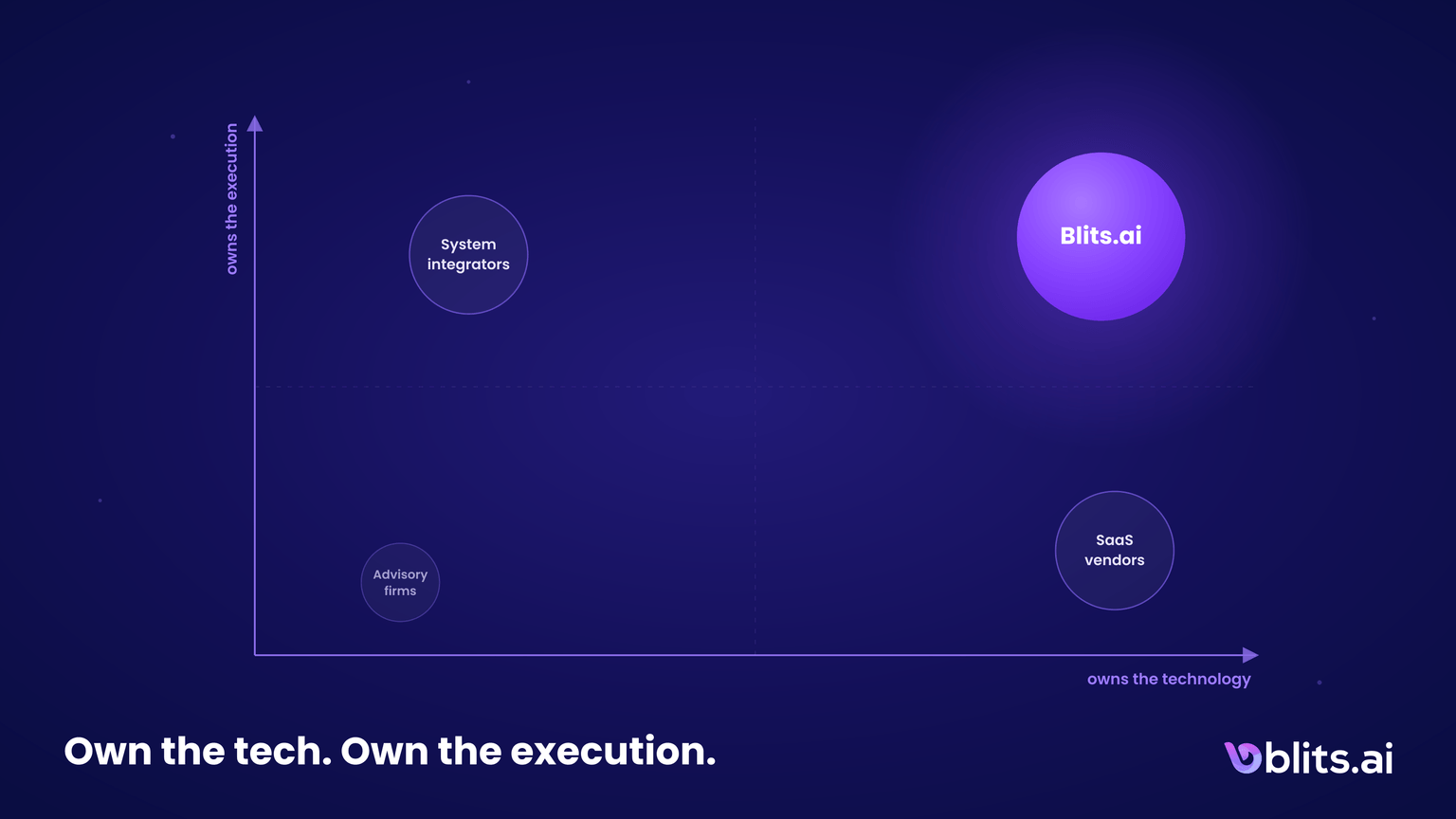
Every large procurement process has a moment I've come to enjoy. Somewhere around the second meeting, someone looks up from their vendor matrix and asks: "So are you a software company or a services company?"
Both. Neither. On purpose. And the reason that answer makes spreadsheets uncomfortable is the same reason our projects go live.
Enterprise AI buying defaults to two models, and everyone in the room knows their scripts.
Box one: the SaaS vendor. You license an excellent platform, you get onboarding sessions, documentation and a customer success manager. Then the software is yours to make successful. The demo was impressive, the roadmap is impressive, and eighteen months later the licenses are impressive too, mostly on the shelf. Not because the product is bad, but because configuration is not execution. Someone still has to restructure the knowledge base, test the dialects, tune the guardrails, connect the core systems and convince the risk committee. That someone, in the SaaS model, is you.
Box two: the system integrator. The opposite trade. You get execution muscle: a delivery team, a program manager, a steering committee cadence. What you don't get is a product. Everything is built custom, from scratch, on your budget and your clock. And when the project ends, the knowledge walks out of the building with the team that built it. The next project starts at zero, and so does the next client's, and you paid for both educations.
The results of these two default models are public record by now. An MIT report found that about 95 percent of enterprise generative AI pilots deliver no measurable impact on the P&L. Gartner predicted that at least 30 percent of generative AI projects would be abandoned after proof of concept by the end of 2025, citing poor data quality, inadequate risk controls, escalating costs and unclear business value. Read that list again: none of those are software features. All of them are execution.
The graveyard of enterprise AI is not full of bad software. It's full of good software nobody drove to production.
My favorite way to explain it: SaaS sells you a gym membership. The equipment is world class, and whether you show up is entirely your problem. The integrator sells you a personal trainer who insists on building a new gym from scratch, every time, at your expense. What you actually wanted is simpler: a great gym where the trainer works out with you.
Here's where we sit, and it's not an accident of history. It's the design.
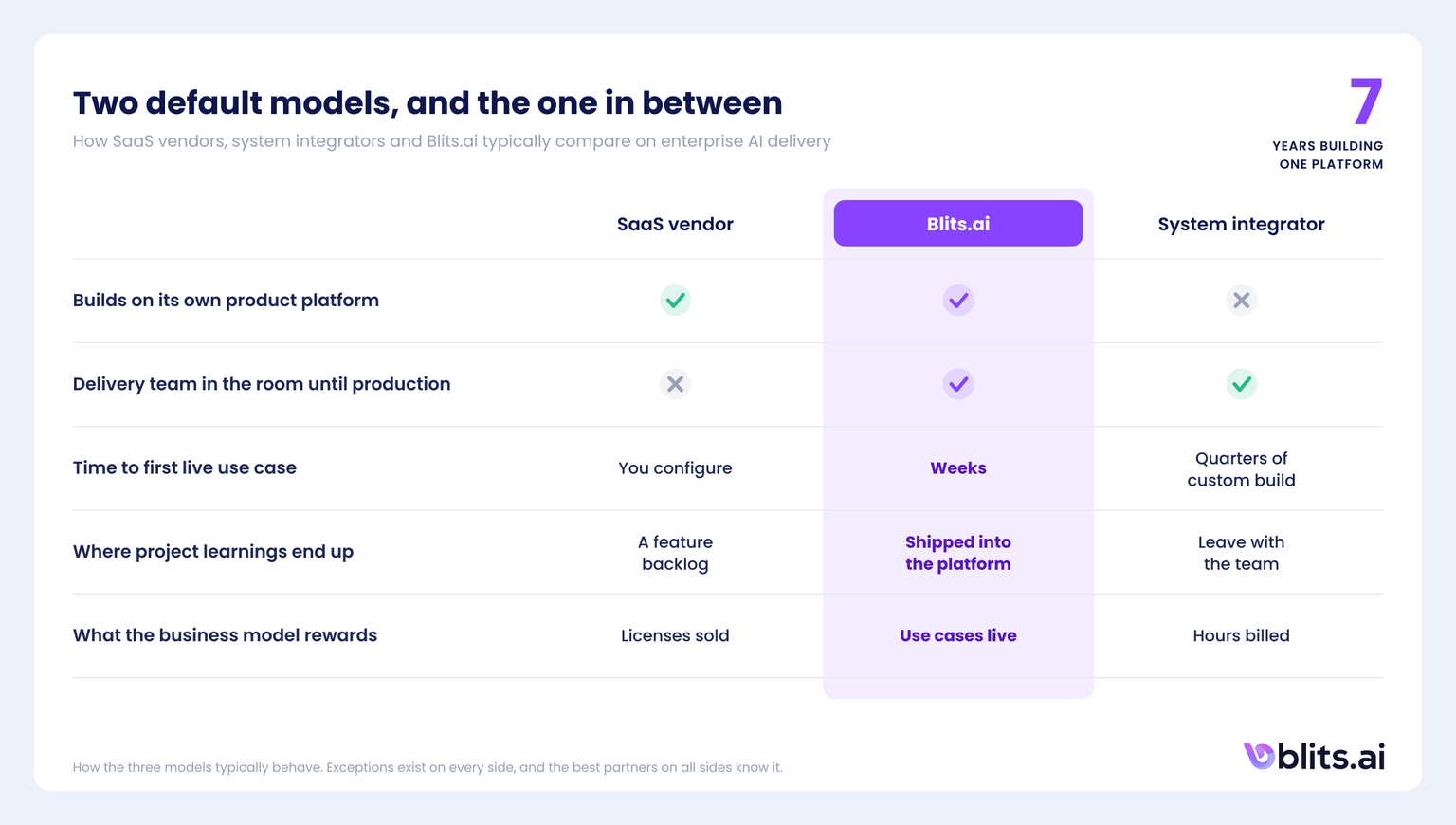
We own the technology. Blits.ai is one platform, built over seven years: bots, agents, agentic workflows, digital humans, voice, more than a hundred models from every major provider, eighty plus integrations, guardrails, a full test suite. Nothing about it was assembled last quarter for your RFP. When a project needs a channel, a language or a model, it's a dropdown, not a workstream. That's why our deliveries move in weeks where custom builds take quarters: the platform carries the weight, so the project only has to carry the use case. We've written before about what that looks like in practice, from swapping models without breaking anything to the 21 and counting use cases we run for banks.
And we own the execution. We don't hand over a license and wish you luck. Our team restructures the knowledge base until retrieval actually works. We run evaluation cycles against real conversations and classify every failure. We test the Arabic dialects with native speakers, sit in the risk committee meetings, wire up the core systems, and stay in the room after go live, because that's when the interesting problems introduce themselves. We are not trying to sell technology and leave. We're trying to get a use case into production and keep it there.
To make that concrete, here's what the first weeks of a typical engagement look like. Week one: your knowledge base goes in, and the first evaluation run tells us honestly how much of it the AI can actually use. Usually less than anyone hoped, and we say so out loud. Week two: flows and agents take shape on the platform, connected to your test systems, while your compliance team reviews the guardrail catalog instead of a promise. By week three or four there's a working assistant in a test channel, replaying hundreds of real conversations every time we change something. Go live is not a ribbon cutting. It's a dial we turn while the test suite watches. And after go live the same team stays on the metrics, because the first month of production teaches more than the whole build did. None of that is exotic. It's execution treated as part of the product, instead of as your homework.
That combination is the whole pitch: the best of both worlds, with the incentives pointing the right way. A SaaS vendor's revenue is complete when the license is signed. An integrator's revenue grows when the project gets longer. Ours only works when use cases go live and stay live, on our own platform, where every failure is visible to us and every success makes the next one cheaper.
The part I'm most proud of is not the platform or the projects. It's the loop between them.
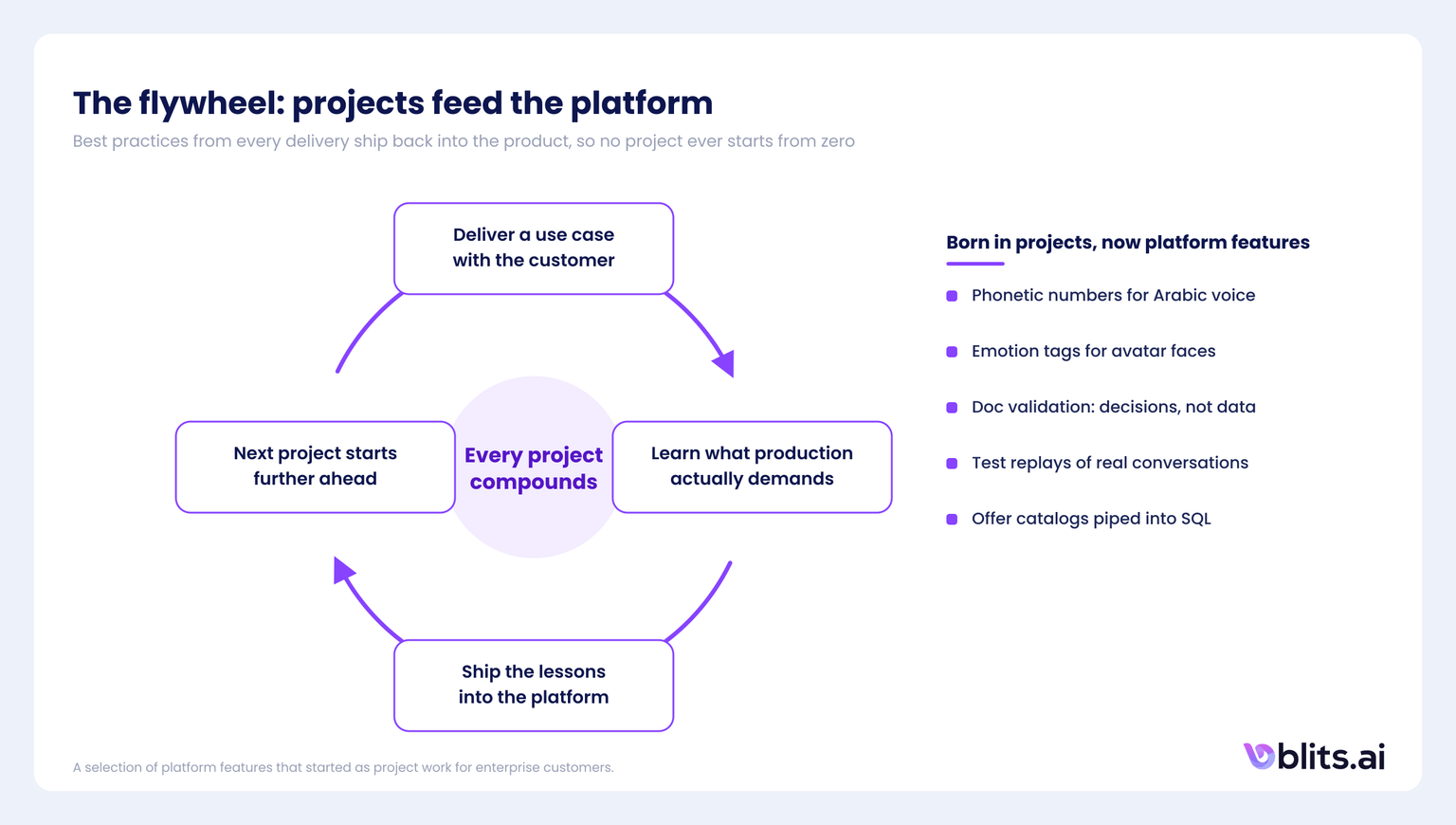
Every project teaches us something that generic product development never would. A voice assistant for a bank taught us that text to speech engines mangle numbers, so the platform now formats them phonetically, for every customer since. Digital human projects taught us that avatars need emotion tags woven into the response stream, so that's a platform feature now, not a custom hack. An onboarding project taught us that document validation agents should return decisions and never personal data, and that pattern shipped into the platform as the default. The test suite itself grew out of enterprises asking the same uncomfortable question: prove the new model didn't break anything. Now it replays their real conversations against every change.
At an integrator, those lessons retire with the project team, or live on in a slide deck nobody opens. At a SaaS vendor, your hard won insight enters a feature backlog to compete with everyone else's votes. In our model, the lesson ships. The next customer starts where the last one finished, which is why customer fifteen goes live faster than customer five did, on a platform that customer five improved.
Every project ends twice: once at go live, and once more when its lessons ship into the platform.
This is also, frankly, why the world's largest enterprises work with us: global card networks, national banks, government service portals, telcos. Not because our brand is bigger than the platforms' or our bench deeper than the consultancies'. Because we show up with seven years of compounding lessons already in the product, and a team that treats their production incident as ours. Organizations that size have no shortage of software or consultants. What they're short on is partners who are accountable for the outcome.
If you're building your AI vendor matrix right now, skip the feature checklists and ask these:
- Show me your last three projects' lessons in the product. Point at the feature that exists because a customer needed it. A SaaS vendor can sometimes do this. An integrator, by construction, cannot.
- Who is in the room in week six after go live? Not on the escalation path. In the room. If the answer is "your team, with our documentation," you're buying the gym membership.
- What do you earn when my use case goes to production, versus when it doesn't? Follow the incentive. Licenses get sold either way. Hours get billed either way. Outcomes are the only currency that keeps everyone honest.
We happily answer all three, in that order, with examples.
Seven years in, I've stopped apologizing for not fitting the vendor matrix. The two boxes exist because they're easy to procure, not because they're what gets AI into production. The numbers on pilot failure say the market has noticed the difference.
So no, we're not a SaaS company, and we're not an integrator, and we're certainly not a body shop. We're the gym where the trainer shows up with you, and where every session makes the gym itself a little better. If that sounds like the partner your AI program is missing, let's talk.