AI Technology23-10-2026
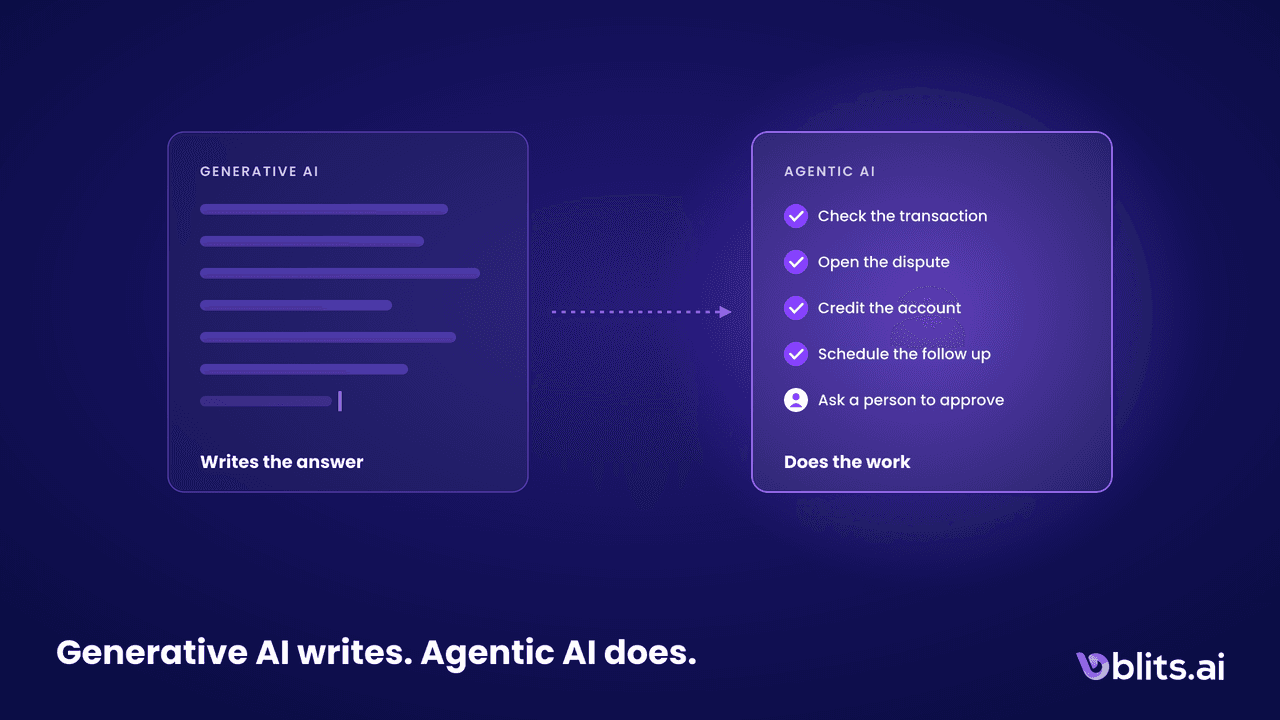
Generative AI writes. Agentic AI does. That sounds like a small step, but it changes what can go wrong, what you need to govern and how you measure success. The real difference between agentic AI and generative AI, why most agentic projects stall, and what the ones in production have in common.
Product Features22-10-2026
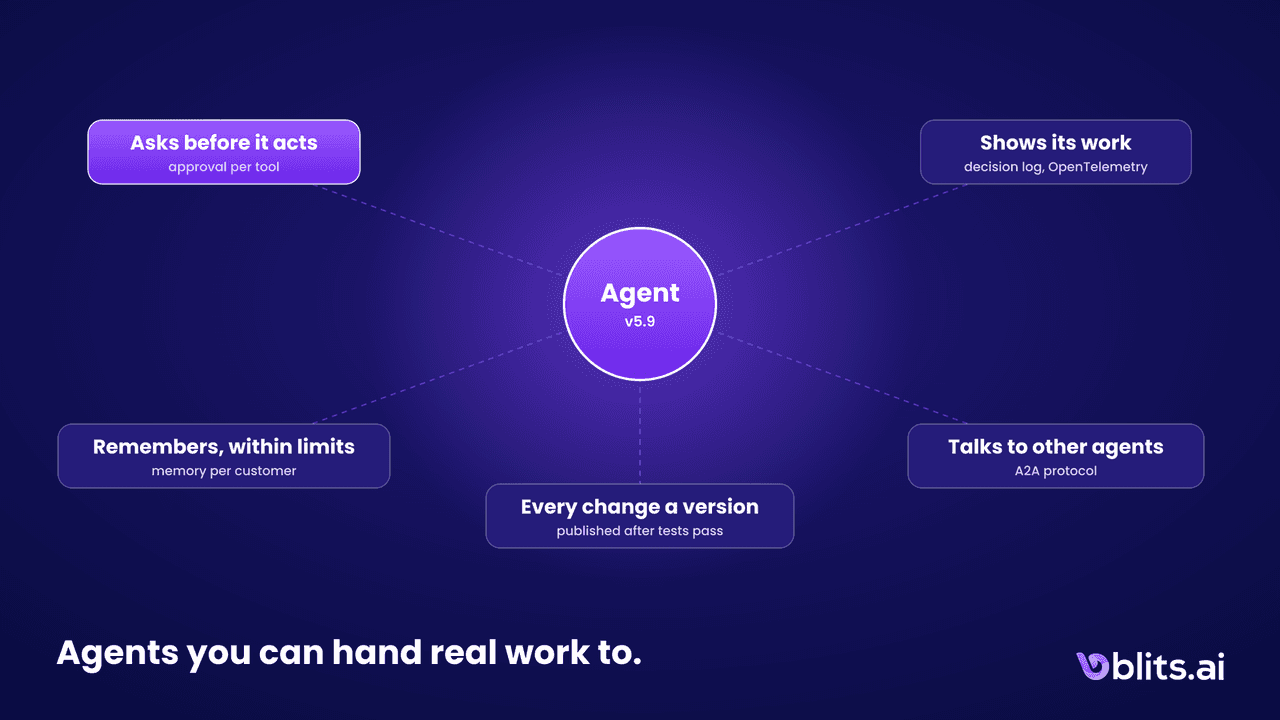
Release 5.9 is about one thing: giving AI agents real work without losing control of it. Agents now ask for approval before risky actions, record every decision, publish only after their tests pass, remember returning customers within strict limits and work with other companies' agents over the open A2A protocol. What each feature does, and how it works under the hood.
AI Technology21-10-2026
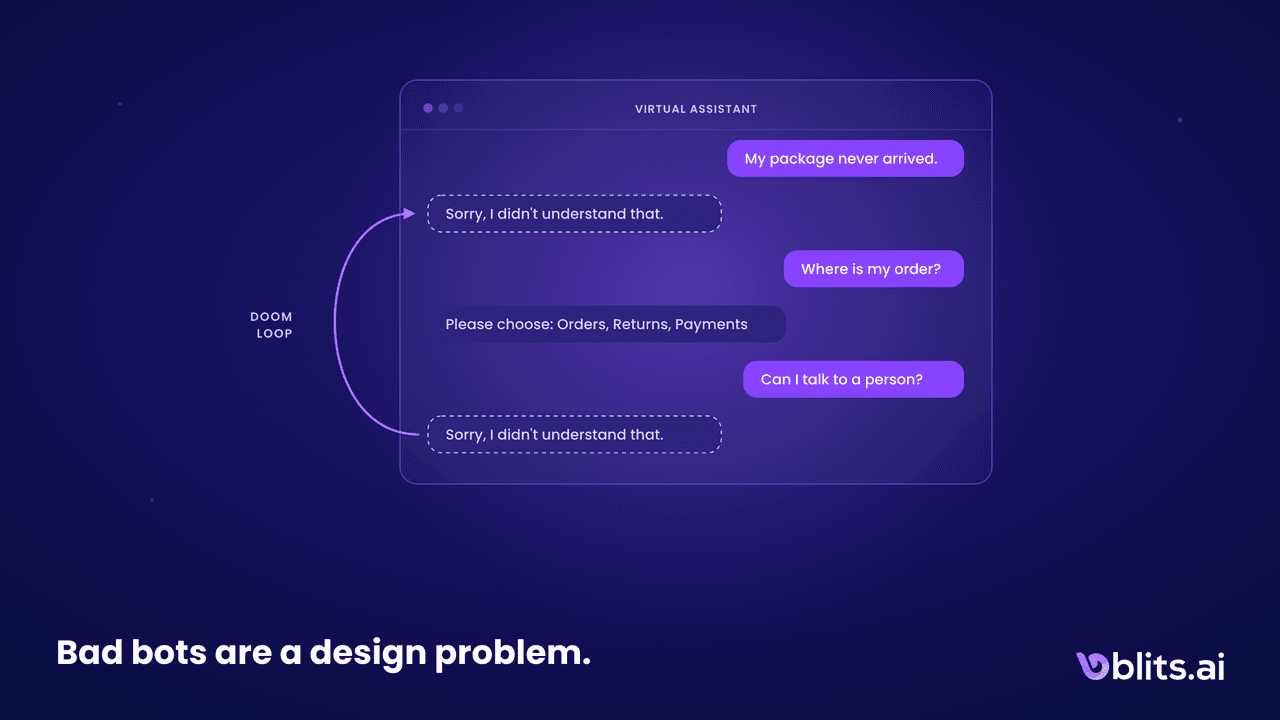
Most chatbots that frustrate people run on perfectly capable models. What fails is the design: unclear goals, no boundaries, fallbacks that go nowhere and handoffs that lose the context. A practical guide in questions and answers, from the team that builds and tests these systems every day.
AI Technology20-10-2026
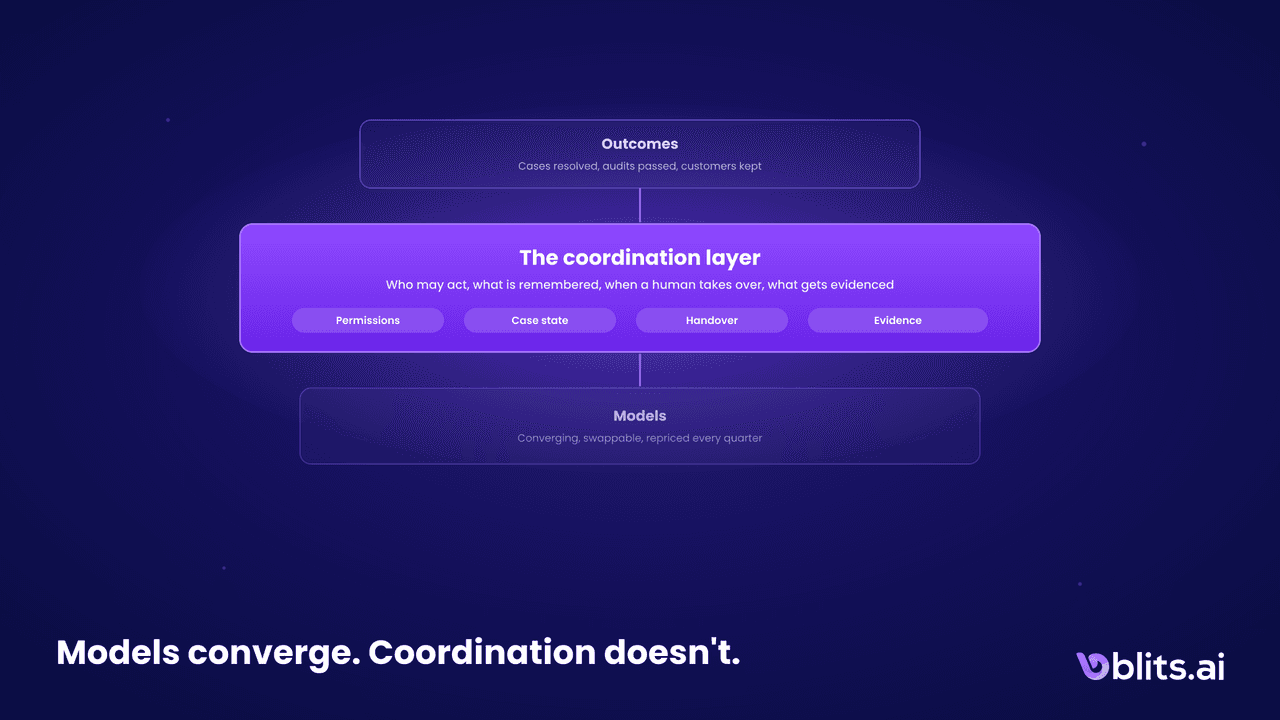
Models are converging and getting cheaper to swap, so the durable engineering in enterprise AI is moving somewhere else: the layer that decides who may act, what is remembered, when a human takes over and what gets evidenced. A build guide for the part of your AI stack you'll still own in five years.
Product Features16-10-2026
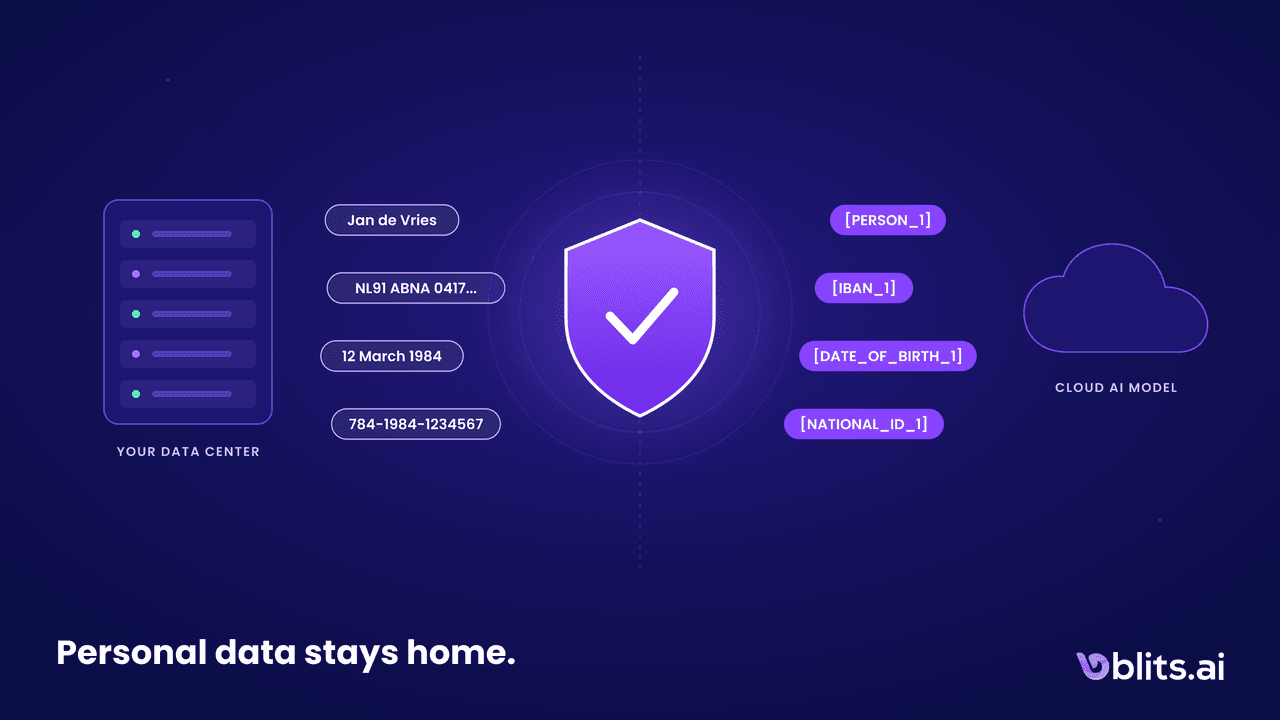
Strict data rules, no local AI cloud region, no GPUs, and a board that wants agents live this quarter. For a lot of banks and other regulated organizations that used to mean picking two out of three. Our new privacy shield removes the trade off: the best cloud models do the thinking, and the personal data never leaves your building.
Events15-10-2026
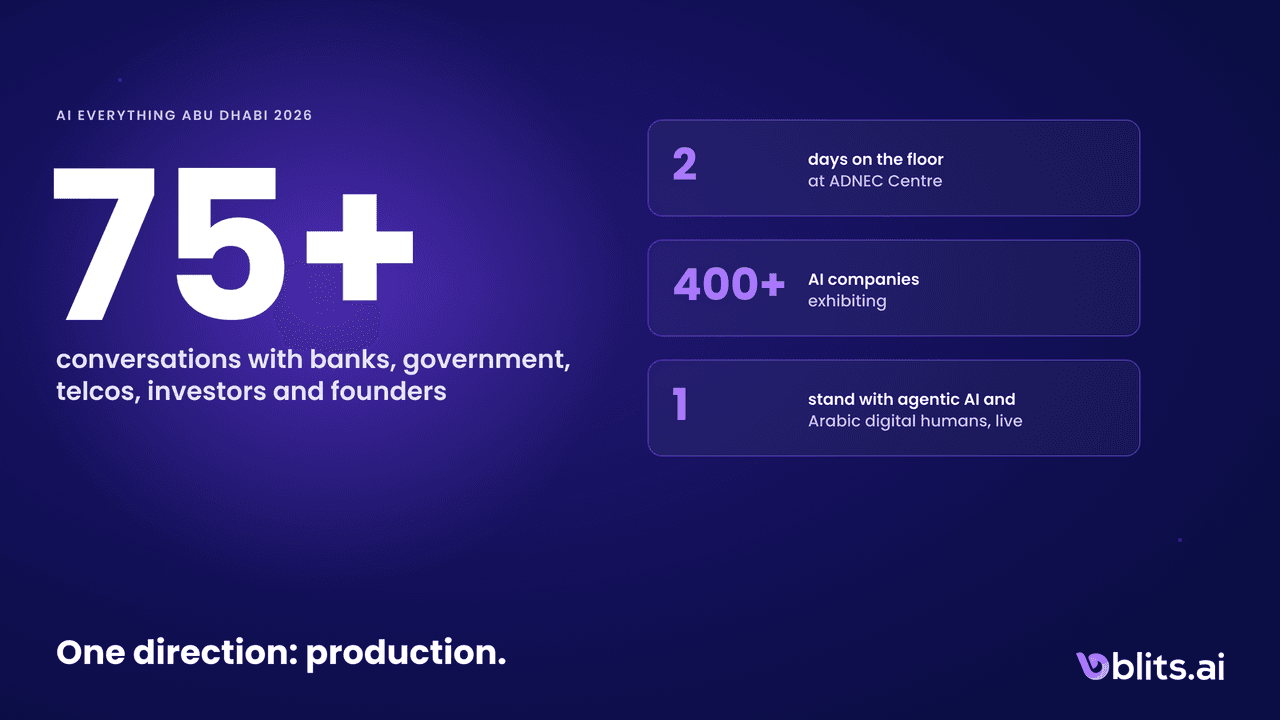
Len, Coen and I spent two days on our stand at Ai Everything Abu Dhabi and had more than 75 conversations with banks, government entities, telcos, investors and fellow founders. Five themes kept coming back, and together they point one way: from impressive demos to measurable results in production.
AI Technology13-10-2026
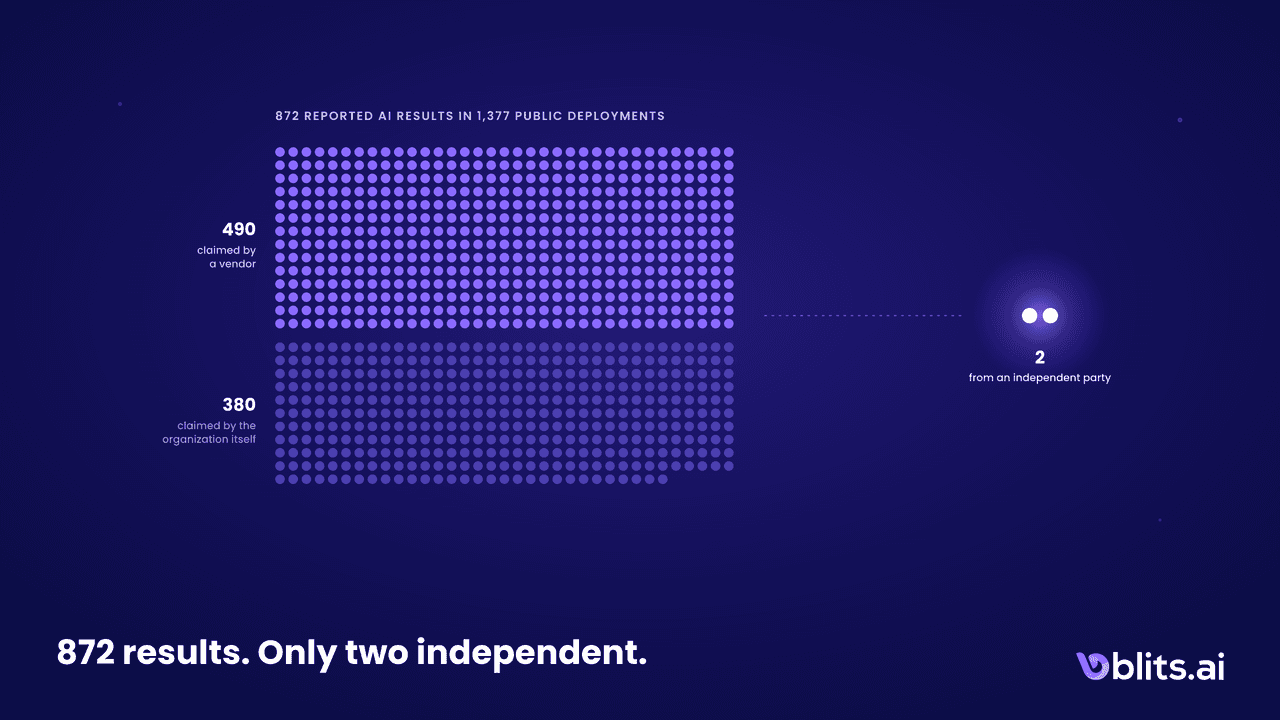
We built a public library of 257 AI use cases and 1,377 real deployments, with every number quoted from its source and labelled with who made the claim. The verdict: AI is doing real work, the industry can't prove it, and the sellers are writing the benchmarks.
AI Technology06-10-2026
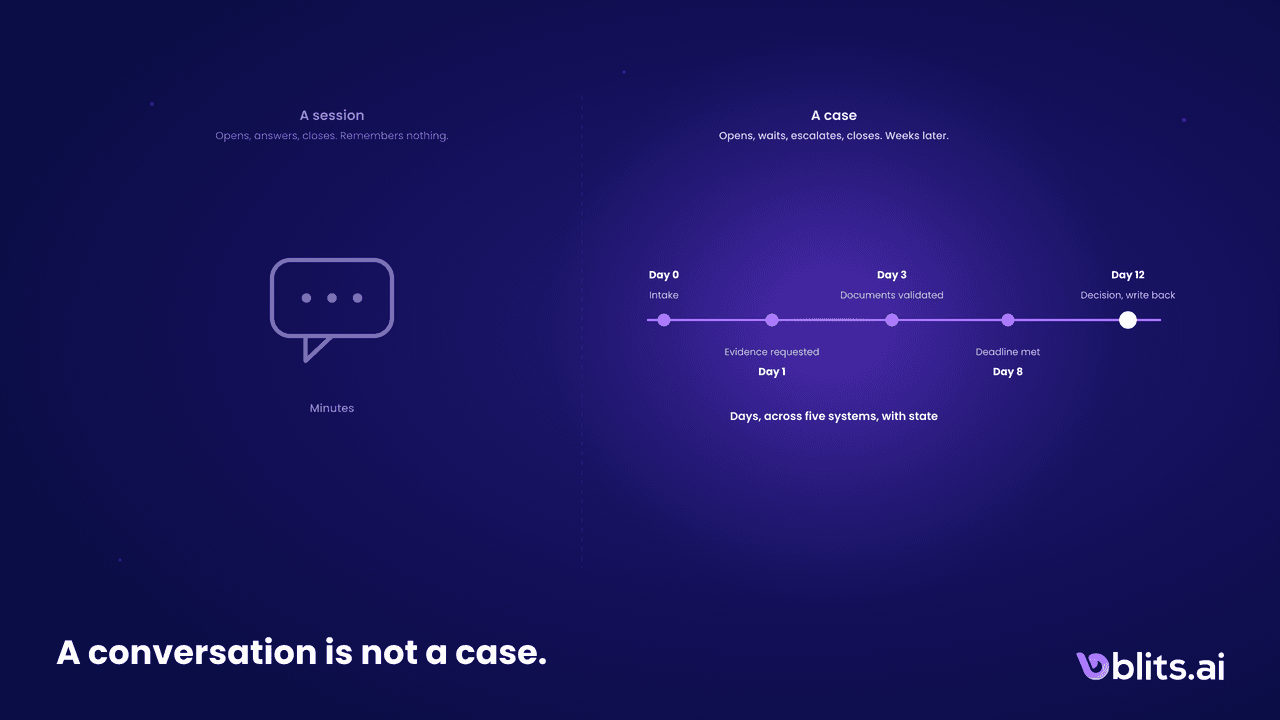
The 95 percent pilot failure stat is making the rounds again, this time with a diagnosis I actually agree with: chatbots automate sessions, but a bank runs cases. Why the unit of work decides whether your AI survives production, and the day eight test that shows which one you built.
AI Technology03-10-2026
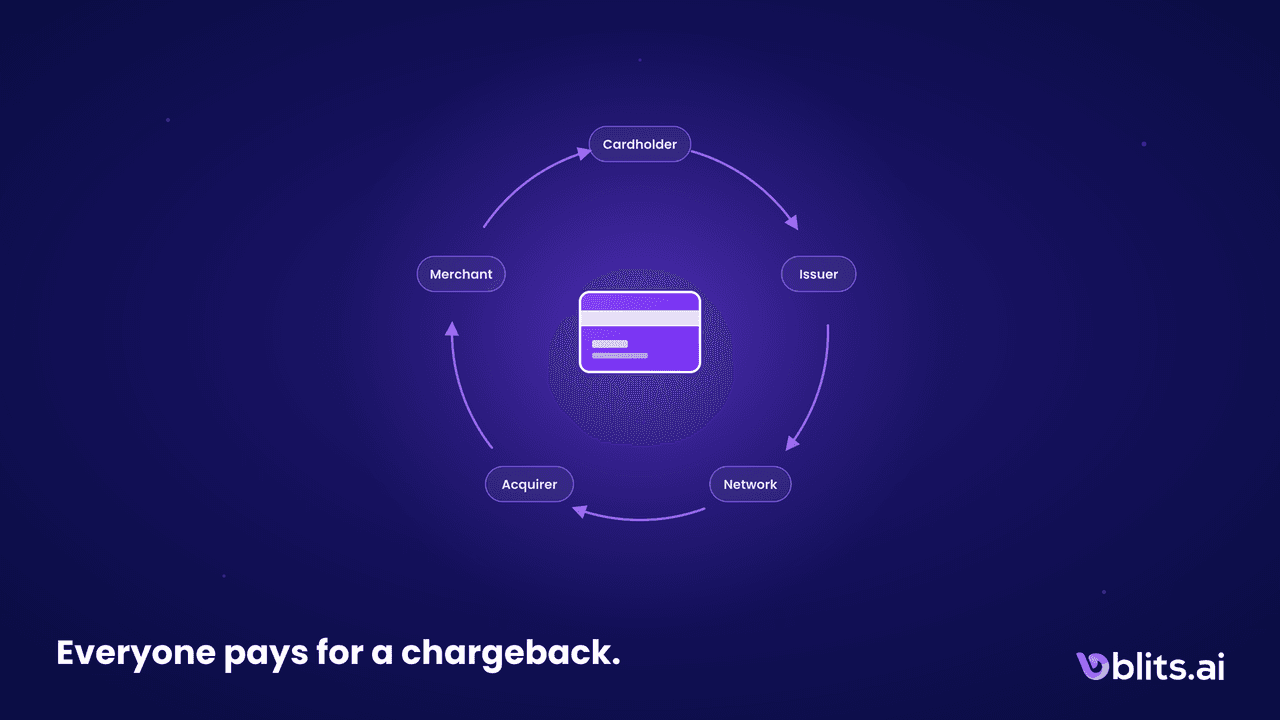
Chargebacks are heading for 337 million a year, most of them aren't real fraud, and each one costs a multiple of its face value. A practical look at the six AI jobs hiding in one dispute, what each of them needs to be governed, and why agentic commerce will change the volume.
AI Technology30-09-2026
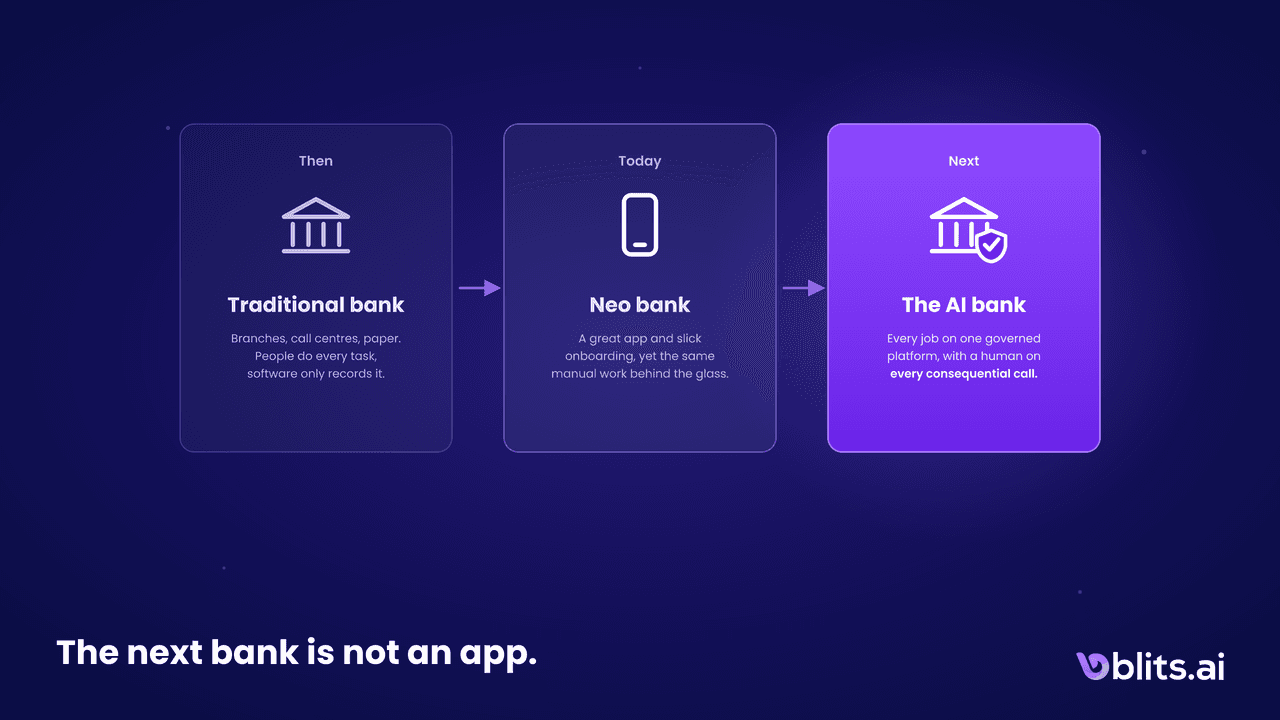
Our banking use case map grew from 21 to 81 jobs, so we turned it into a playbook. Along the way the story changed: the destination is the AI bank, where the work itself runs on governed AI, and what decides who gets there is governance far more than the models.
AI Technology23-09-2026
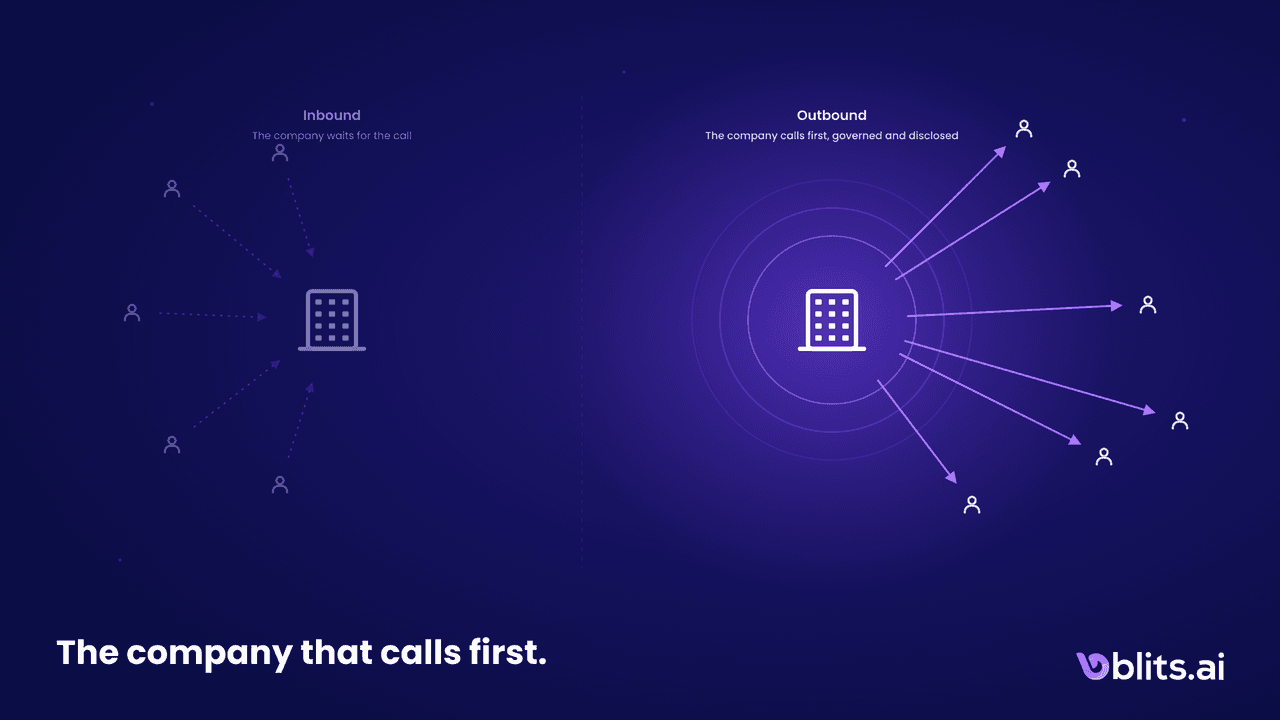
A brief landed on my desk asking for 600,000 outbound calls a month, by AI. The pattern is not a banking story: it applies to every enterprise with customers worth calling. Why human dialling died, what insurers, banks, lenders and software companies already run, and the anatomy of a governed outbound call.
Product Features29-08-2026
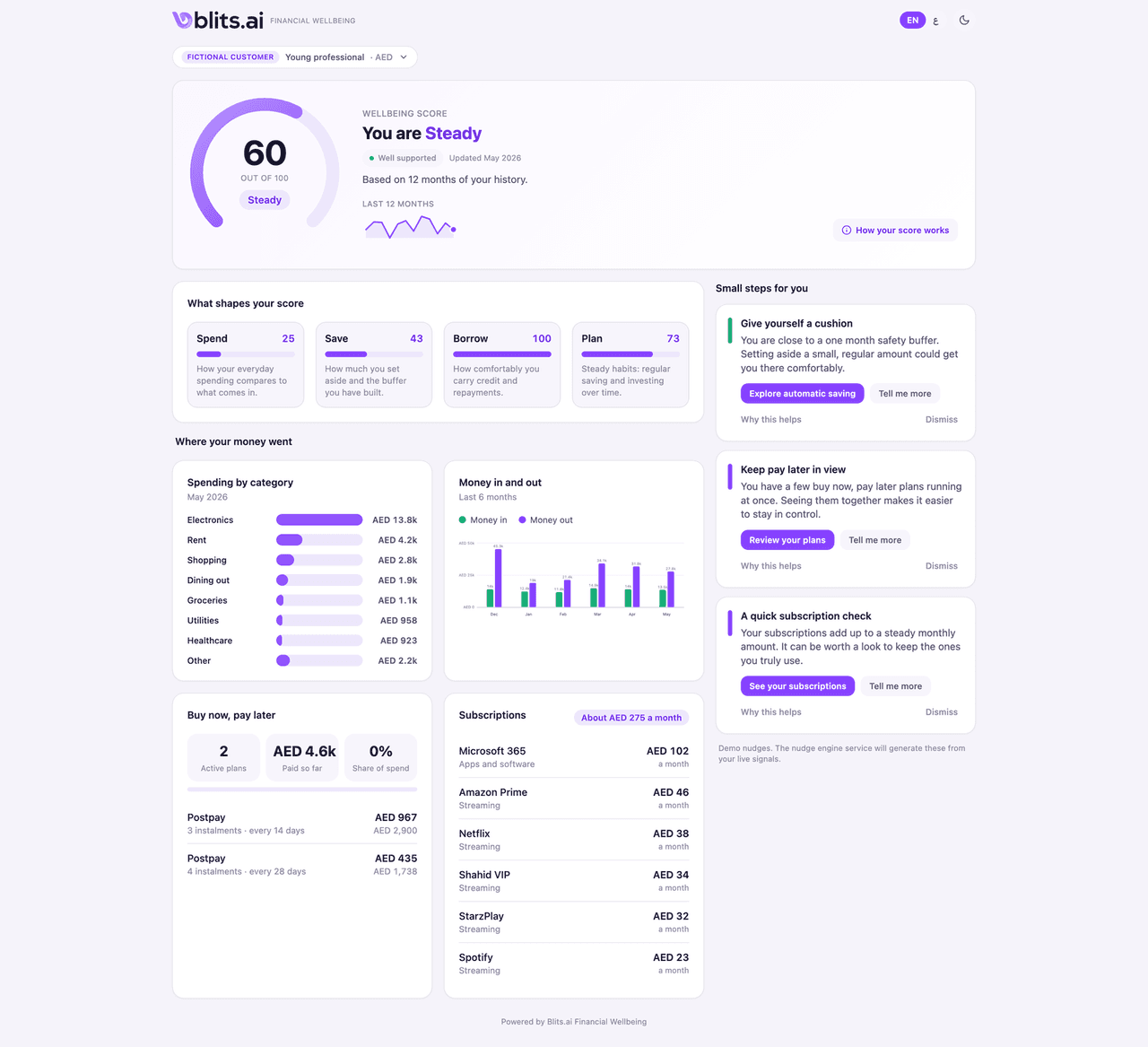
Our newest product turns a bank's own transaction data into a wellbeing score, plain language insight and gentle nudges toward healthier money habits. It runs inside the bank, it measures its own impact, and it will never give financial advice. Here is how it works.
AI Technology12-08-2026
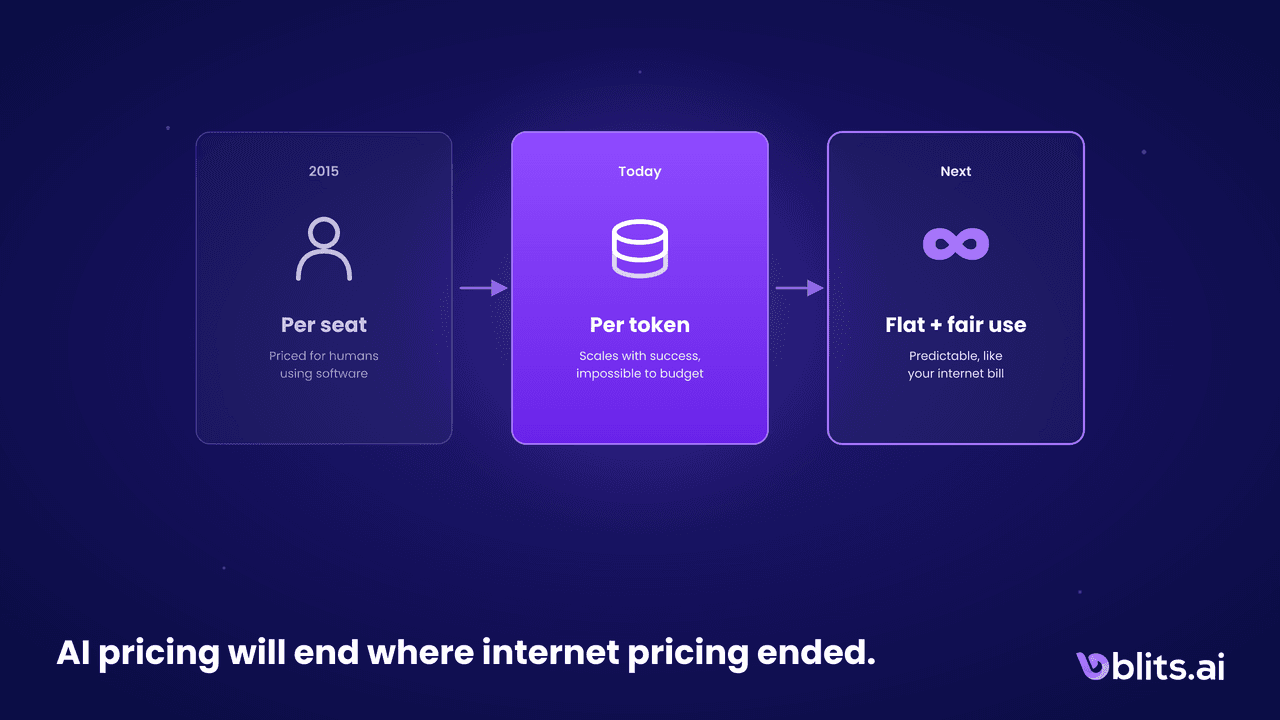
Per seat licensing carried software for a decade, but agents don't sit in seats and token pricing breaks the moment AI succeeds. Where AI pricing lands.
AI Technology12-08-2026
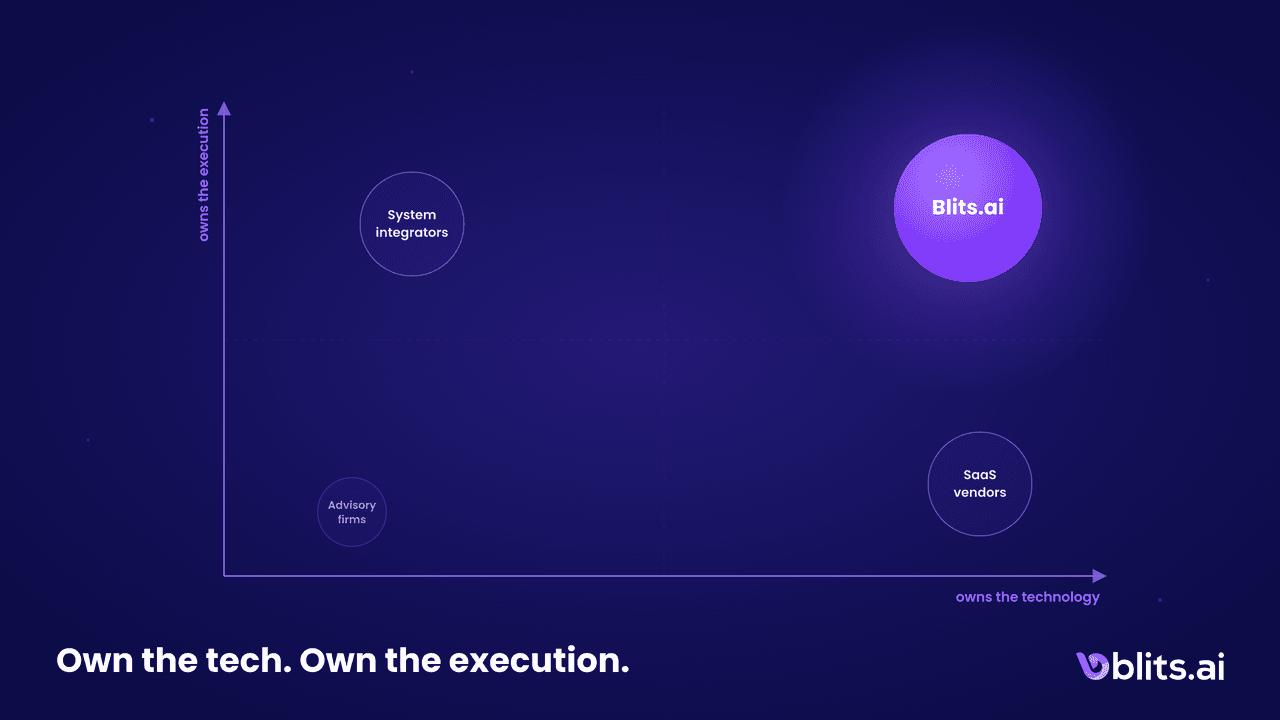
Procurement wants us to be a software vendor or an implementation partner. We are neither, and I think the model in between is what gets AI into production.
AI Technology27-07-2026
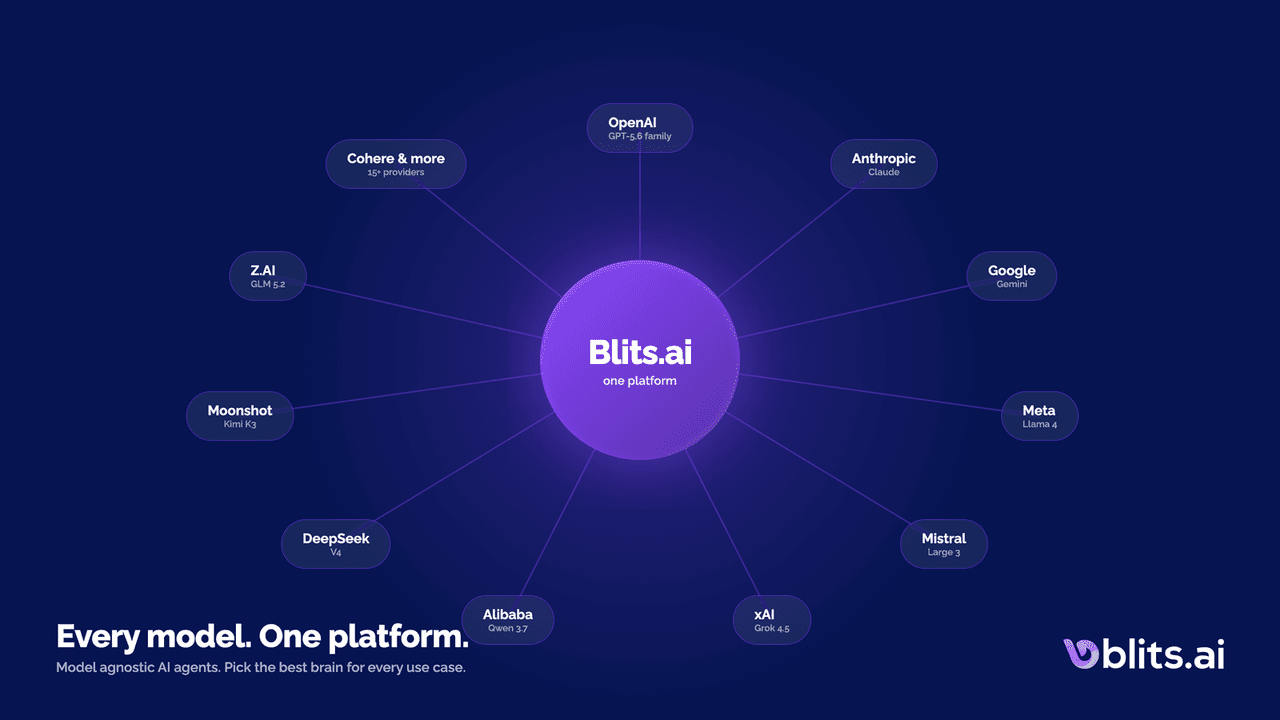
62 AI model versions got a retirement date this year. Why locking your business to one model is a hidden risk, and why staying model agnostic wins.
AI Technology23-07-2026
Native speech to speech demos beautifully, then fails enterprise needs. Why the text layer, where guardrails and audit live, still wins regulated voice.
Product Features20-07-2026
A plain roundup of five things we shipped this year: emotional voice, interactive cards, agentic tasks, in chat payments and response feedback.
Events15-07-2026
Five takeaways from Mastercard's summit in Johannesburg: the technology is no longer the bottleneck, governance, trust and context are.
Events10-07-2026
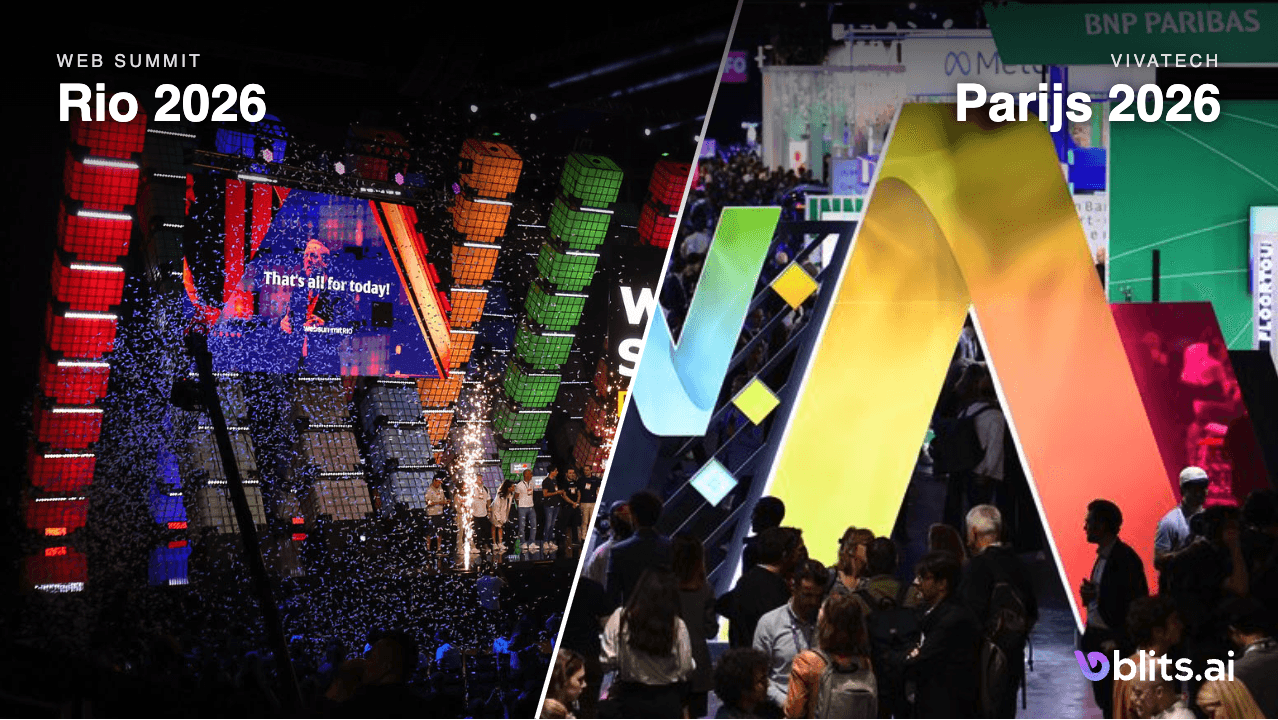
Signals from VivaTech and Web Summit Rio: production over pilots, substance over spectacle, and why your operating framework beats any one model.
AI Technology02-07-2026
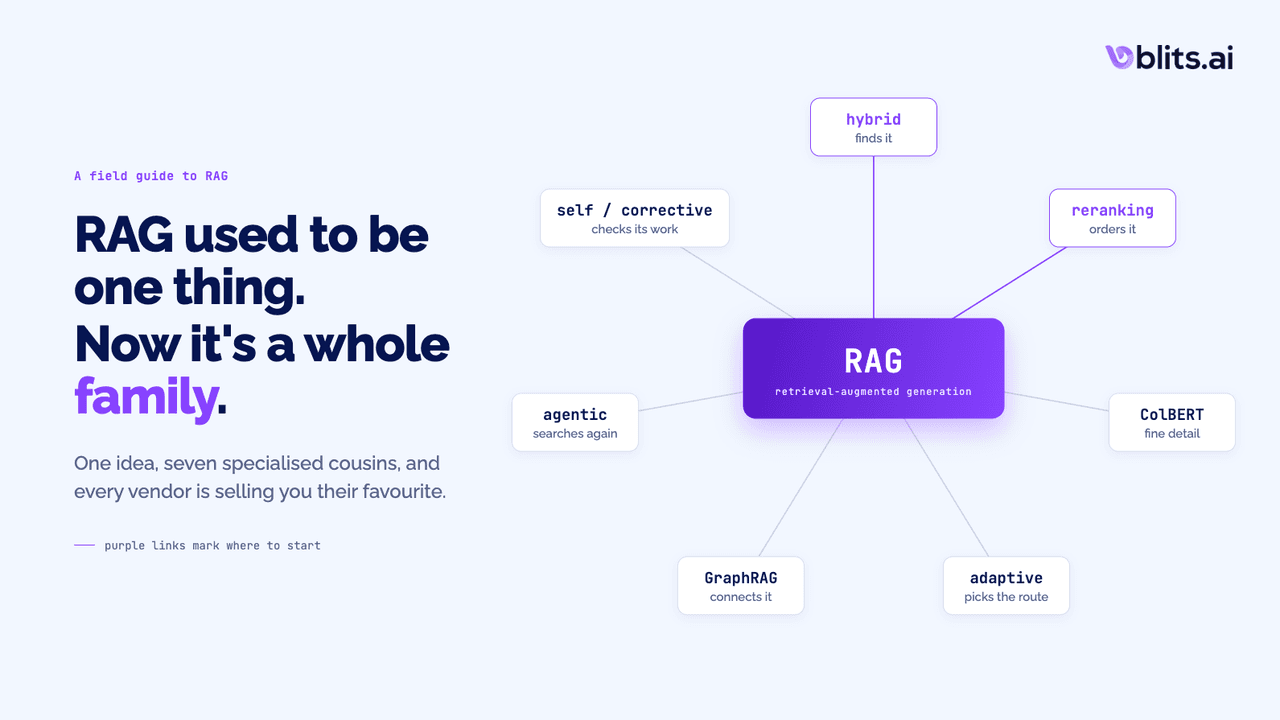
Hybrid search, reranking, ColBERT, GraphRAG, self-RAG: a plain language guide to what each RAG variant does and which ones you probably don't need.
AI Technology16-04-2026
A knowledge assistant that aces its pilot can fail silently, recall sliding while dashboards stay green. Why good RAG rots after the demo.
AI Technology10-04-2026
Agentic systems promise autonomous workflows, but speech and dialect quality fail first. Why Arabic, Turkish, Chinese and more run into the same gap.
AI Technology08-04-2026
MOS has saturated and demos are hand tuned. The lab protocol we use to grade TTS on latency, jitter, entity accuracy, barge in and cloning risk.
AI Technology31-03-2026
You already delegate spending with cards, POs and dual sign off. An AI agent is a new delegate. How to write its mandate, and where the analogy breaks.
AI Technology23-03-2026
A dashboard tells you the plane landed. A control tower keeps two aircraft off the same runway in real time, with the authority to divert one. What that distinction means for running AI agents in production, and why an HTTP 200 will lie to you.
AI Technology19-03-2026
Start with one agent, and reach for multi agent only for parallel, read heavy work. The case against splitting too early, and how to do it right.
AI Technology15-03-2026
Most MCP breaches needed no exploit code; the servers behaved as specified. What goes wrong in production, and why the new OAuth spec is half a fix.
AI Technology11-03-2026
Most teams treat EU AI Act compliance as a legal side project. A checklist of what enterprises should implement now to avoid disruption and rework.
AI Technology07-03-2026
AI performance means more than accuracy. These are the production KPIs that matter (latency, P99, TTFT and error rates) and how to measure them.
AI Technology03-03-2026
Text to speech is core AI infrastructure. What TTS engines are, the model approaches, the providers that matter, and why speed and dialect decide.
AI Technology25-02-2026
AI hallucinations are a business risk as much as an error. What they are, why models make things up, how often it happens, real cases from courts and companies, practical mitigations, and what you gain by getting it right.
Product Features17-02-2026
Introducing Agentic AI Studio: a platform agnostic, enterprise ready way to design and run autonomous workflows with your own models and data.
AI Technology27-01-2026
MCP servers standardize how LLMs find and use tools. What they are, why they matter, how we use them at Blits.ai, and where this is going next.
AI Technology19-01-2026
Why commerce as we know it does not work for AI and what the Universal Commerce Protocol is trying to fix
AI Technology11-01-2026
Why giving AI agents controlled access to payments changes a lot, and why the open question is who designs the rules they spend under.
Product & Culture08-01-2026
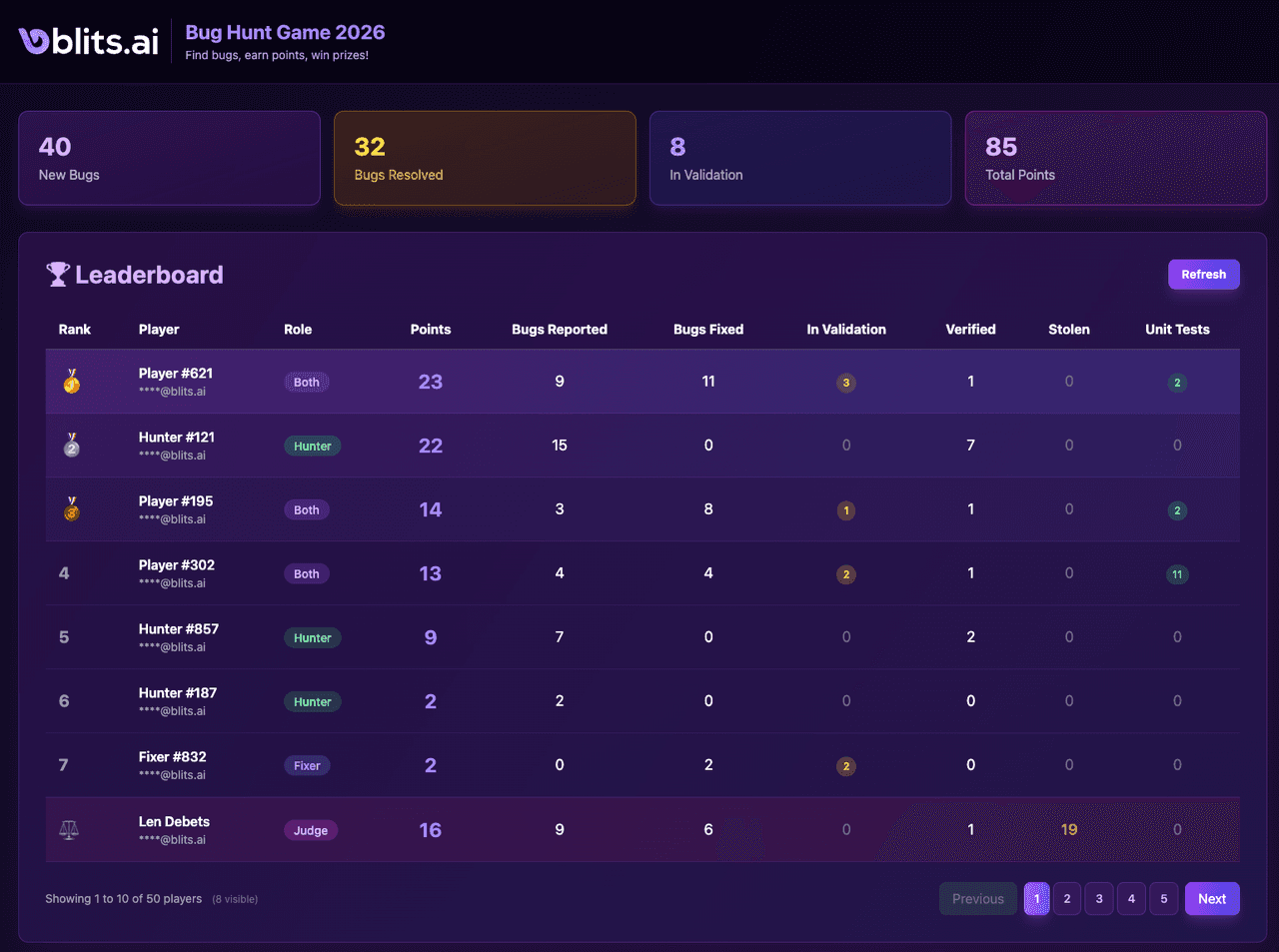
In the first week of January we turned quality assurance into a Bug Hunt Game. This is what happened when we put Hunters, Fixers and a Judge on a shared leaderboard powered by Azure DevOps.
Company News05-01-2026
Blits.ai joins LLMs4EU. Who builds large language models, on what data, and under which European values and regulations, and why that matters now.
AI Technology19-05-2025
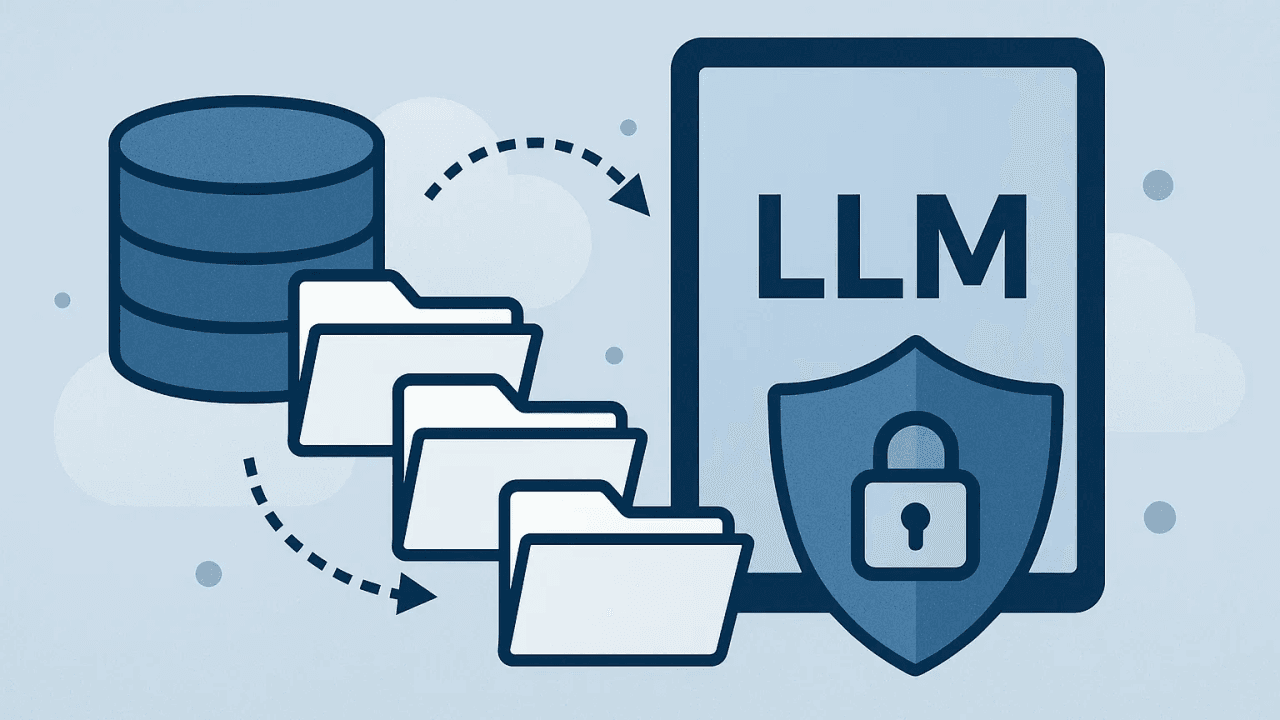
A plain guide for business teams on how to add your company data to an LLM safely, without leaking secrets, and the concepts behind it.
AI Technology12-05-2025
I think it's great that technology is so embedded in our daily lives. It helps us get knowledge faster, finish tasks more efficiently, gives us inspiration, and occasionally scares the hell out of us with those crazy (fake) videos. I help a lot of companies implement AI, so in the end it pays my bills. But after spending a ridiculous amount of time with all these new technologies, it's time to write down the things I really hate about AI.
Company News24-02-2025
AI moves at breakneck speed, and being the CTO of a fast growing scaleup in it is a great job. It is also not for the faint of heart. We work on large language models (LLMs), chatbots, digital humans and voicebots, and most of our customers are large banks, international companies and professional enterprises.
AI Technology14-07-2023
Blits.ai now supports GPT-4, bringing new capabilities to chatbot development and deployment. What it means for conversational AI.
AI Technology28-03-2023
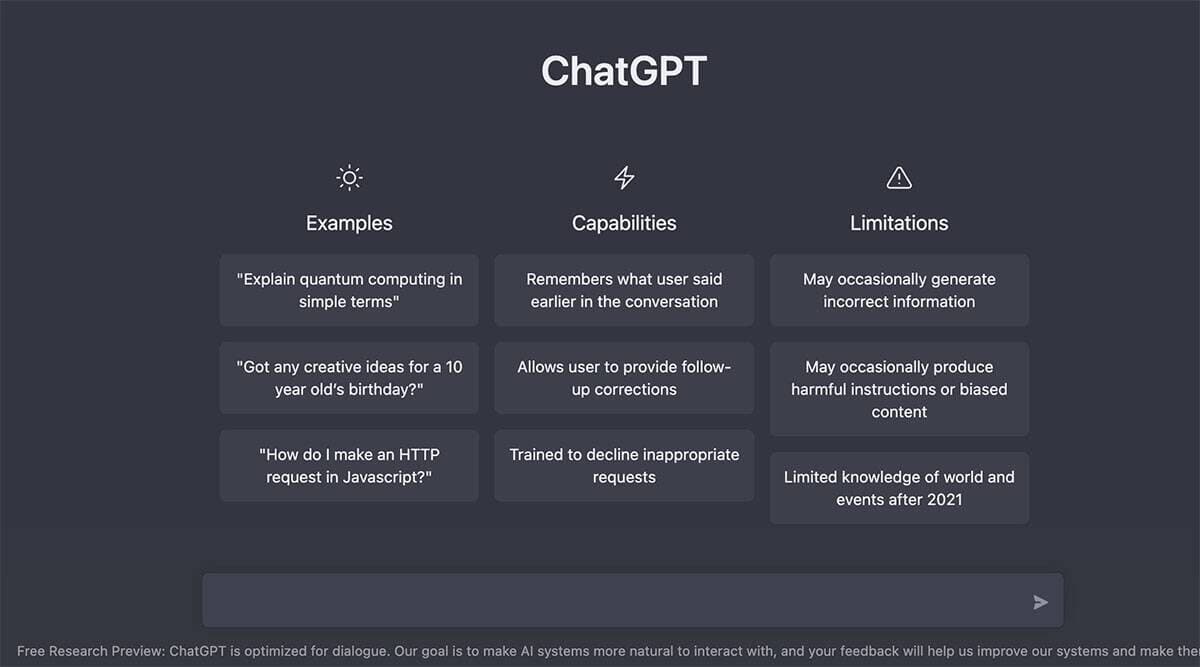
Someone once told me stupid questions don't exist. Maybe so, but people are still afraid to look stupid by asking about things that are assumed to be general knowledge, and Artificial Intelligence (AI) is one of them. With ChatGPT and Midjourney everyone loves to talk about AI, yet I only know a handful of people who actually know how it works. So here are the basics.
AI Technology20-02-2023
Over 5 years ago I started a chatbot (ad)venture called Blits.ai. My reason was simple: I believed the way we humans deal with data would turn into a conversation. Now that ChatGPT (generative AI) is all over the news and every LinkedIn feed, more and more people are reaching the same conclusion. Great! We're clearly not there yet, though.
Research25-08-2022
Our research into conversational AI performance shows clear gains in chatbot effectiveness across several industries and use cases.
AI Technology25-01-2022
GPT-3 has changed what people expect from conversational AI. Ask it almost anything and you get a fluent, often surprisingly good answer. Whether that makes it practical for a chatbot or voicebot that talks to your customers is a different question, and that is what this article is about.
Company News11-02-2021
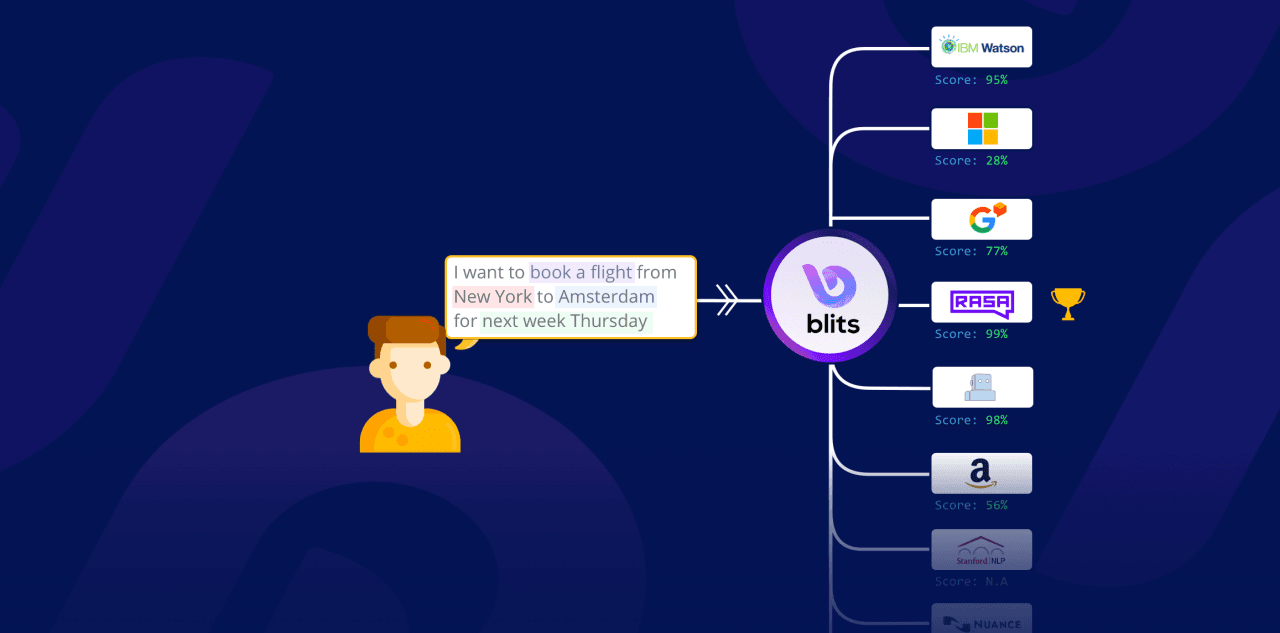
We're introducing a new method at Blits.ai that changes how chatbots work under the hood. From the start our idea was simple: companies should be able to use the best performing engines on the market without having to pick one vendor and hope for the best. Right now we are two things at once, a middleware layer and a low code platform, and through it our customers get access to 40+ cognitive AI services.
Product Features20-08-2020
A chatbot that answers a few FAQs is easy to build. Here are 15 advanced features that move your chatbot from a simple Q&A tool to something your business depends on.
AI Technology23-06-2020
NLU is often treated as a black box, but knowing how it works is key to building effective conversational AI. A look inside.