"Which AI model should we use?"
I get this question in almost every meeting, and I understand why. People usually expect a one word answer, GPT something or Claude something or Gemini something, so they can pick the winner, sign the contract and move on.
I usually answer with a different question: for which task, at what price, in which country, and in which month? In this industry the "best" model is a moving target, and it moves faster than most companies can sign a purchase order.
Earlier this month we received a routine email from OpenAI. Perfectly polite, the kind most people archive without reading. It listed 29 models with a shutdown date. Eighteen of them switch off on July 23rd and another eleven on October 23rd, plus every fine tuned variant built on top of them, all in a single email.
And that's one vendor. When you add up the retirement calendars that OpenAI, Microsoft Azure and xAI have published themselves, you get 62 model versions with a shutdown date in 2026 alone:
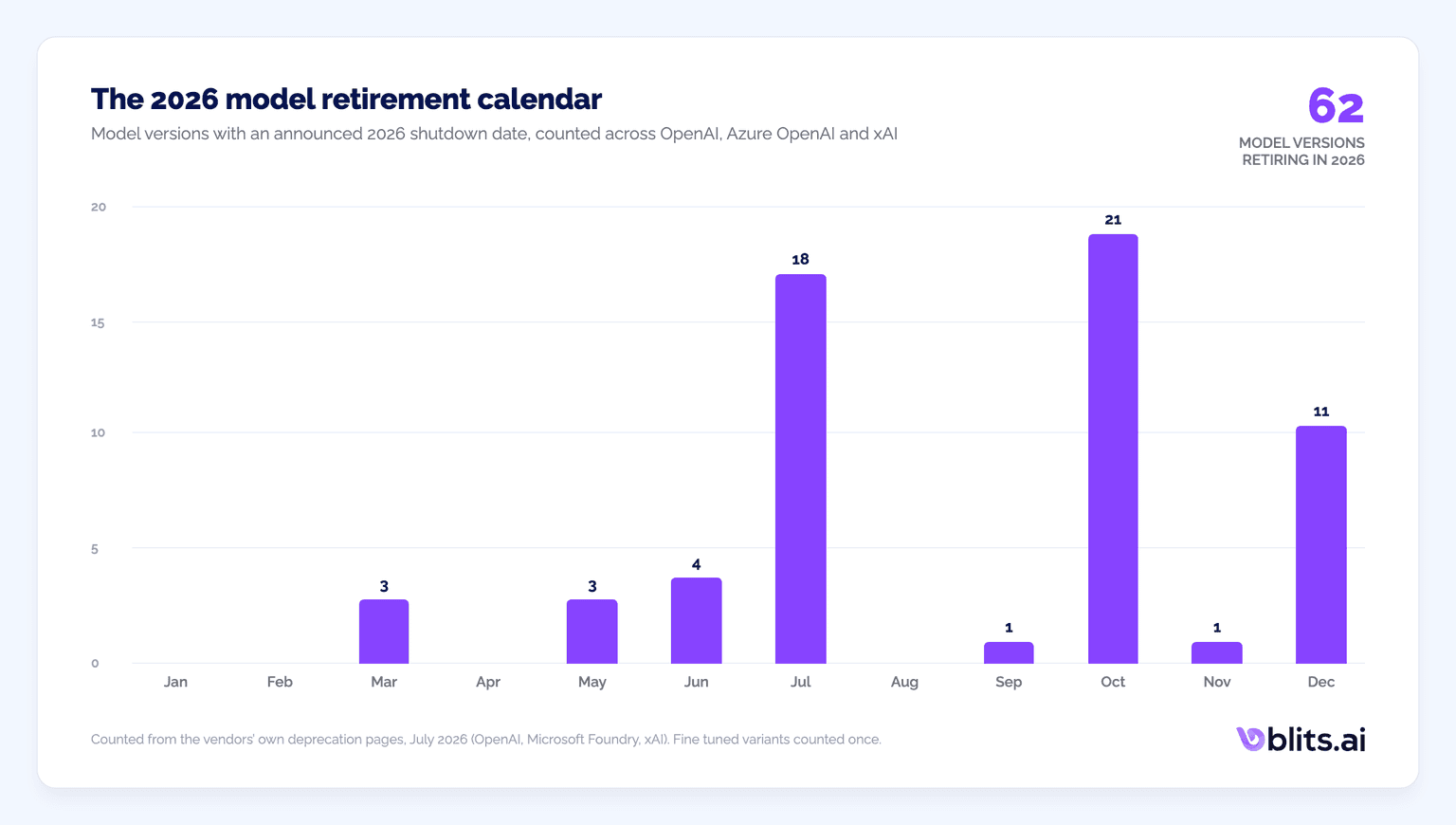
Some of these names deserve a moment of silence. GPT-4, the model that made headlines around the world in 2023, the one your board asked about in every meeting that year, shuts down on October 23rd. xAI retired Grok 3 after roughly fifteen months. Microsoft publishes its retirements in a rolling twelve month schedule that reads like a train timetable.
We've lived this ourselves, on this very blog. In early 2022 we wrote about how practical GPT-3 was for chatbots. A year later we proudly announced GPT-4 support. Both posts are now history lessons. The companies that hardwired those models into their products got to rebuild. Our customers got an email saying nothing, because nothing broke. So treat a model as a component you will replace, because you will.
None of this is vendors being difficult, by the way. The pace of improvement is so high that keeping old models running is like maintaining a fleet of fax machines next to your mail server. OpenAI launched its GPT-5.6 family on July 9th: three new models in one day. Moonshot released Kimi K3 this month. The conveyor belt doesn't stop. The question is whether your AI setup treats that as a threat or as free upgrades.
The "which model is best" question also misses something else. Even on a single day, with all models alive and well, there is no overall winner.
Independent benchmark platform LayerLens tested more than 200 models in the first quarter of this year and concluded exactly that: no company won. One provider led bug fixing, another led programming, a third led system administration. On general knowledge tests, fifteen models scored so close together that the differences were smaller than the variation between two runs of the same test. Analysts have started calling multi model setups the default architecture for enterprise AI, and I think they're a bit late to the party.
We see the same thing in our own numbers. Because Blits.ai connects to every major provider, we can run the same test across all of them, live, whenever we want. On a Friday morning in July we did exactly that: 102 models, three identical questions each, 19 minutes, zero failures. Here are twelve of them:
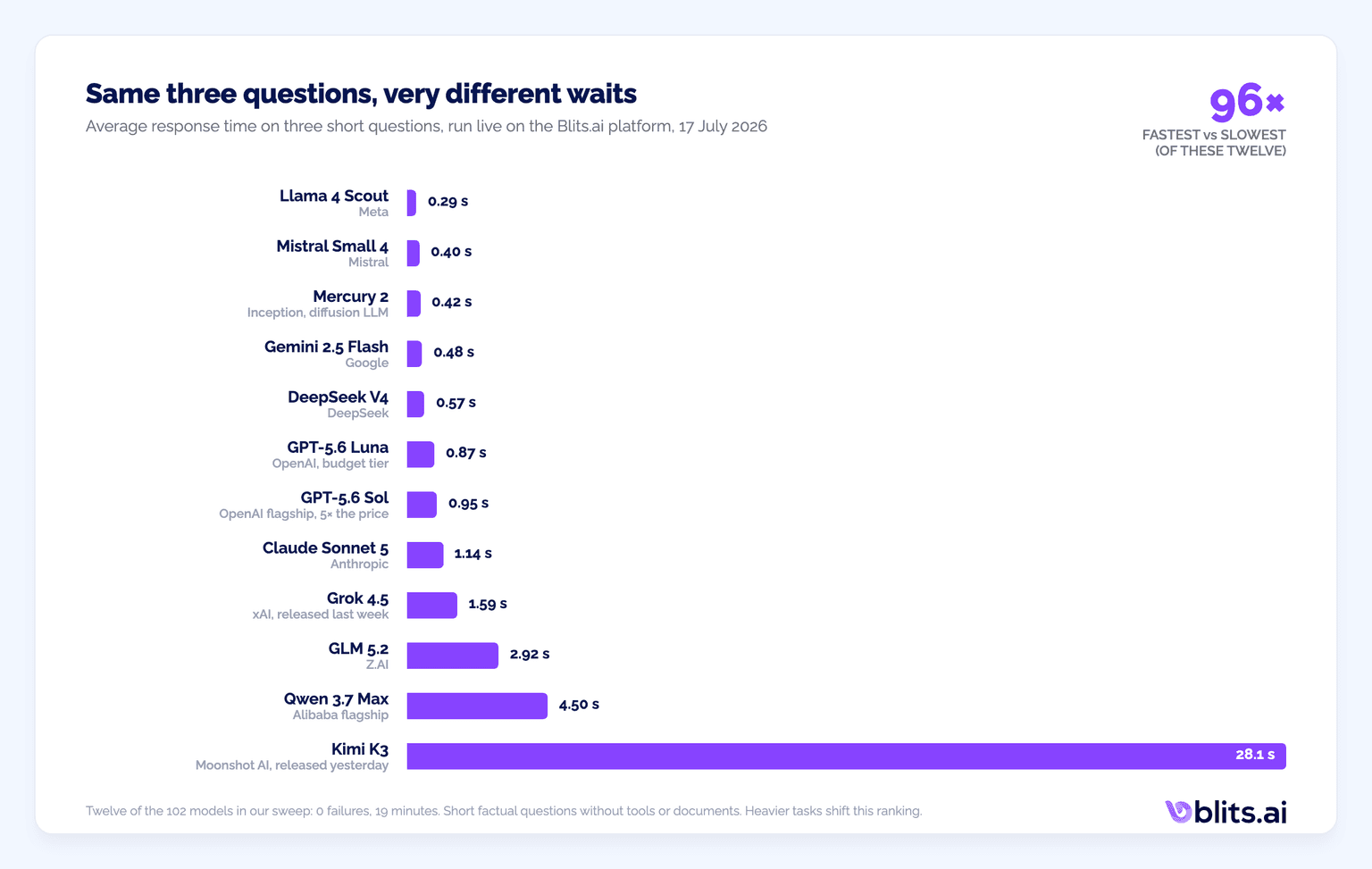
Look at what this chart actually says. Meta's Llama 4 Scout answers in a third of a second. Kimi K3, the newest, shiniest flagship on the list, released one day before this test, takes 28 seconds, because it's a heavyweight reasoning model that thinks before it speaks. Neither of them is "better." One of them belongs in a live customer chat, and the other one absolutely does not. Put K3 on your website chat and every visitor stares at a typing indicator for half a minute. Put Scout on your complex compliance questions and you'll get fast, confident, shallow answers.
My favorite detail is that OpenAI's flagship Sol costs five times more than its budget sibling Luna, and on short questions it isn't any faster. What the extra money buys is depth, which you may not need.
Asking "which AI model is best" is a bit like asking which employee is best. You don't hire one person to be your lawyer, your delivery driver and your receptionist.
Now add money to the picture. This is the list price for producing one million tokens of output, roughly 750,000 words, across a few well known models this month:
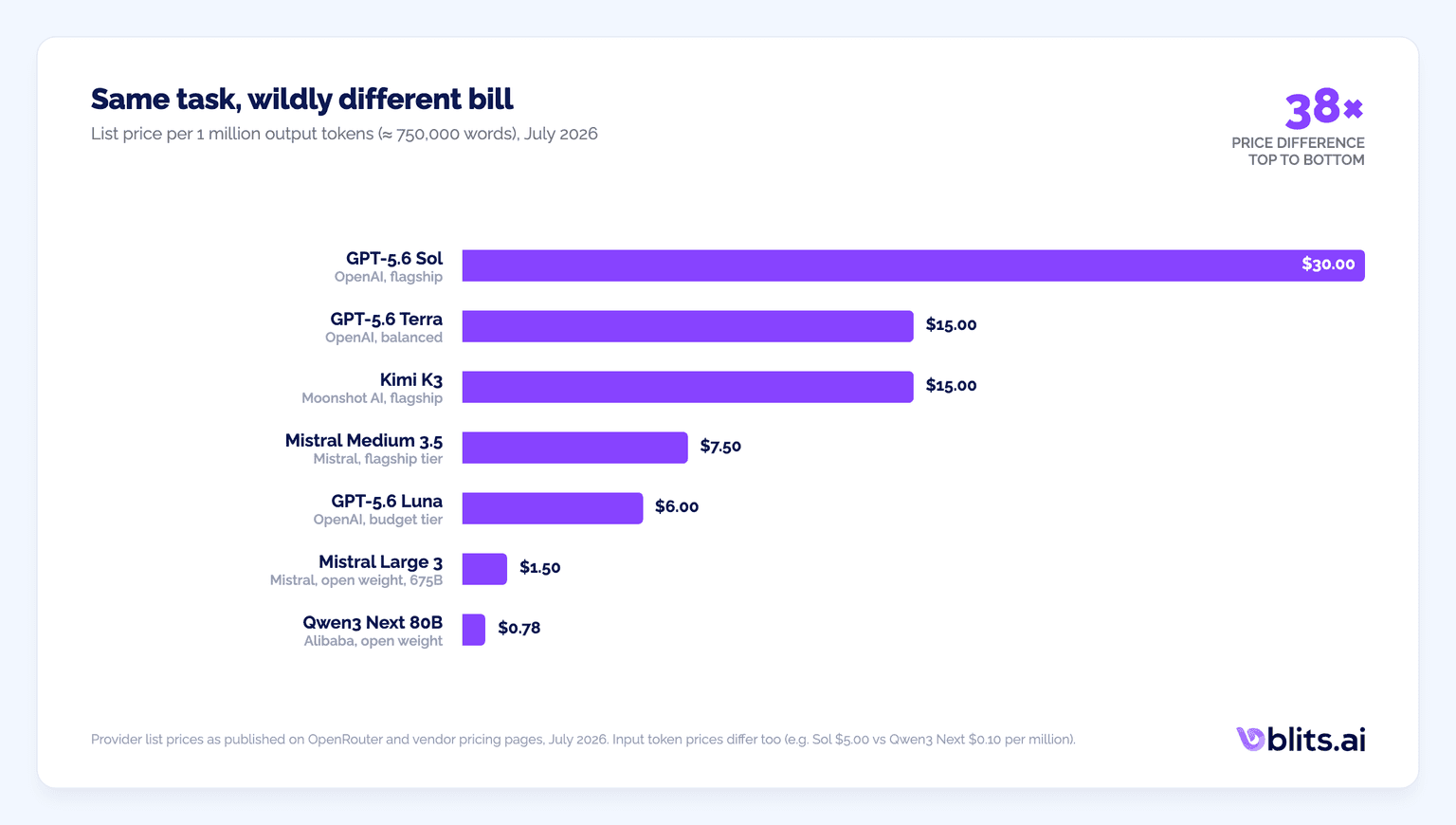
That's a 38× difference between the top and the bottom of one chart. And the expensive one is not 38 times better. For a lot of everyday work, a well chosen open weight model is indistinguishable from a flagship. Answering "what are your opening hours" with a $30 per million flagship is like sending a senior law partner to sign for a package. He'll do it flawlessly. You'll still fire whoever arranged it.
On the other hand, prices also drop just as violently. Mistral's newest small model is cheaper and faster and smarter than what we ran two years ago. If your platform can swap models freely, every one of those price drops lands directly in your budget. If it can't, you keep paying 2024 prices for 2024 quality while the market runs away from you.
Model agnostic has become one of those words vendors put on slides, so let me be concrete about what it means in the Blits.ai platform.
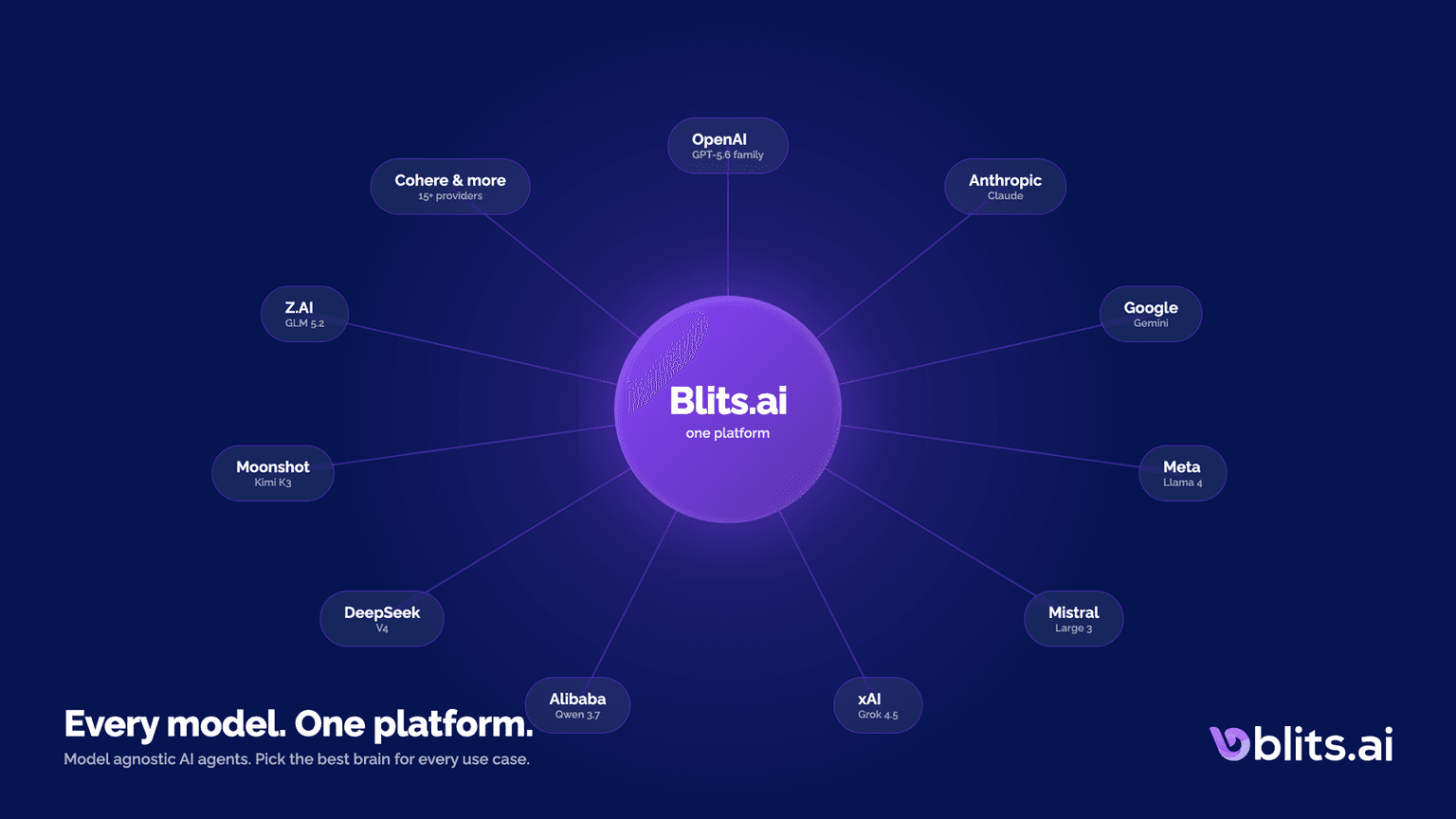
Every provider, one plug. Blits.ai connects to OpenAI, Anthropic, Google, Meta, Mistral, xAI, Alibaba, DeepSeek, Moonshot, Z.AI, Cohere, Perplexity, Microsoft and more: over fifteen providers, more than a hundred models. When Kimi K3 launched this month, it was available on our platform the same day. We didn't pull a heroic integration project overnight for that, the architecture is simply built for it.
The switch itself is a dropdown. Your flows, your knowledge base, your guardrails, your integrations: none of that is tied to a model. Changing the brain behind your customer service agent is a selection, not a migration.
Most vendors conveniently skip the next bit. The switch takes ten seconds, trusting it takes a lot longer. Every model has its own personality. One is more verbose. One suddenly formats dates the American way. One follows your guardrails slightly differently, one calls your systems at slightly different moments, one handles an angry customer with a different tone. Swap the model and hope for the best, and your customers will be the ones who find these quirks for you. I'd call that gambling.
This is exactly why we built a full test suite into the Blits.ai platform. Your real conversations become test sets: hundreds of questions, follow ups and edge cases from your actual practice, including multi turn conversations where the customer changes their mind halfway. Before a new model goes live, the suite replays all of them against it, an automated grader compares every answer against your rules and your tone of voice, and you get a pass rate. You end up with a report (rather than a demo or a gut feeling) that says the new model handled 97 percent of your real cases at least as well, plus the 3 percent you should look at. The sweep of 102 models above is that same machinery running at full width. We've written before about measuring AI performance with the right KPIs; this is where those KPIs earn their keep.
Different jobs, different brains, inside the same assistant. The agent that greets your customer can run on something fast and cheap, hand complex cases to a deep reasoning model, and use a regional model where the law or the language demands it. For our clients in the Gulf we run Arabic fine tuned models for conversations full of dialect; for European public sector clients we route through deployments hosted in the EU. Same platform, same conversation, different engine per job. And every one of those combinations is covered by the same test suite.
I'd take three questions into your next vendor meeting.
- How many providers can I switch between today (today, not on the roadmap)?
- Walk me through the day my model gets a deprecation email. Who does the work, and what does it cost me?
- Show me the test report. I want proof the replacement is at least as good on my use cases, and a public benchmark doesn't prove that.
If the answer to the first question is "one, but it's the best one," you now know exactly what that promise is worth. It's worth about eighteen months. And if the answer to the third question is a confident smile instead of a report, that smile is what your customers will be testing in production.
Every model your business runs on today is on borrowed time. That sounds alarming, but it's only alarming if you've built in a way where replacement hurts. The churn is not going to slow down: 62 retirements this year, three new flagships in a single July week, prices moving 38× apart and then collapsing again.
You can't stop that conveyor belt, and you shouldn't want to. It keeps delivering better, faster, cheaper brains. You just don't want your business bolted to one spot on it.
The companies winning with AI never had to guess the right model, because they could test.
We'll keep running the sweeps every week either way. If you'd like to see what the 102 model test looks like on your use cases, you know where to find us.
Updated on 12 October 2026.