
Events15-07-2026
From Johannesburg: Five Signals on Where Agentic AI Meets Enterprise Banking
Five takeaways from Mastercard's summit in Johannesburg: the technology is no longer the bottleneck, governance, trust and context are.
Read More →
Len and I spent two days on our stand at Ai Everything Abu Dhabi and had more than 75 conversations with banks, government entities, telcos, investors and fellow founders. Five themes kept coming back, and together they point one way: from impressive demos to measurable results in production.

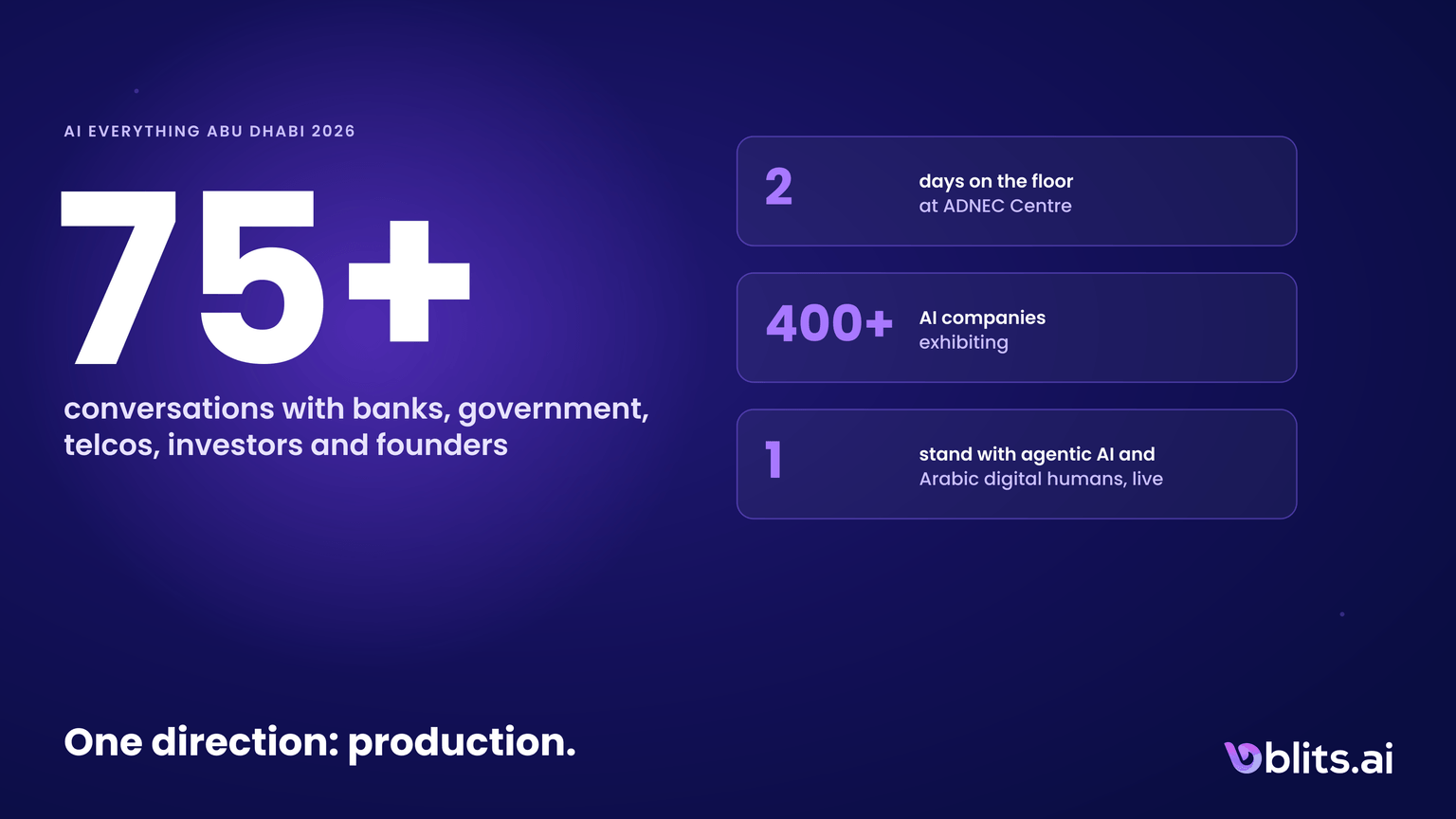
Last week Len and I spent two days on our stand at Ai Everything Abu Dhabi, at the ADNEC Centre. The organizers brought together more than 400 AI companies and over 180 speakers under the theme "New Intelligence." We brought what we always bring: agentic AI and Arabic speaking digital humans, running live on our platform rather than on slides.
Over those two days we spoke with more than 75 people. Banks and insurers, government entities, telecom operators, investors, infrastructure providers and fellow founders. In this article I'll share the themes that kept coming back, what we think they mean, and one conversation that summed them up better than we could.
Key message: the conversation about AI in the Gulf has moved from what AI can do to what it measurably delivers in production, under whose control, and in whose language.
The most common question at our stand was not "what can it do?" It was "where is this already running?" Many of the organizations we spoke with have run one or more pilots over the past two years. What they want now is an agent that handles real customers and real transactions, with a result someone can measure.
That shift is visible at government level too. Abu Dhabi has set out to become the first AI native government by 2027, and Microsoft announced a Copilot rollout to 35,000 government employees during the event. When the public sector moves at that scale, the banks and service providers around it are expected to keep pace.
It is also why we pointed several visitors to our AI Use Case Library, where Len and the team have documented more than 1,300 public deployments, each with its source and the stage it has reached. A buyer who asks "where is this running?" deserves an answer with evidence.
Sovereign AI was one of the focus areas of the summit, and in our conversations it took a very concrete form. Where does the data live? Which model runs where? Can the most sensitive workloads stay in the country while the rest uses the strongest commercial model available? Who can see the logs?
These are not objections. They are the questions of organizations that intend to deploy. Our answer has been the same for some time: a platform that runs in the customer's own environment, works with whichever model fits each workload, and lets a bank switch models without rebuilding its agents. In the Gulf, that flexibility is not a feature, it is a condition for doing business.
Agentic AI was everywhere on the floor, from energy to public services. The more experienced the visitor, the more specific the question: what exactly may the agent do on its own, what needs a person's approval, and how is every action recorded?
That is the right question. An agent that can block a card, change an address or initiate a payment needs the same clarity as a new employee: a defined role, clear limits and someone accountable for its decisions. We showed how our agents work within those limits, with a named person on every consequential step and an audit trail behind every action. Len described the rules we apply in The AI Bank Runs on Governance.
Arabic is not one language for a customer service agent. A response in perfect Modern Standard Arabic can still feel distant to a customer who expects the way people speak in their own city. Many visitors tested our digital humans in their own dialect, and that is exactly the test that matters.
We build and evaluate our assistants in Gulf, Saudi and Egyptian Arabic, among others, and we test them with native speakers as well as automatic scores. In a region where trust is often decided in the first few seconds of a conversation, dialect and register are not details. They are the experience.
Across all of these themes runs one thread: trust. Models are converging and becoming easier to replace. What decides whether a bank or a ministry puts an agent in front of its customers is whether it can trust the system: its answers, its limits, its records and the company behind it.
One of our conversations was with Basil Fateen, head of startups and venture capital at NVIDIA for the Middle East, Turkey and Africa. He made the point about trust in a talk at Communicate AI in Dubai a week before the event: "The key in this phase and the real value lies in the trust layer, not in technology."
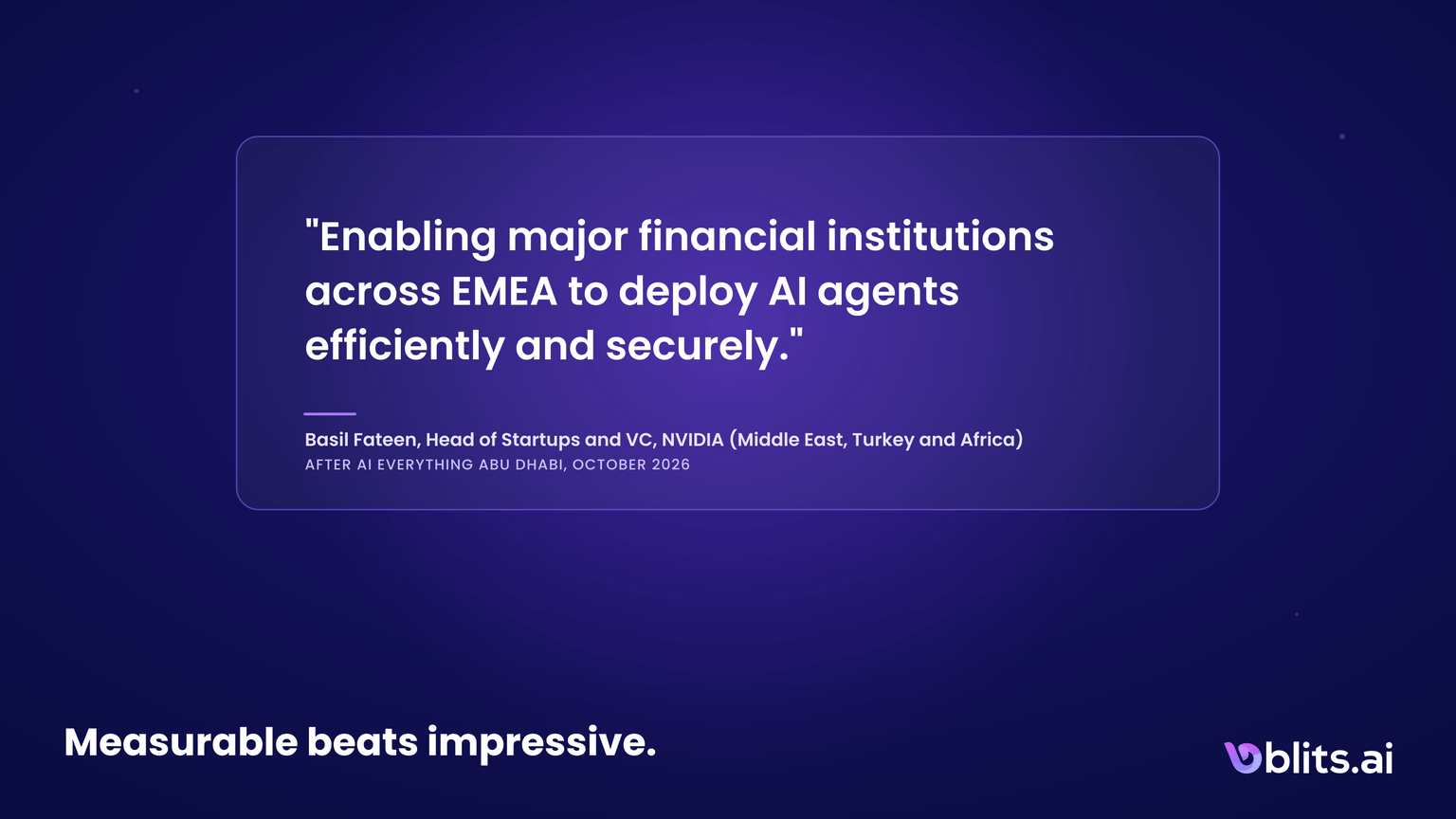
After Ai Everything he shared his impressions on LinkedIn, opening with the word that runs through this whole article: "I absolutely LOVE seeing measurable positive impact by founders who are passionate about the problem they're solving." Among the founders he named, he described us as follows.
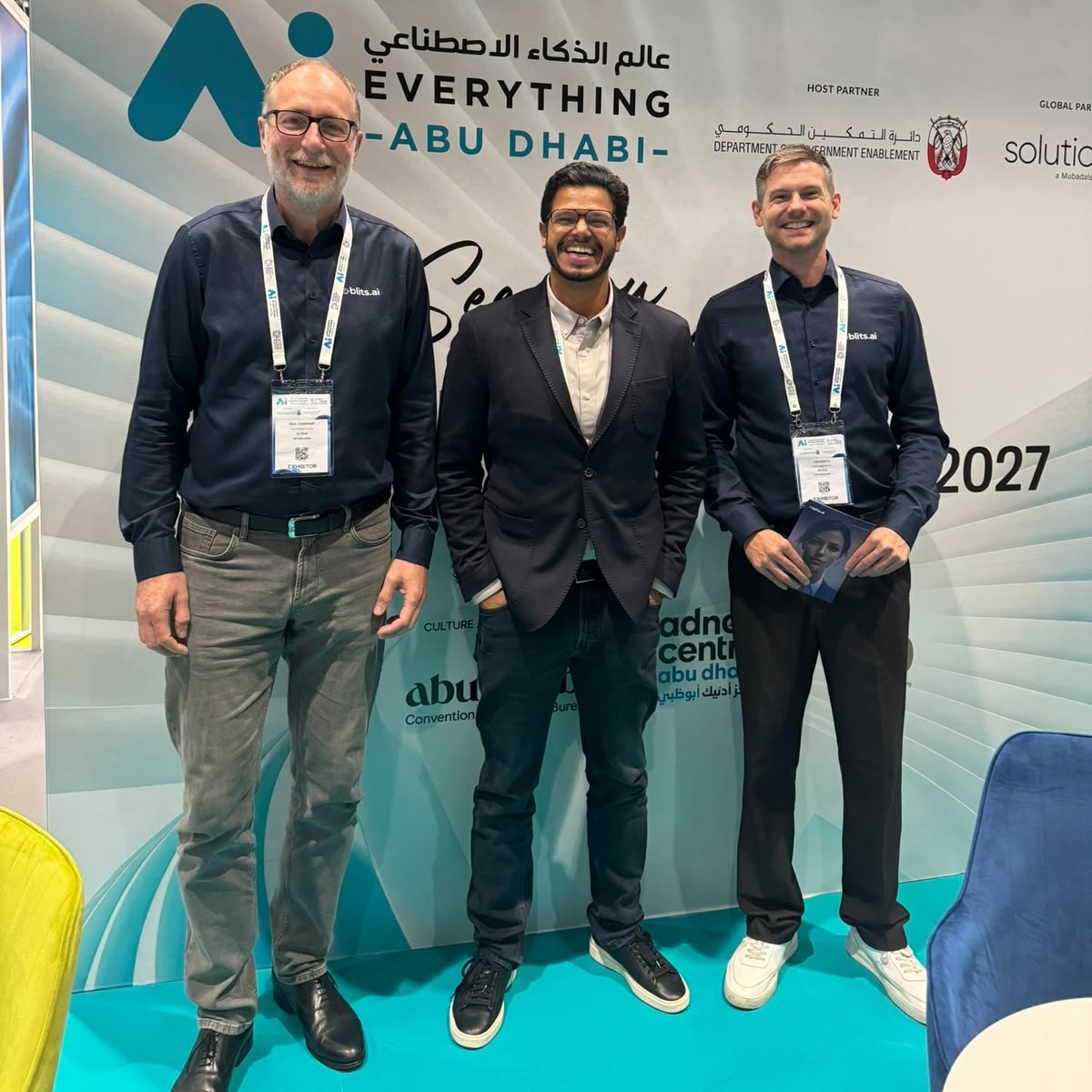
From left: Paul Coerkamp, Basil Fateen (NVIDIA) and Len Debets at Ai Everything Abu Dhabi.
We were grateful to read it. "Efficiently" and "securely" are the two words we spend most of our time on: a platform where the second and third use case go live faster than the first, and controls that a bank's risk and compliance teams can sign off on.
More than 75 conversations means a lot of follow up, and we are working through it now: demos in customers' own environments, dialect tests with their own scripts, and a few workshops to map use cases against what is already running elsewhere.
Our next stop is the Singapore FinTech Festival from 18 to 20 November, stand 3-SK-30.
Our thanks to everyone who stopped by the stand, to Basil and the NVIDIA team, and to the organizers of Ai Everything for two excellent days. If we did not get to speak in Abu Dhabi and you are working on AI agents in financial services or government, we would be glad to walk you through what we have learned. You can reach us here.
Five takeaways from Mastercard's summit in Johannesburg: the technology is no longer the bottleneck, governance, trust and context are.
Signals from VivaTech and Web Summit Rio: production over pilots, substance over spectacle, and why your operating framework beats any one model.
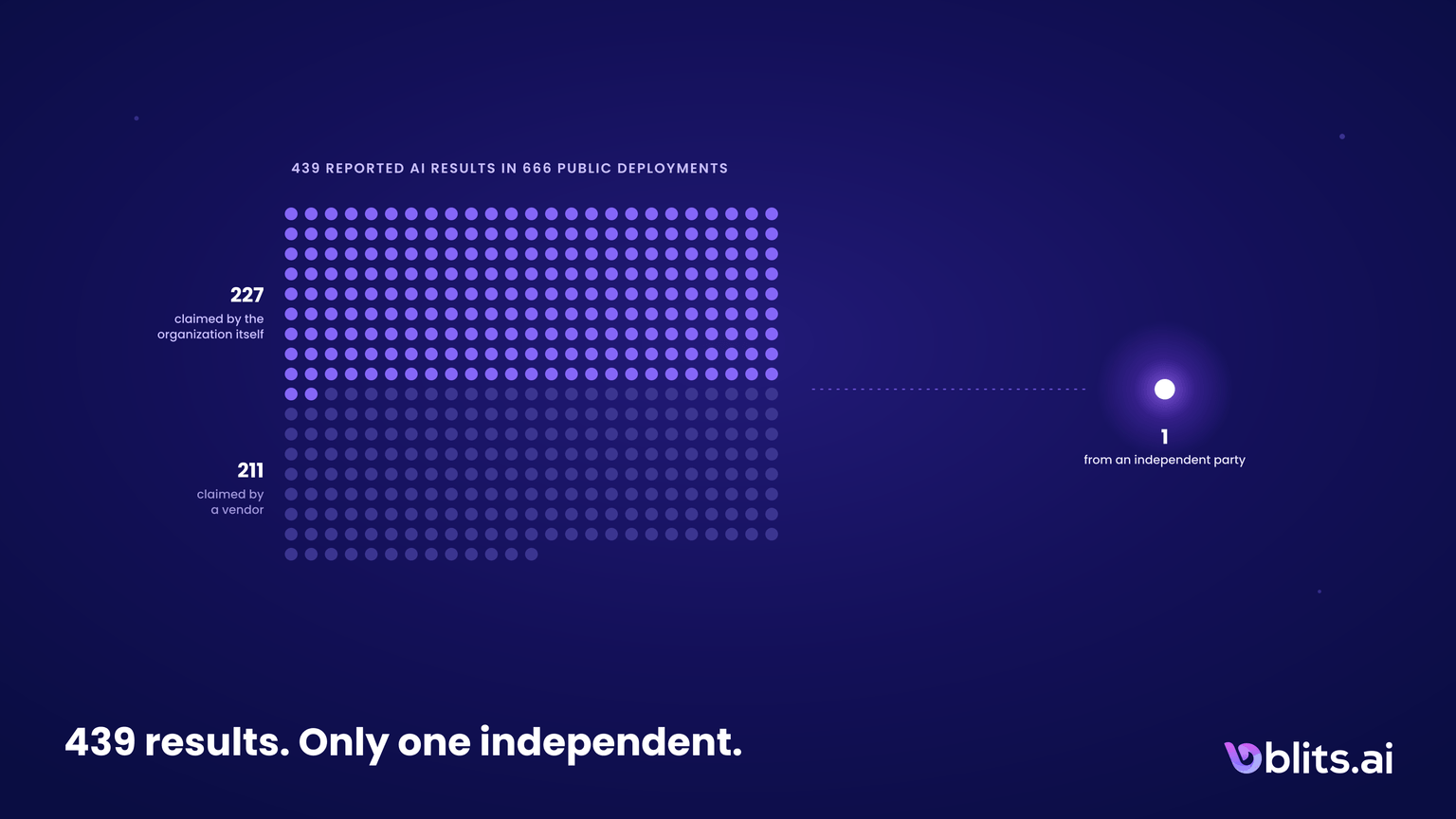
We built a public library of 257 AI use cases and 1,377 real deployments, with every number quoted from its source and labelled with who made the claim. The verdict: AI is doing real work, the industry can't prove it, and the sellers are writing the benchmarks.
New posts on conversational AI, enterprise automation and customer experience, sent to your inbox when they go live
No spam, unsubscribe at any time