Most AI case studies are marketing, if we're being straight about it. You get a PDF with a stock photo and a headline that says "73% faster", and nobody knows faster than what, measured by whom or after how many months. Nobody asks either. That number lands in a board deck, then in a business case, and six months later somebody wonders why the pilot didn't deliver.
So we did something almost nobody bothers to do, and counted. We built the AI Use Case Library: 201 AI use cases, 666 public deployments, 521 organizations, 46 countries. Every single number is quoted word for word from its source and labelled with who made the claim. On top of it sits the State of AI Use Cases, a report that recalculates itself every time a record is added. Analyst reports give you a quadrant once a year. This gives you the quote, the source and who said it, every day. What we found won't make the AI industry very happy.
Of course we used AI to build it. Research agents go through newsrooms, annual reports, earnings calls, government AI registers and vendor case studies. A fact check agent fetches every source again and checks every number. A second agent only tries to prove the page wrong. Only pages that survive both get published. And I own the rules, as the named editor.
We apply those rules to ourselves too. Our own 50 deployments are in the library, but anonymized, in the lowest evidence grade, and they count for exactly nothing in the benchmarks. You can't check them, so they don't count. If we won't bend the rules for ourselves, we won't bend them for anyone.
Only 57 percent of the public deployments share a measurable outcome at all. The rest announce that they use AI and stop there.
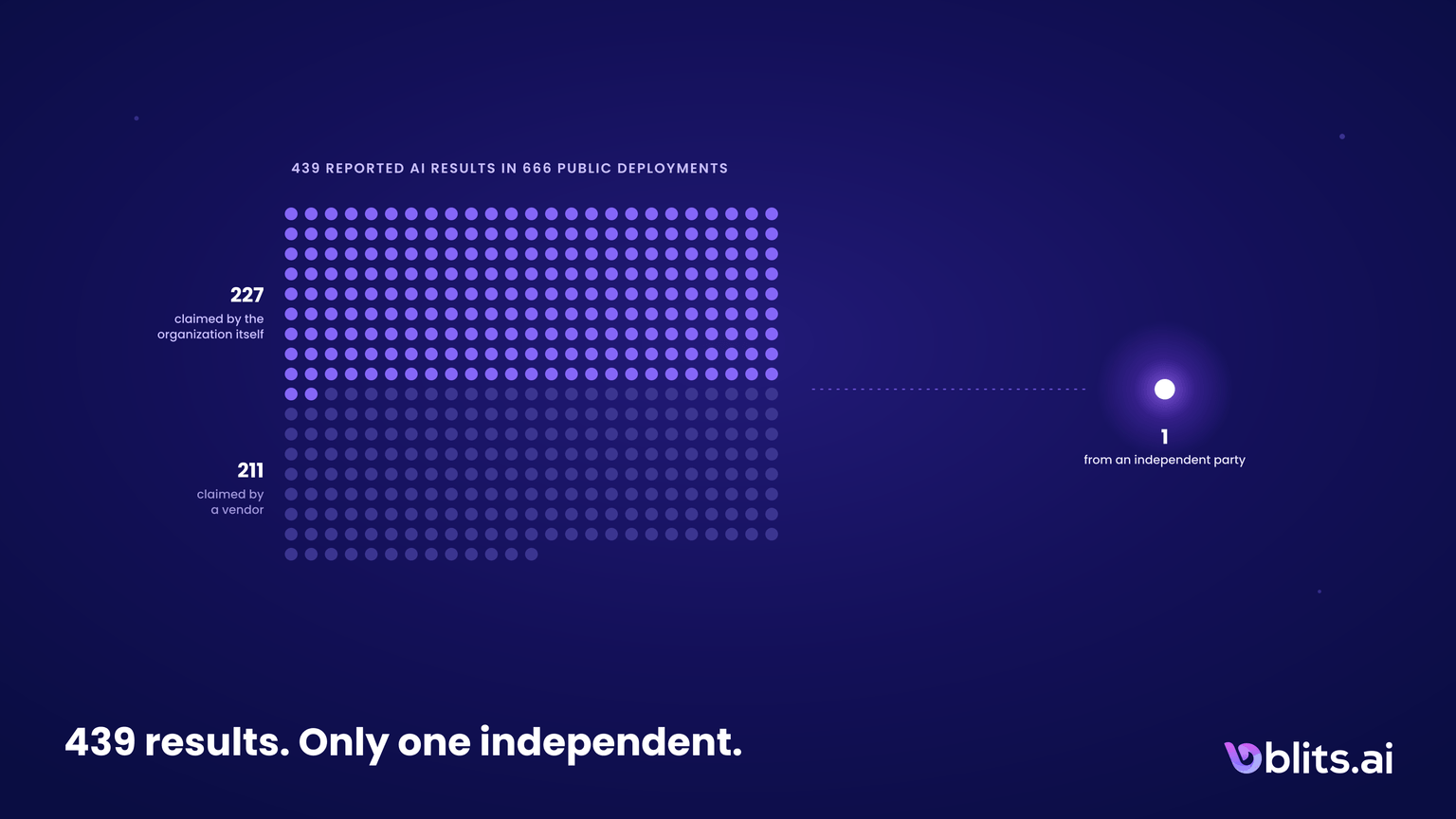
And the numbers that do get shared are hardly ever checked by anyone else. The library holds 439 reported results: 227 come from the organization itself and 211 from a vendor, which leaves exactly one from an independent party. One, out of 439.
We also grade every deployment on the strength of its evidence. Grade A means independent oversight: a regulator, a supervisor or an auditor reporting on the deployment. Out of 666 public deployments, the number of grade A records is zero.
Everybody has an AI success story. Almost nobody has someone independent who checked it.
I'm not saying anyone is lying. I'm saying nobody checked. In finance, an unaudited number is called a claim. In AI, we call it a case study.
For every KPI we take one value per organization, throw out the "up to" numbers (a ceiling is not a result) and calculate the median.
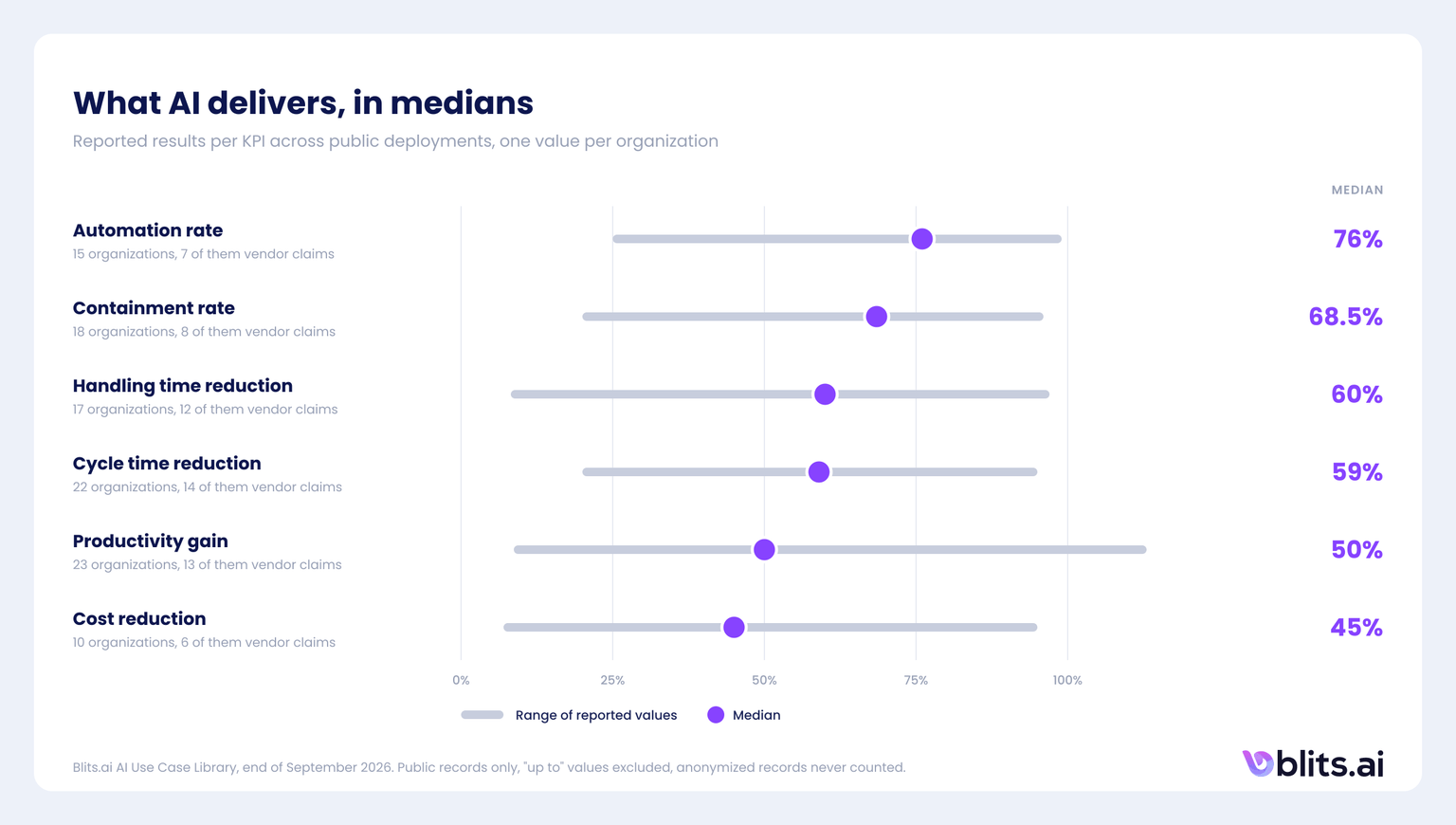
Now look at who's talking. For cycle time reduction, 14 of the 22 values come from vendors. For handling time, 12 of 17. For cost reduction, 6 of 10. The numbers the market quotes to buyers are, for the most part, supplied by the people selling.
And the sellers' numbers are bigger. On handling time reduction, vendors report a median of 66 percent and the organizations themselves 41. On cost reduction vendors say 69 percent, the organizations 40. The samples are small, but the direction is hard to miss. To be fair, on containment and automation it's the other way round. But those aren't the numbers that end up in the savings line of a business case.
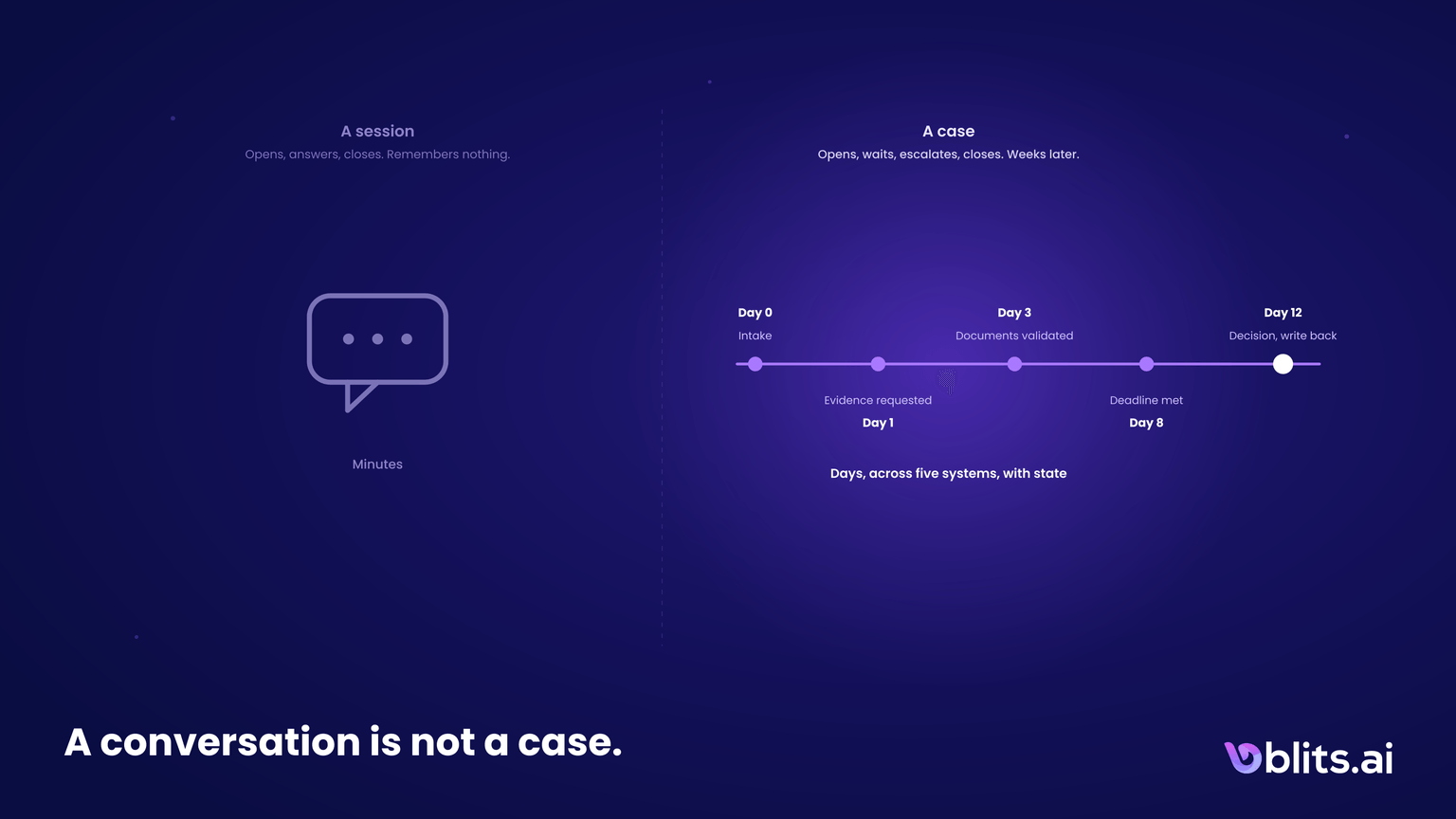
So right now, the sellers are writing the benchmarks. The good news is that the medians are still strong, just a lot more boring than the brochures. A median containment rate of 68.5 percent across 18 organizations, right in the two thirds band I wrote about in A Conversation Is Not a Case. A median automation rate of 76 percent across 15. A median productivity gain of 50 percent across 23.
If you want one number for your CFO, take the one the buyers report. The 97 percent from a vendor slide is the one that gets you fired.
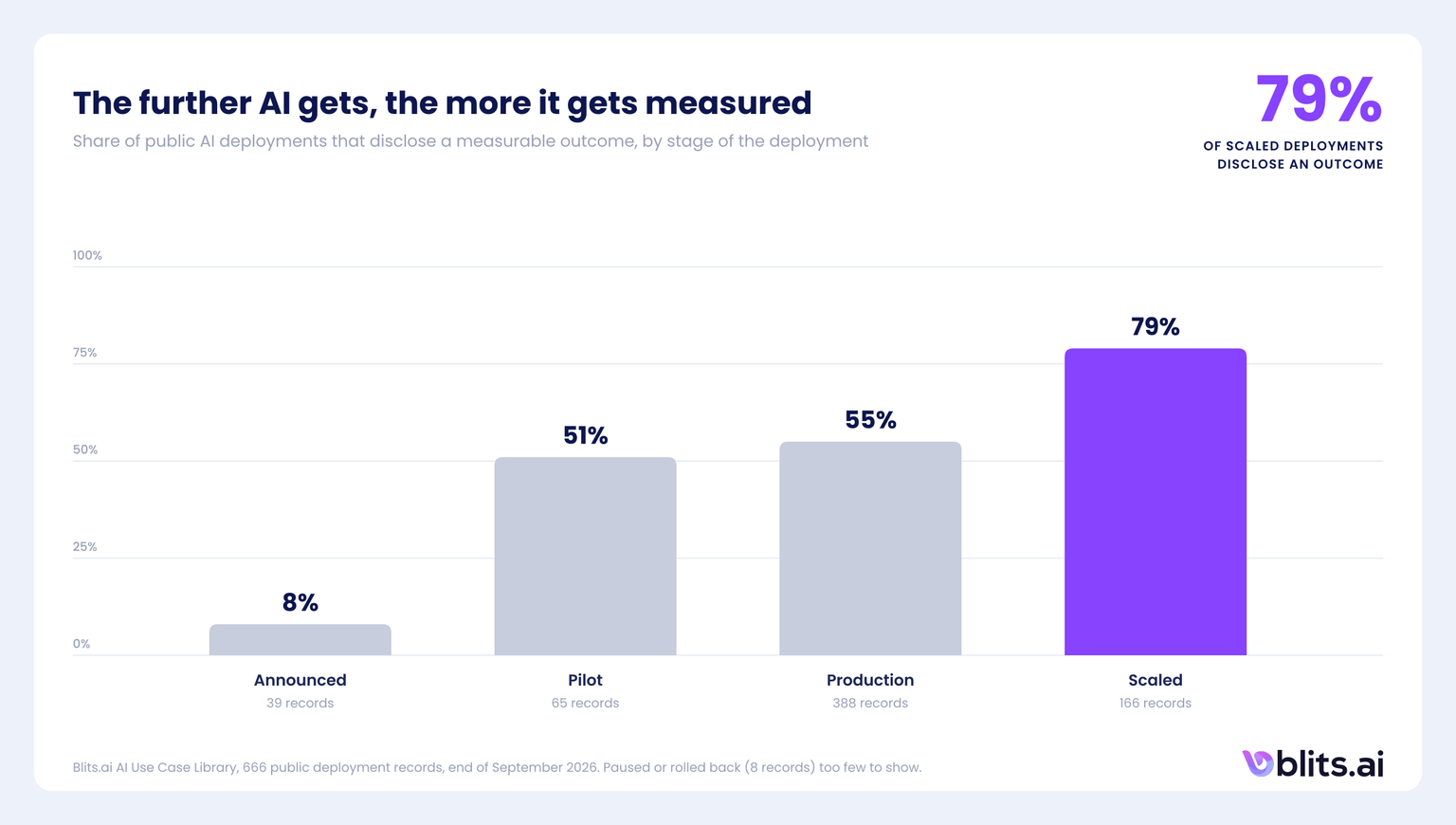
Of the deployments that were only announced, 8 percent share an outcome. Pilots and production sit around half, and deployments that have scaled come in at 79 percent. The pattern is simple. When AI really works, somebody measures it, because somebody has to defend the budget. An announcement is a press release. A scaled deployment with a number is evidence. If a vendor shows you announcements as references, ask for a scaled one. If they don't have one, you have your answer.
And look at what's missing. Only 8 of the 666 records are paused or rolled back. About one percent. Meanwhile MIT reported that 95 percent of generative AI pilots at companies are failing. Both are true, because nobody writes a press release about the pilot that died.
The public record is a highlight reel. Read every AI success story like one.
70 percent of the public deployments belong to use cases where the AI completes the work itself, as a supervised agent or an agentic workflow, not as a helper that suggests an answer. The most common pattern in the whole library is the agentic workflow, in 102 of the 201 use cases. It's ahead of the RAG knowledge assistant (73) and the conversational agent (71). And the curve is steep: 60 deployment records from 2023, 162 from 2024, 224 from 2025.
So the question has moved from whether it can answer to what it is allowed to do, and that's why governance now decides which projects make it and which don't.
And before anyone panics about the EU AI Act: only 10 of the 201 use cases are high risk by default. For 98 of them, the risk tier depends on how you build it, which makes risk mostly a design decision.
North America has 299 deployments in the library and Europe 189. The Middle East, Africa and Latin America together have 31, less than 5 percent.
That's odd, because some of the most ambitious AI projects I've worked on run in the Gulf and across Africa. Banks there stopped asking whether to use AI a while ago and mostly want to know how fast. But they don't publish, so the world's benchmarks are written as if they don't exist. Every "industry average" you read is really a North American and European average.
Government has the opposite problem. It has the most public deployments in the library, 144, thanks to public AI registers. But only 28 percent of them disclose an outcome. A register proves AI is being used. It doesn't prove it works.
Right now the count for grade A is zero, and I don't think that will last. Supervisors are already writing AI inventories and human oversight into their rules, and once they start asking for results as well, a lot of headline numbers are going to shrink.
So here's my prediction. Within two years, no serious buyer signs an AI contract without asking who measured the result, and they'll ask it before they ask about price. Evidence grades will be as normal in AI procurement as security certificates are today. Vendors who can show a checked number will win those deals, and the ones who only have a slide will spend a lot of time explaining themselves.
Which brings me to a challenge for every AI vendor, and that includes us. Publish the number, say who measured it and say what stage the deployment is in. That's all I'm asking.
The full dataset is free to reuse under CC BY 4.0, and the methodology spells out every rule we apply. Because the report recalculates itself every time a record is added, it should only get better from here.
And if you think your deployment belongs in the library, send us the number and the source. If it holds up it goes in, and if it doesn't, it stays out. Same rule for everyone, us included.