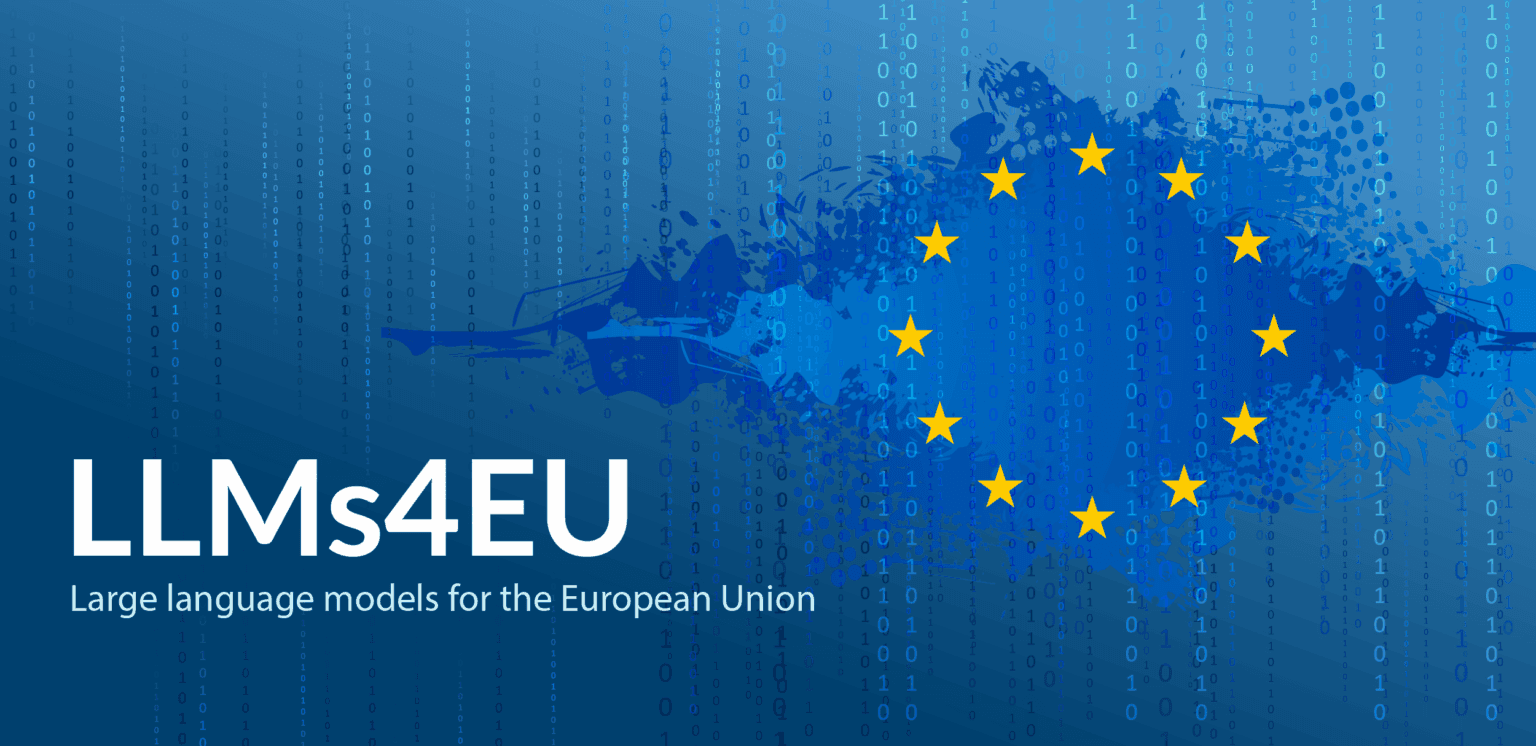
We have joined LLMs4EU, a European Union funded effort to strengthen Europe's position in large scale language technology, as one of the participating SMEs.
More and more of the way organizations look up information and talk to customers runs on large language models, and the best known of those models were built outside Europe. Hence a question you now hear often in Europe: who builds these models, on what data, and under which values and rules? LLMs4EU was set up around exactly that question.
The full name is Large Language Models for the European Union. It is a multi year project, paid for under the EU's Digital Europe Programme, and its goal is a shared European base for training, fine tuning, evaluating and deploying large language models. Those models should reflect the languages Europe actually speaks, its legal frameworks and its society.
Language coverage is a large part of the work. Plenty of European languages get little attention in the current foundation models, since there is not much money to be made serving them, and LLMs4EU wants to change that for a long list of EU languages.
Models, datasets and tools are supposed to be openly available, so that a European company can build on them without relying on a provider outside Europe. GDPR compliance and alignment with the EU AI Act are designed in from the beginning. That last point matters to anyone who has tried to retrofit compliance onto a system that was built without it.
Europe has good research institutions, serious enterprises and a lot of capable SMEs. Where it fell short was coordination, the joint work needed to get foundation models that hold their own technically and also fit European regulation and values without workarounds.
LLMs4EU is meant to fill that gap, first of all by giving European companies and public institutions access to advanced language models. It also supports work on multilingual and domain specific AI applications across sectors such as public services, telecom, energy, tourism, and research. Open, reusable components are preferred over closed systems nobody can inspect. And the global AI market is consolidating fast, so technological autonomy is on the agenda too.
For enterprises in regulated environments this has direct consequences, for how safely and transparently AI can run in production and for whether it can keep running there.
More than sixty partners from across Europe are involved, among them TNO and KPN, leading research institutes, universities, telecom providers and technology companies. Academic research, applied innovation and industrial deployment are all represented. The consortium was set up broad on purpose. Building European language models needs people from many disciplines and sectors, and a group of researchers alone could not do it.
Blits.ai joins as a European SME that works on applied generative AI for enterprises. We deploy LLM based solutions in complex, regulated environments, where multilingual support, reliability, explainability and compliance are requirements from day one. Training a model is one step. Making it usable, governable and deployable at scale is a separate piece of work, and that is where we can contribute from our deployments. In return we stay close to the European research and infrastructure work as it develops.
It also fits what we do as a company. We build generative AI for production use, multilingual by default and suitable for organizations under strict regulation. LLMs4EU supports the same priorities: language models that work across European languages and cultures, AI systems that can be audited, and architectures that respect European rules while still competing worldwide.
LLMs4EU runs for several years and is a long term investment. What it produces will affect how language models are developed, shared and adopted, by companies as well as public institutions. Our contribution will stay on the applied side. We want the results to end up in systems that European organizations can deploy and run responsibly.
Updated on 12 October 2026.