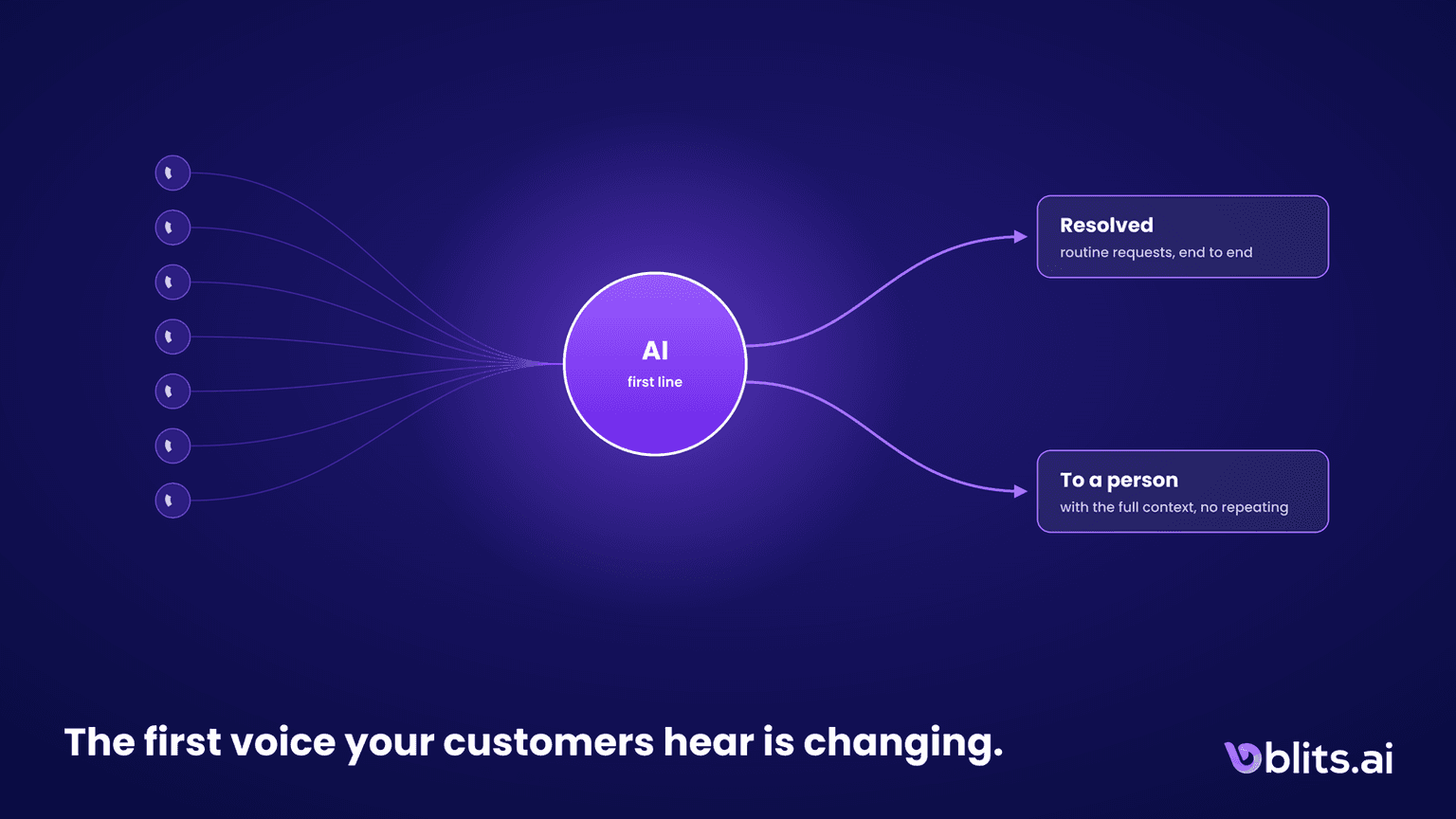
An AI call center is a contact center where a voice agent answers the phone first, resolves the routine requests itself and passes everything else to a person with the full context. Behind that first line, AI listens along with the human agents and reviews every call afterwards. The people are still there. What changes is which calls reach them, and how much help they get when they do.
I've visited a lot of contact centers this year, at banks, telcos and government agencies across Europe, the Middle East and Africa. The conversations on the floor have shifted. Two years ago, the question was whether a voice bot could understand callers at all. Today the operations managers I meet assume it can. What they want to know is what happens to their floor when it does.
Chat got AI first because it was easier. Text is forgiving: a customer can reread, a bot can take a second longer, and nobody notices a pause. The phone is different. A caller expects an answer within a second, speaks with an accent, interrupts, and is often calling because something already went wrong. That is exactly why it matters. For many banks and telcos, the phone is still where the most expensive and most emotional conversations happen.
It is also where the staffing problem lives. Contact center agent turnover climbed to 28.1 percent in 2023, according to Metrigy research published by TechTarget. ContactBabel puts attrition in US contact centers at around 30 percent and estimates the cost for a 500 seat operation at more than $5 million a year. When I talk to contact center leaders, cost is rarely the first thing they mention. Hiring and training people for a job where a third of them leave every year is.
And the old fixes haven't solved it. In a Gartner survey of almost 6,000 customers, only 14 percent of service issues were fully resolved in self service, and even issues customers called very simple were resolved there only 36 percent of the time. Press 1 for this, press 2 for that was never self service. It was a waiting room.
When people say "AI call center" they usually mean the voice bot. In the projects that work, AI shows up in three places at once.
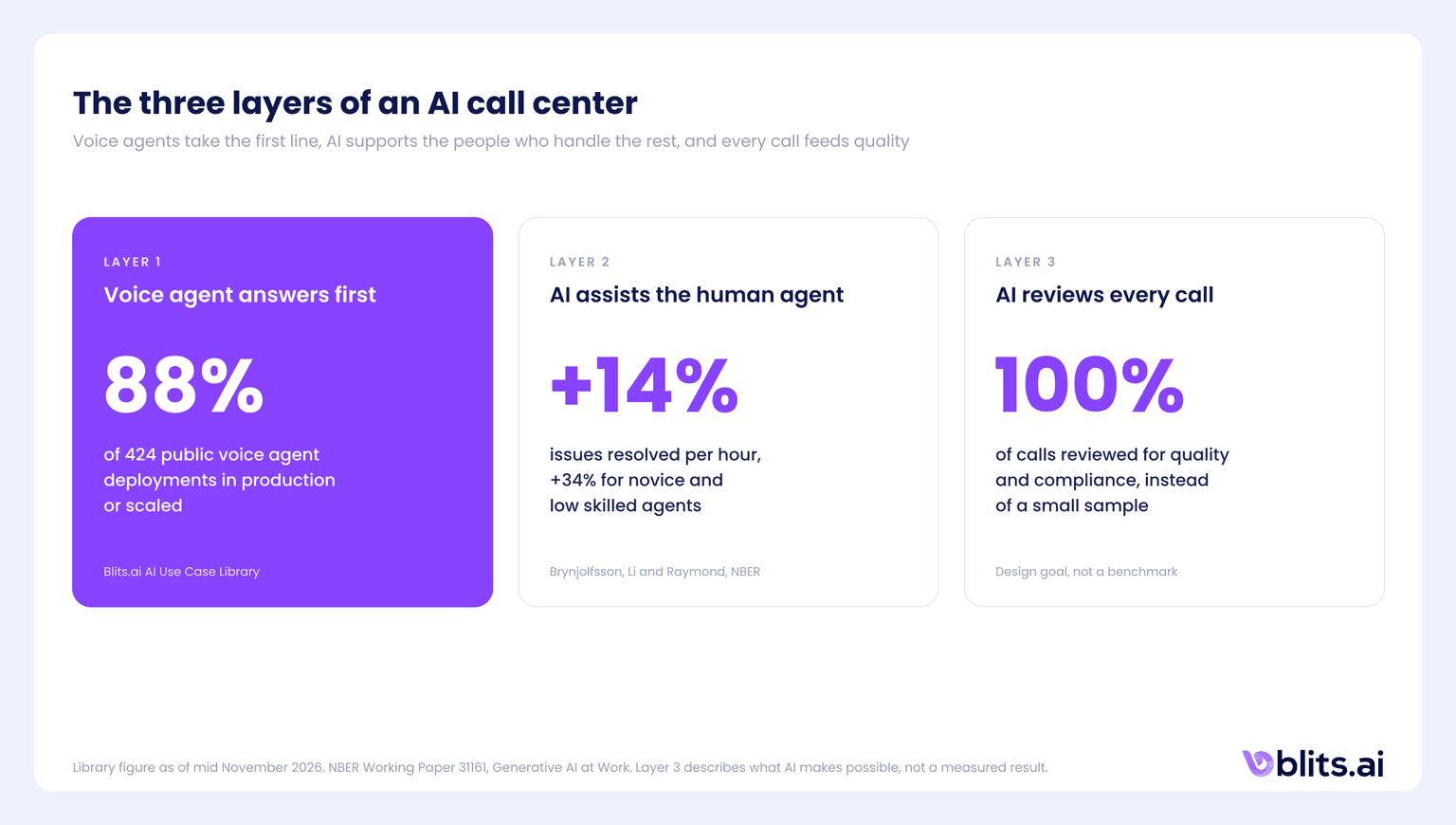
Layer 1: the voice agent answers first. It greets the caller, works out what they need and, for a growing list of requests, finishes the job: blocking a card, rescheduling a delivery, checking a claim, resetting a password, booking an appointment. When it can't, it transfers the call with a summary of everything already collected. In our AI Use Case Library we track 424 public voice agent deployments across 44 use cases. 88 percent of them are in production or scaled, not in pilot. The single biggest use case is the first line contact center agent, with 116 documented deployments.
Layer 2: AI assists the human agent. On the calls that reach a person, AI listens along, pulls up the right policy or customer record, suggests next steps and writes the call summary afterwards. This layer has the strongest evidence of anything in this article. A study of more than 5,000 support agents by economists from Stanford and MIT found that AI assistance increased productivity by 14 percent on average, measured as issues resolved per hour, with a 34 percent improvement for novice and low skilled workers. Read that second number again with 30 percent attrition in mind. The people who benefit most are the ones who just joined.
Layer 3: AI reviews every call. Most quality teams listen to a small sample of calls, a handful per agent per month. AI can check every call for compliance phrases, complaints, vulnerable customers and missed sales or retention moments, and flag the ones a person should hear. It is the least glamorous layer and, in regulated industries, often the one that pays for itself fastest. The library has only 14 public deployments of call quality and compliance monitoring, mostly because banks don't write press releases about their QA team.
The voice agent gets the headlines. The agent assist and the quality layer often get the results.
The public record already has both kinds of story, and you learn more from reading them side by side.
Commonwealth Bank of Australia is the clearest example of both. In August 2025, the bank reversed 45 customer service redundancies that it had justified by the introduction of a voice bot, after the union disputed that call volumes had fallen. The bank admitted it had not adequately considered all relevant business considerations. Less than a year later, Microsoft and CBA reported that the bank's new platform handles more than two million conversations every month across voice and messaging, and that around 84.6 percent of self service messaging interactions were resolved end to end. Same bank, same technology family. The difference was what they promised and when.
Gartner sees the same pattern across the market. It expects that by 2027, half of the organizations that planned to significantly reduce their customer service workforce because of AI will abandon those plans. Not because the AI doesn't work, but because the business case was written as a headcount number before anyone knew which calls the AI could actually finish.
The scale is real when it is built patiently. Bank of America's assistant Erica, a chat assistant rather than a voice agent, has passed 3 billion client interactions with nearly 50 million users, over almost a decade. Vodafone reported that its assistant SuperTOBi raised first time resolution for appointment booking in Portugal from 15 to 60 percent. Both are company claims about chat, so treat them as direction, not as a benchmark for your phone line.
This is the part that rarely makes it into the vendor slides, and the part operations managers ask me about most.
The first change is that the calls reaching people get harder. If the voice agent handles balance checks, card blocks and appointment changes, the human agents get the disputes, the bereavements, the fraud victims and the customers who are already angry. Average handling time per call can go up even while total cost goes down. If your targets don't change with the work, your best people will feel punished for it.
The job changes with it, and so does training. Agents spend less time on routine scripts and more on judgment, which makes Layer 2 important: an assist tool that helps a new agent with a complicated case is worth more on this floor than it was on the old one.
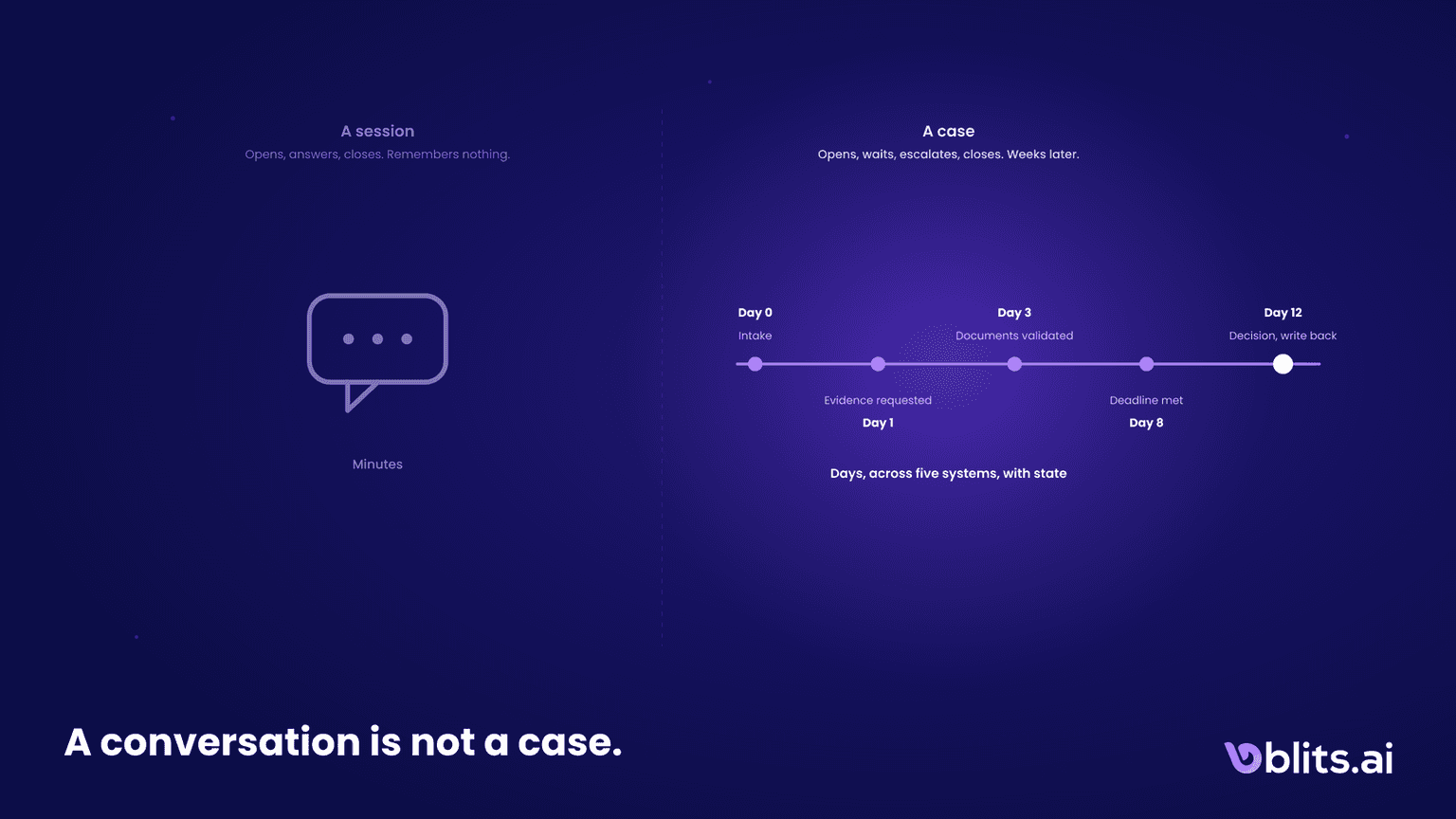
Handover also becomes the most important moment. A caller who has just explained their problem to a voice agent will not explain it again, so the person who picks up must see the summary, what has been verified and what the caller already tried. I go into the design of this in AI Customer Service in 2026, and it is the first thing customers notice.
Language and dialect stop being an edge case. In many of our markets, callers switch between Arabic dialects and English in the same sentence, or between French and Arabic, or Dutch and English. A voice agent that only handles textbook pronunciation will fail exactly the customers who most need the phone. Yuri explains the technical side of this in AI Voice Agents for Enterprises.
Finally, your metrics have to move. Containment and average handling time were built for a different floor. Add first contact resolution, repeat calls within a few days, transfer rate with and without context, and customer satisfaction split by whether the call was handled by AI, by a person, or both.
The contact centers that do this well start small and specific. Pick three or four call types that are frequent, well defined and can be finished in your systems. Put the voice agent on those, with a clear and fast route to a person for everything else. Turn on agent assist and call summaries for the human team from day one, because that is where the quick wins are. Then let your quality team review what the AI did every week and decide, based on real calls, which call type to add next.
And write the business case around what customers get done, not around headcount. The banks that had to walk back their announcements had the technology. What they lacked was a few months of evidence from their own calls.
If you're working out what an AI call center would mean for your own floor, I'm always glad to compare what we've seen. You can read how our voice bots work, or send us a note with the call types you would start with.