When banks and insurers ask us about agents, the question underneath is almost always about control: who decides, what gets logged, and what happens when the AI is wrong. Agentic workflows are the way most of them end up answering it.
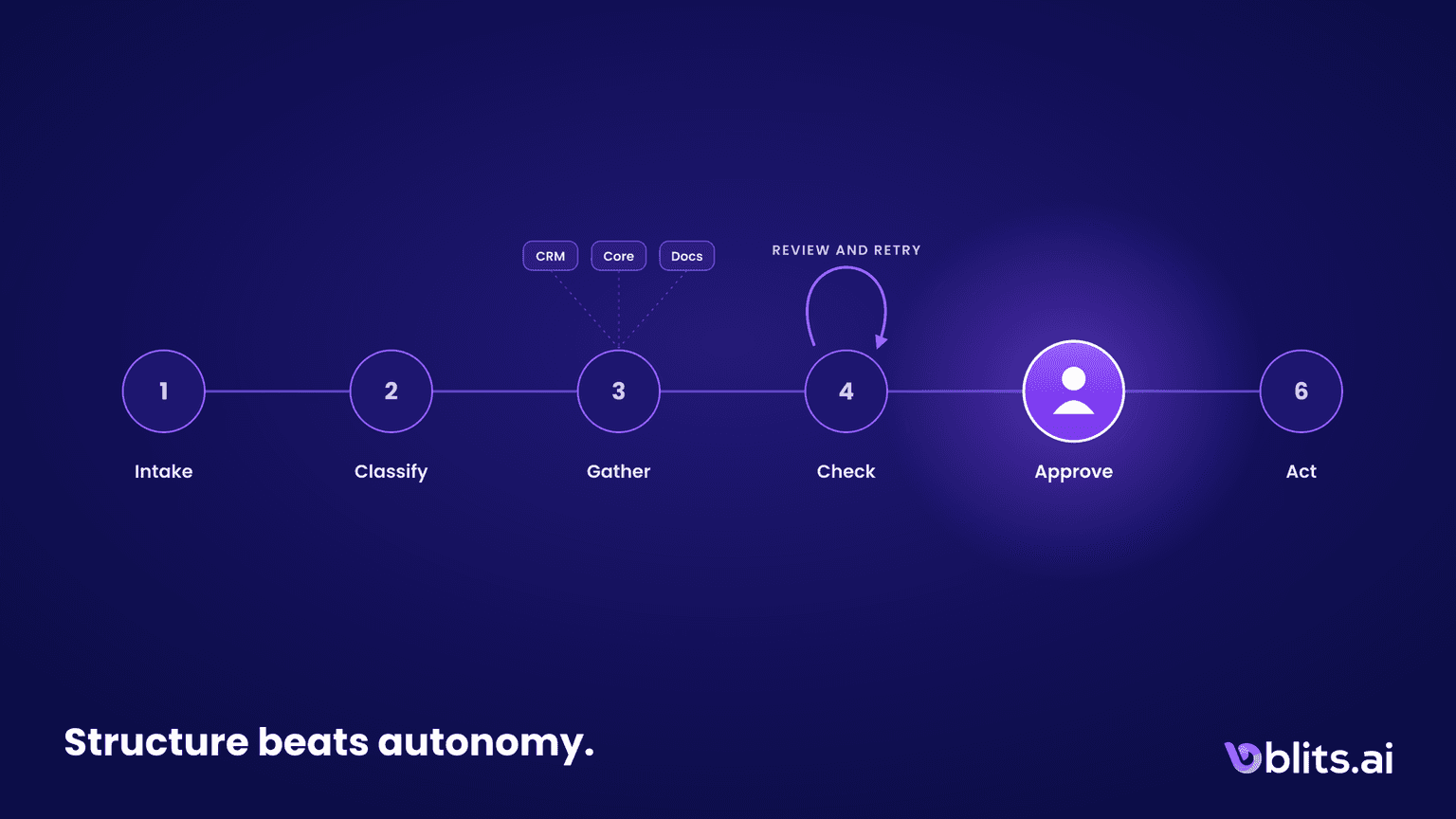
An agentic workflow is a process in which an AI model works through a task in steps instead of answering once and stopping. It reads the input, decides what to do, calls the systems it needs, checks its own result and passes the decision that matters to a person. The model can be the same one a chatbot uses, and what differs is the structure around it: the steps, the permissions and the approvals.
The terms are often used interchangeably, but the distinction matters for anyone who has to answer to a risk committee. Anthropic draws the line clearly in its guide Building effective agents:
"Workflows are systems where LLMs and tools are orchestrated through predefined code paths."
Agents, by contrast, are systems in which the model directs its own process and decides which tools to use.
For regulated organizations that difference is practical. In a workflow, you decide the steps, the order and where a person signs off. The model brings judgment inside each step: reading a document, classifying a request, drafting a decision. In a fully autonomous agent, the model also decides the route. That flexibility is useful for open ended tasks, but harder to explain to an auditor.
Our advice to banks and insurers is consistent: start with workflows, and give the model more freedom only where it clearly earns it. In what we see, most of the value comes from structure, and well designed workflows with a person on the decisions that matter do better than clever agents without boundaries. The market is moving the same way. Of the 302 AI use cases we document in the AI Use Case Library, 125 are built on the agentic workflow pattern. Across the 1,705 public deployments in it, 61 percent belong to use cases in which the AI performs the work itself.
Andrew Ng made the case for working in steps in early 2024. Most people use a language model like asking someone to write an essay in one go, without ever going back. In what he called an agent workflow, the model can iterate: draft, review, improve. His example on a coding benchmark is striking. GPT-3.5 answering directly scored 48.1 percent and GPT-4 scored 67.0 percent, but "wrapped in an agent loop, GPT-3.5 achieves up to 95.1%."
For enterprises the takeaway reaches well beyond coding. The design of the process can matter more than the choice of model, and a weaker model in a well designed workflow can outperform a stronger model used in one pass.
Ng describes four design patterns. Together with Anthropic's workflow patterns, they cover almost every agentic workflow we build for financial services.
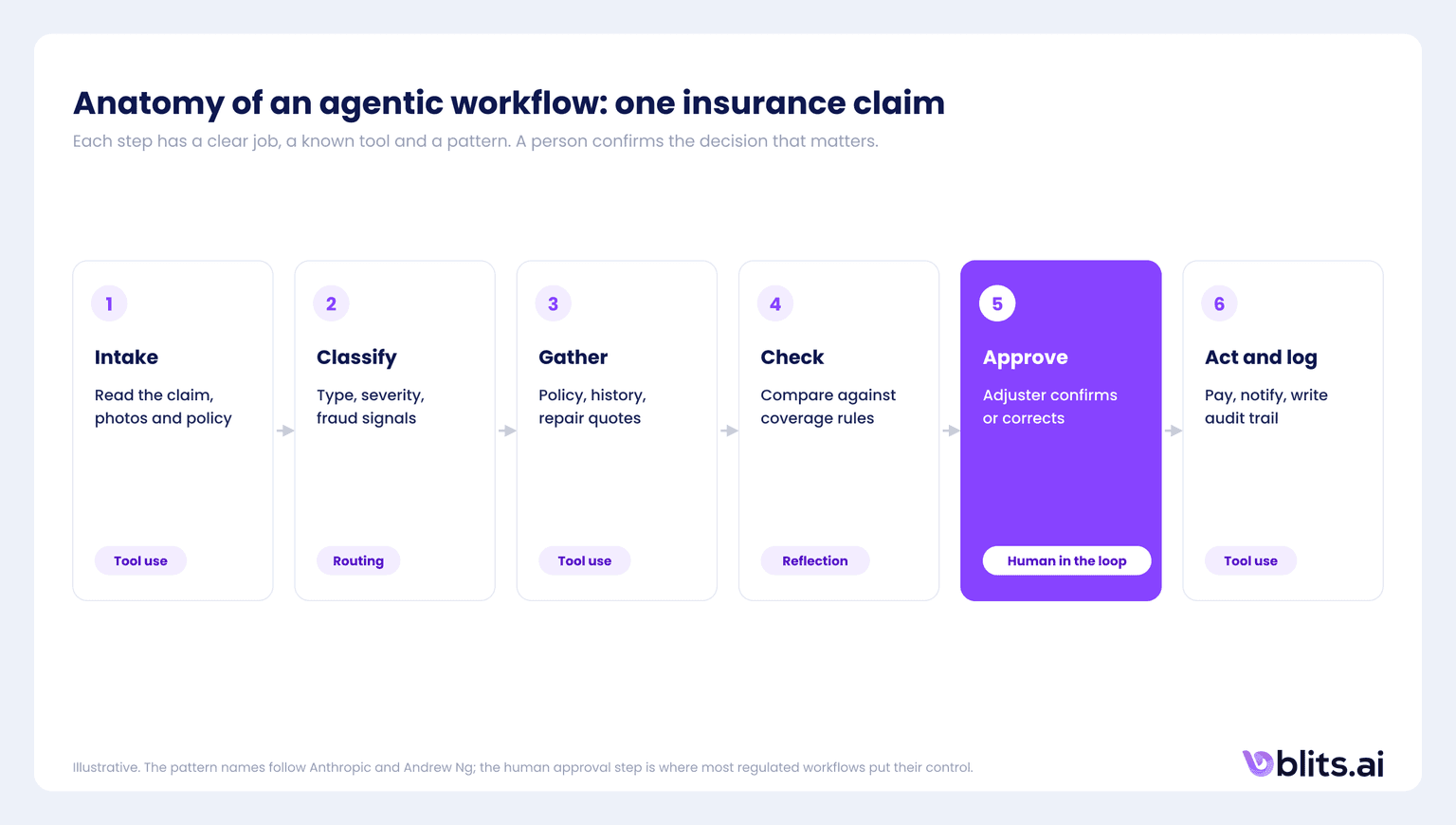
The model reads from and writes to your systems: the core banking platform, the policy administration system, the CRM, the document store. This is what turns an answer into an action. Every tool call needs clear permissions, and the permissions are enforced outside the model, not in the prompt.
The workflow decides which path a case takes. A simple address change follows one route, a disputed claim another. Routing can be done by rules, by the model or by a combination, but the possible routes are defined in advance.
The model checks its own work before it moves on: does the claim fall within the coverage, does the extracted data match the source document, is the draft complete? Reflection is the cheapest quality control there is, and it catches a surprising share of errors.
Some workflows split the work over several specialized agents, each with one job. That can help when the steps really differ. It also adds coordination overhead, so we only use it when a single workflow becomes too complex to manage.
Regulated organizations add a fifth element to these four. It is a requirement more than a design pattern: a person on every consequential decision. The AI prepares, the human decides, and the audit trail records both.
In Australia, Allianz launched Project Nemo in July 2025 for food spoilage claims after storms and power outages. The system uses seven task specific AI agents, and Allianz reports an 80 percent reduction in claim processing and settlement time. Experienced professionals still review and confirm the outcomes. It shows the pattern in its clearest form: the workflow takes the hours and people own the decision.
The South African bank reports that onboarding a small business client used to require 87 KYC fields and about 420 minutes of work. In a case study published by Salesforce, its vendor, Absa reports that onboarding times fell by 95 percent, to under 20 minutes, as part of a wider transformation that combined agentic AI with other changes.
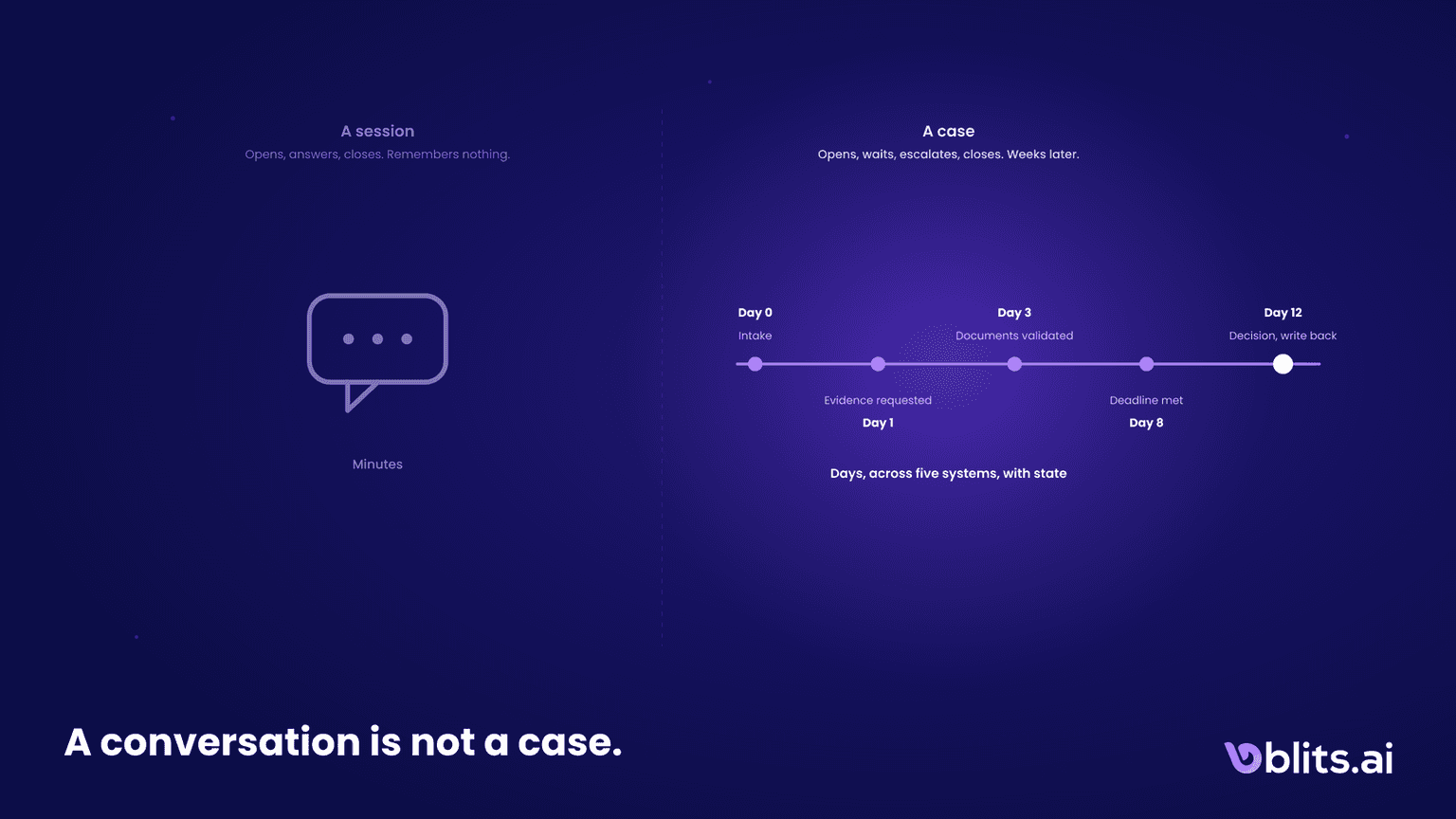
In our library, the most common insurance use cases are exactly these workflow shaped jobs: claims triage and straight through processing, claims fraud detection and photo based damage assessment. In banking we see the same shape in document collection for onboarding, dispute handling and KYC refresh. Each is a case that runs over days, touches several systems and ends in a decision someone must be able to explain, which is why a conversation is not a case.
Not every agentic project will succeed. Gartner predicts that more than 40 percent of agentic AI projects will be canceled by the end of 2027, because of escalating costs, unclear business value or inadequate risk controls, as reported by Outlook Business.
All three causes are design problems. Costs escalate when every step calls the largest model. Value stays unclear when nobody defined the outcome before the build started. Risk controls are inadequate when permissions, approvals and logging are added at the end instead of designed in. Len described the controls we consider non negotiable in The AI Bank Runs on Governance.
Five things are worth settling first. Start with the outcome and how you will measure it: processing time, straight through rate, error rate. Then decide which steps need judgment and which need rules, using the model where language and judgment matter and rules for everything that must be exact. Next, list the systems each step touches and with what permission, read only where possible and write access only where needed, enforced outside the model. Name the role that decides, along with the decision and what that person sees at the moment of deciding. Finally, agree on what gets logged: every step, every tool call and every approval, so that "show me how this decision was made" takes a query instead of a project.
A team that can answer these is ready to build an agentic workflow that survives an audit. On our agentic AI platform, these elements are part of the platform, so each new workflow starts with permissions, approvals and audit trails in place. If you want to see how this would run for your claims or onboarding process, we are happy to show you one running.