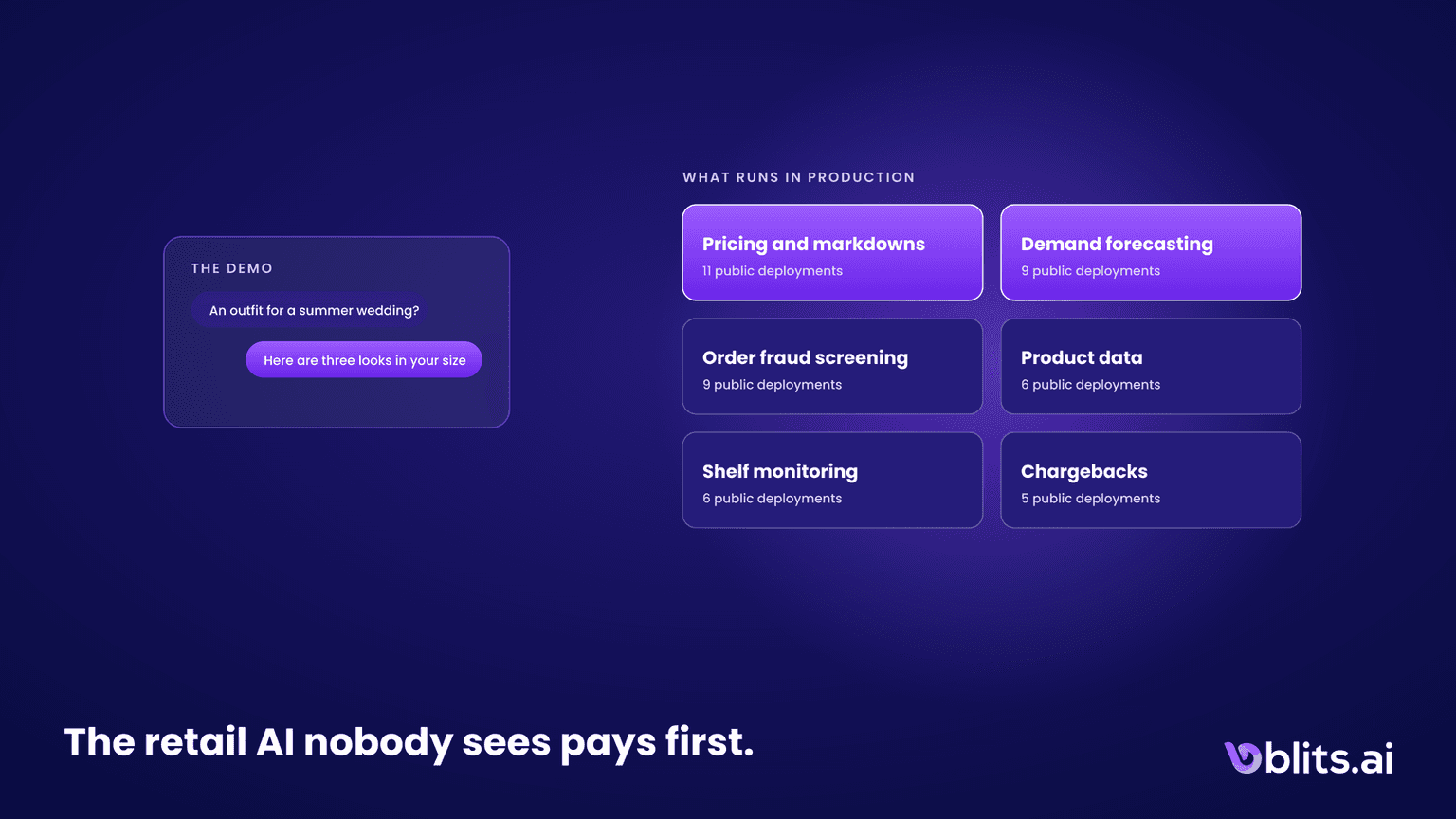
Every retail AI demo looks the same. A shopper types "I need an outfit for a summer wedding in Lisbon," and a friendly assistant comes back with three looks, the right sizes and a discount code. Everyone in the room nods. Somebody says "this changes everything."
Then you look at what retailers actually run in production, and it is mostly pricing, forecasting, fraud screening and product data. That is less exciting on a stage and much more exciting on a P&L.
Retail AI is the use of AI across the retail chain: what to buy, how to price it, how to describe it, how to stop fraud and how to serve the customer. The demos focus on the last one. The money, so far, mostly sits in the others. Below I cover why, and where that is starting to change.
Our AI Use Case Library tracks 147 public retail AI deployments at 126 retailers. 85 percent of them are in production or scaled. That's higher than I expected. Retail doesn't do long pilots. If something doesn't pay, it's gone before the next season.
The deployments themselves look like this.
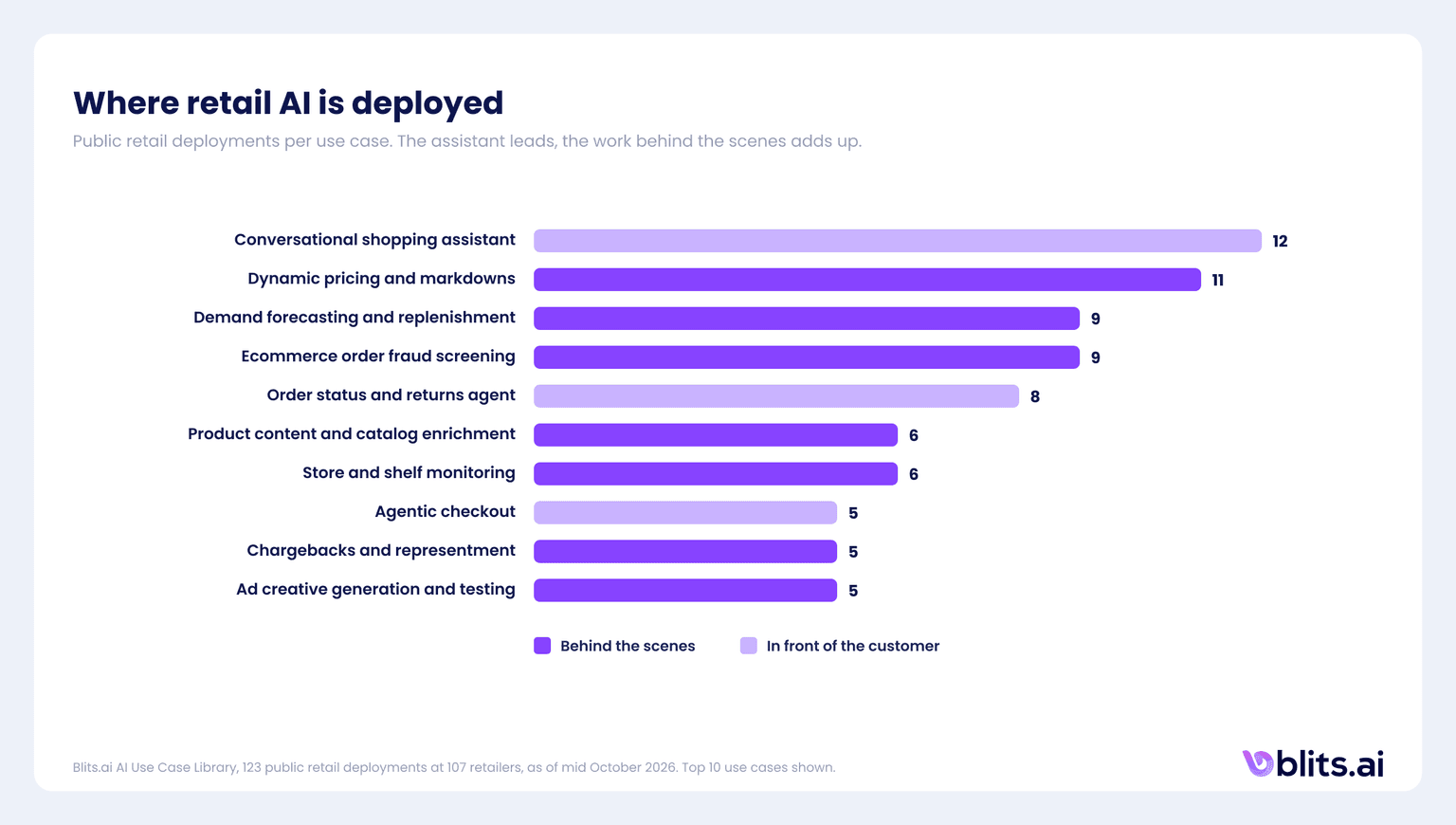
The single largest use case is dynamic pricing and markdowns, with 15 deployments. The conversational shopping assistant is second with 13, so the demo is never far away. But look at the rest of the list: demand forecasting and replenishment (10), order fraud screening (9), product content and catalog enrichment (6), shelf monitoring (6), chargebacks (5). Across the fifteen most common retail use cases, the deployments behind the scenes outnumber the ones in front of the customer by about two to one.
One more number, because I can't help myself. Of the 110 published results in retail, 73 come from vendors and 36 from the retailers themselves. Independent measurements: one, from a regulator. So when a slide says a shopping assistant "lifts conversion by 40 percent," please ask who measured it. In retail, it is almost always the person selling it.
Why do pricing and forecasting win? Because they have three things a shopping assistant usually lacks.
First, the data already exists: sales history, stock levels, promotions, weather. Retailers have been collecting this for decades, so you don't need to build a knowledge base first.
Second, there is a number you can check. A markdown either cleared the stock or it didn't, and a forecast was either close or it wasn't. Nobody argues about whether the AI was "helpful."
Third, a human is already in the loop. Category managers review the price recommendations and planners approve the orders. The AI makes them faster without replacing their judgment overnight.
Walmart is a good example of the boring kind done at scale. Back in 2024, the company said it had used large language models to create or improve more than 850 million pieces of data across its product catalog, work that would otherwise have needed about a hundred times the headcount. No customer ever saw that AI. Every customer benefits from it, because search and recommendations only work as well as the product data underneath.
In retail, the AI nobody sees usually pays for the AI everybody talks about.
No. And this is where 2026 is different from 2023.
The big platforms are now reporting real numbers. On its October 2025 earnings call, Amazon said Rufus, its shopping assistant, had 250 million active customers that year, that customers who use it during a shopping trip are 60 percent more likely to complete a purchase, and that it is on track to deliver over $10 billion in incremental annualized sales. Walmart says the order value of customers using its assistant Sparky is about 35 percent higher than of those who don't, and that roughly half of its app users have tried it.
These are impressive figures, but they are management claims on earnings calls. "More likely to complete a purchase" is a correlation: people who ask questions while shopping were often going to buy anyway. And Amazon and Walmart have something most retailers don't: enormous catalogs with clean product data, full purchase histories and their own engineering armies.
The traffic is coming, though. Adobe measured that traffic to US retail sites from generative AI tools increased by 693.4 percent in the 2025 holiday season, and was careful to add that the base of users is still modest. Shoppers are starting their search in a chat window. The question is what they find when they arrive at yours.
There's a third group that gets less attention than either, and I think it's the most underrated: customer service. Where is my order? Can I return this? Why was I charged twice?
IKEA did something here I like. As of 2023, its AI assistant Billie had handled 47 percent of customer queries to call centers over two years. And instead of cutting the call center, Ingka trained 8,500 call center workers as remote interior design advisers. The AI took the routine questions, and the people moved to work that sells kitchens.
Lowe's went the other way around and pointed AI at its own staff as well as its shoppers. Its assistant Mylow and the store associate version get about a million questions a month. An associate in an aisle who can instantly answer "which of these sealants works on a wet surface" is a better shopping assistant than any chatbot, because the customer is already standing there.
In our library, the order status and returns agent has 9 deployments at retailers, and it's my favorite category because it has everything pricing has: clear data, a checkable outcome and a measurable cost per contact. If you want a customer facing AI project that survives budget season, start here. Coen wrote about what makes these work in AI Customer Service in 2026.
My rough rule after looking at all of this: a retail AI use case survives beyond the demo when the data already exists and the outcome is a number. If step one is "first we need to clean the product catalog," then cleaning the catalog is the real project, so do that first, with AI if you like. Stock cleared, fraud caught, contacts resolved and minutes saved count. "Engagement" does not.
It also needs an owner after launch and the ability to act. Prices, product data and policies change every week, and an assistant that answers from last month's return policy is worse than no assistant. One that explains the return process is nice, but one that starts the return, books the pickup and refunds the card is the one customers come back to. Last, know who measured the result, as the lack of independent measurements above shows.
The shopping assistant will get there for many more retailers. Probably sooner than the skeptics think, but the retailers I'd bet on are the ones who fix their product data, automate the boring decisions and get service right first. When they add a shopping assistant on top of that, it has something real to work with.
Ahold Delhaize put it well in its latest results: after proving results with over 120 AI use cases, it is moving to the next level of maturity, looking at whole processes from sourcing to store operations and agentic shopping. That's the order. Prove it on the boring stuff, then go big.
Product data and service come first. Our AI agents are built for exactly this kind of work, and if you want a second opinion on where to start, talk to us about your catalog.