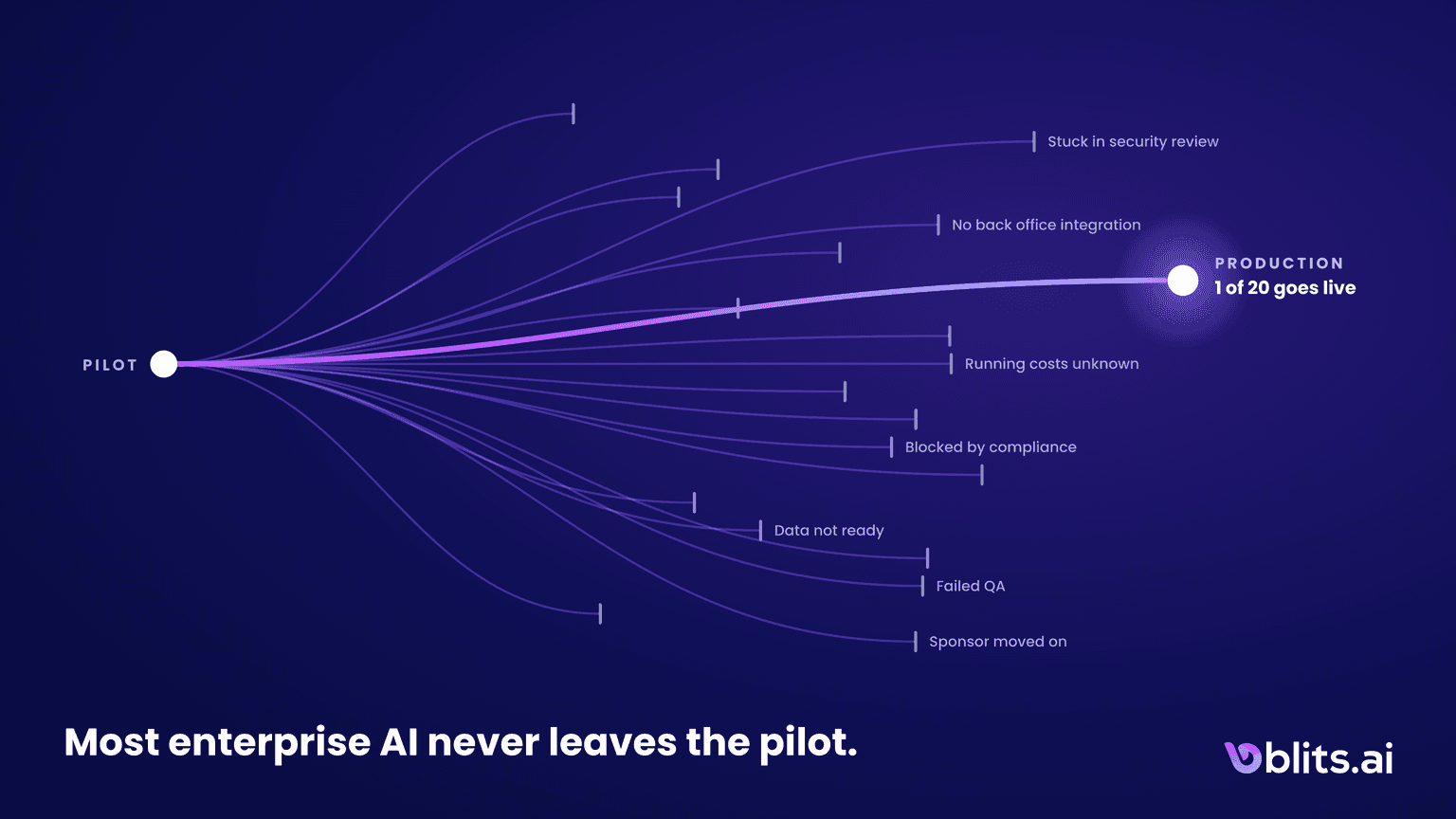
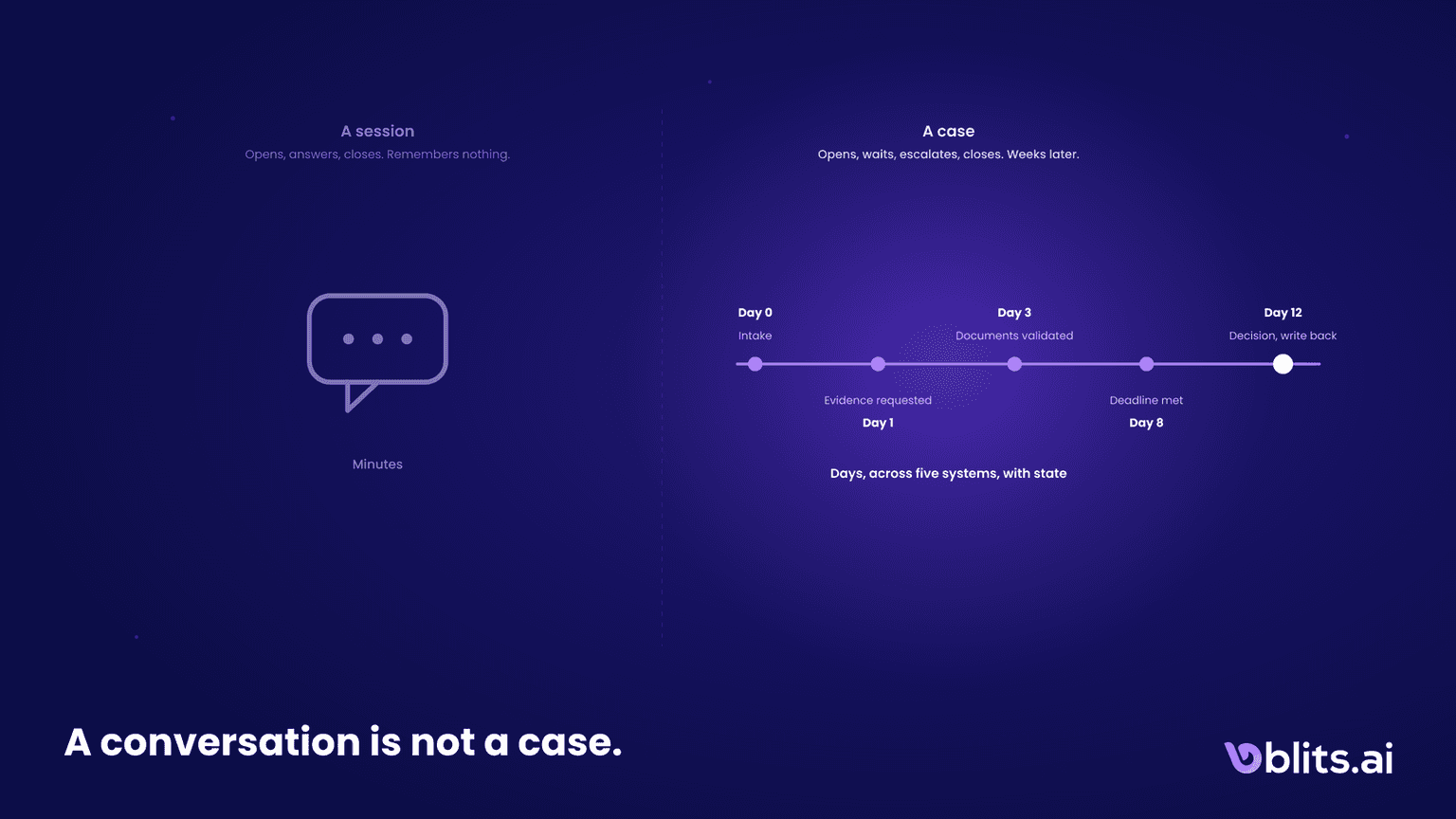
"Most enterprise AI never leaves the pilot. Ours goes live." That sentence is the first thing you read on our home page. It is a big claim, and a big claim deserves more than one line. So this post is the long version. What do we know about enterprise AI that gets stuck, why does it get stuck, and what do we do so it doesn't?
I'll start with the first half of the sentence, because I didn't make it up.
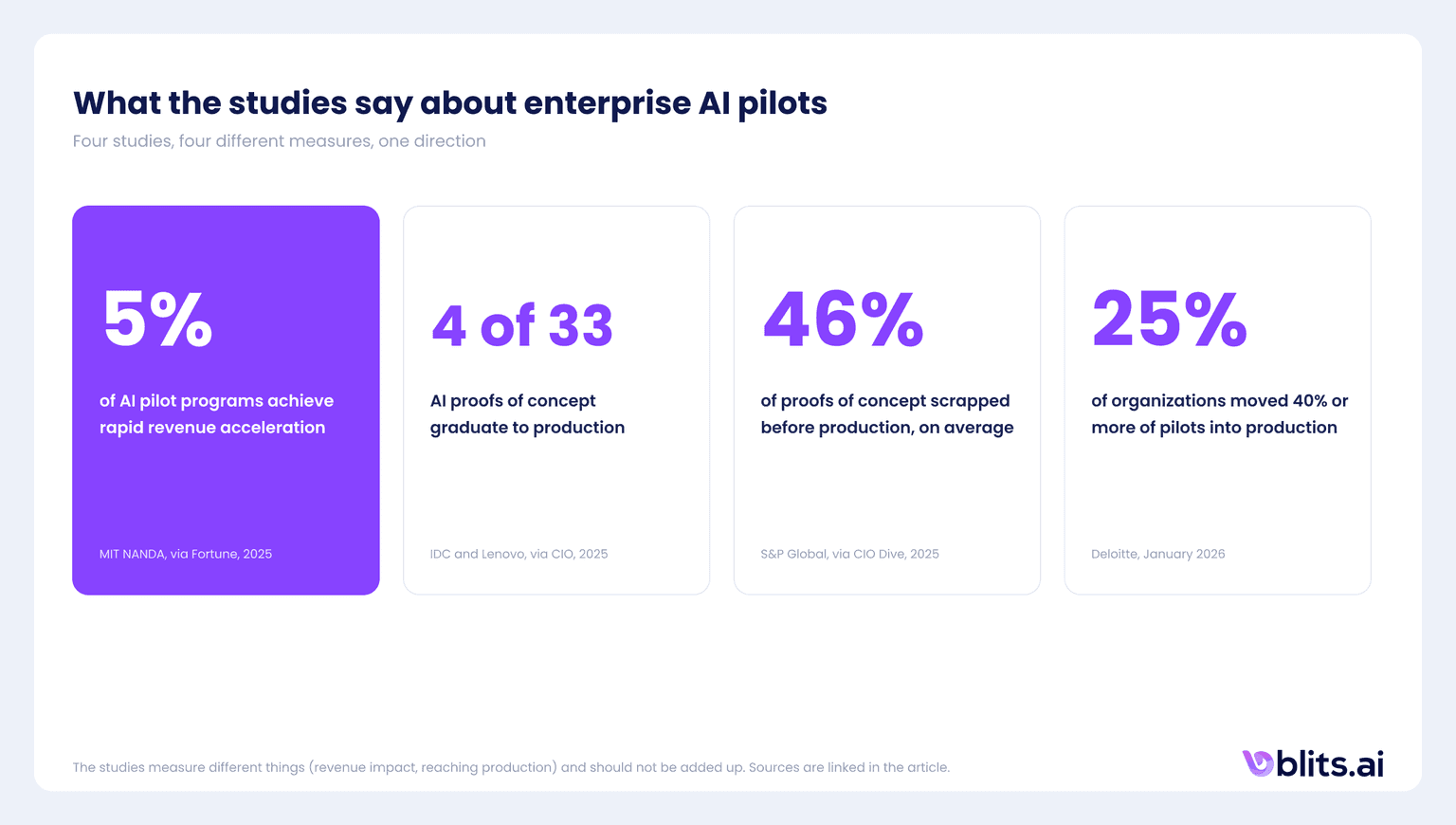
MIT's NANDA initiative published The GenAI Divide in August 2025. As Fortune summarized it, about 5 percent of AI pilot programs achieve rapid revenue acceleration, and the vast majority stall. S&P Global Market Intelligence found that the share of businesses scrapping most of their AI initiatives rose to 42 percent, up from 17 percent a year earlier, and that the average organization scrapped 46 percent of its proofs of concept before they reached production. IDC, working with Lenovo, counted it per project: for every 33 AI proofs of concept a company launched, only four graduated to production.
You could say that was 2025 and things have moved on. A little. In Deloitte's State of AI in the Enterprise report from January this year, only 25 percent of respondents had moved 40 percent or more of their AI pilots into production. And in a Gartner survey of more than 2,000 CIOs published this October, only 13 percent said their organization had realized significant or transformational value from AI. My favorite number from that survey: just 31 percent have rules for stopping an unsuccessful pilot. So most companies can't get pilots into production, and can't kill them either. They just sit there, costing money.
One caveat, because I care about using numbers properly. These studies don't all measure the same thing. MIT looks at revenue impact, S&P and IDC at reaching production, Gartner at value. Don't add them up. They do all point the same way, and it matches what I see in meeting rooms.
If you watch the animation on our home page for a minute, you'll see pilots stall one after another, each with a reason next to it. We didn't pick those ten reasons for effect. They are the ones we keep running into when an organization tells us why an earlier AI project stopped. When corporate AI implementation failure comes up in a boardroom, the model usually gets the blame. In the stories we hear, the model is rarely the reason.
I'll group them, because they come in families.
"Never left the sandbox", "no back office integration" and "missing functionality" are the same story. A pilot that answers questions from a few uploaded PDFs is quick to build and looks great in a steering committee. Then someone asks whether it can block the card, change the address or look up the real order, and the answer is that this was out of scope for the pilot. The integration with the core systems was always going to be most of the work, and it was postponed to a phase that never got funded.
"Stuck in security review" and "blocked by compliance" kill more pilots than any model limitation. I've said before where the time in an enterprise AI project goes: roughly 20 percent technology, 20 percent customization and 60 percent approvals and stakeholders. A pilot that skips that 60 percent only moves it to the end, where it shows up as a full stop. The CISO sees the architecture for the first time when you ask for a production go ahead, and discovers that customer data goes to a model in another region, with no audit trail and no answer to who approved what.
"Running costs unknown" and "out of budget". A pilot runs on a credit card and a few thousand conversations. Production means a few hundred thousand, with voice, guardrails and retries on top. If nobody can say what an interaction costs at that volume, finance will say no, and finance will be right. Gartner predicted back in 2024 that at least 30 percent of generative AI projects would be abandoned after proof of concept, and escalating costs and unclear business value were two of its four reasons.
"Failed QA" and "data not ready". Everyone in the pilot team feels that the assistant is good, and a feeling is not something you can hand to a risk team. When they ask how often it gives a wrong answer about fees, and the answer is "we tried it a lot and it seemed fine", the project is over. Usually the knowledge behind it is the weak spot: three versions of the same policy, one of them from 2021, and the assistant picks the wrong one with total confidence.
The last one is the most human. A pilot belongs to one enthusiastic director. That director gets promoted, reorganized or headhunted, and what stays behind is an experiment without an owner and without a line in anyone's budget. A system in production has an owner by definition, and that is one more reason to get there quickly.
A pilot shows that AI can do something once. Going live means running it every day and being able to explain it to the regulator.
Now the second half of the sentence. I'm not claiming we are smarter than everyone else. We are a platform company that has delivered more than 100 use cases, many of them for banks, and we have organized the way we work around the ten reasons above. In plain terms it comes down to this.
We start with the production requirements. Before anyone writes a prompt, we want to know where it will run, which systems it must talk to, who has to approve it and what it has to prove. It sounds slow, and it turns out to be the fastest route, because nothing has to be rebuilt later. A first use case typically goes live within weeks, and the second one reuses the integrations, the guardrails and the approvals of the first.
It runs where your security team wants it to run. In our managed cloud, in your own cloud or on premises, with the model you choose. That takes the hardest security discussion off the table before it starts. For customers who want cloud models but can't let personal data leave, there is the privacy shield. The platform is certified for ISO 27001, ISO 42001, SOC 2 Type II and PCI DSS Level 1, which doesn't replace your own review but shortens it considerably.
The agent does real work in real systems. Agents act through tools connected to your core systems, with a permission per tool. A refund above a limit waits for a colleague. Everything an agent decides is in a decision log your auditors can read. I described those controls in Agents That Ask, Remember and Show Their Work.
Quality is measured, every release. Each use case gets a test suite with the questions that matter, including the nasty ones. A change to an agent can be set to go live only after those tests pass. So when risk asks how you know it works, you show a report.
You know what an interaction costs before you scale. Usage is metered per assistant and per model, so the business case is built on measured numbers from your own traffic.
We stay. Platform plus people. Our team designs, builds, runs and improves the agents with yours, so the project doesn't depend on one sponsor's enthusiasm or on three scarce engineers you'd have to hire first.
None of this is exotic, and most of it is boring in the good sense of the word. What separates a pilot from a production system in enterprise AI is integration, approval, proof and ownership far more often than the model, and you can plan for all four from day one.
One more thing, because the word gets stretched. For us a use case is live when real customers or employees use it for real requests, when it is connected to the systems it needs, when it runs under your security and compliance rules, and when somebody owns its numbers. A chatbot on an internal test page with ten friendly users is a pilot, however long it has been running.
If your enterprise AI strategy lists a handful of initiatives and you want to know where each one stands, ask four questions about each of them. Which system does it change something in? Who signed off on it? What is its pass rate on a fixed test set? Whose budget pays for it next year? Four clear answers and you are in production. Blanks, and you know what to work on.
We make the same offer to everyone, and it's on the home page too: bring the use case that matters most to you, we show you a working version first, and then we put it into production. Preferably one that already got stuck somewhere, because those are the most fun.
Our AI Use Case Library shows what organizations like yours already run in production, with sources. And if you want to talk through a pilot that isn't moving, send me a message. I'll tell you which of the ten it is.