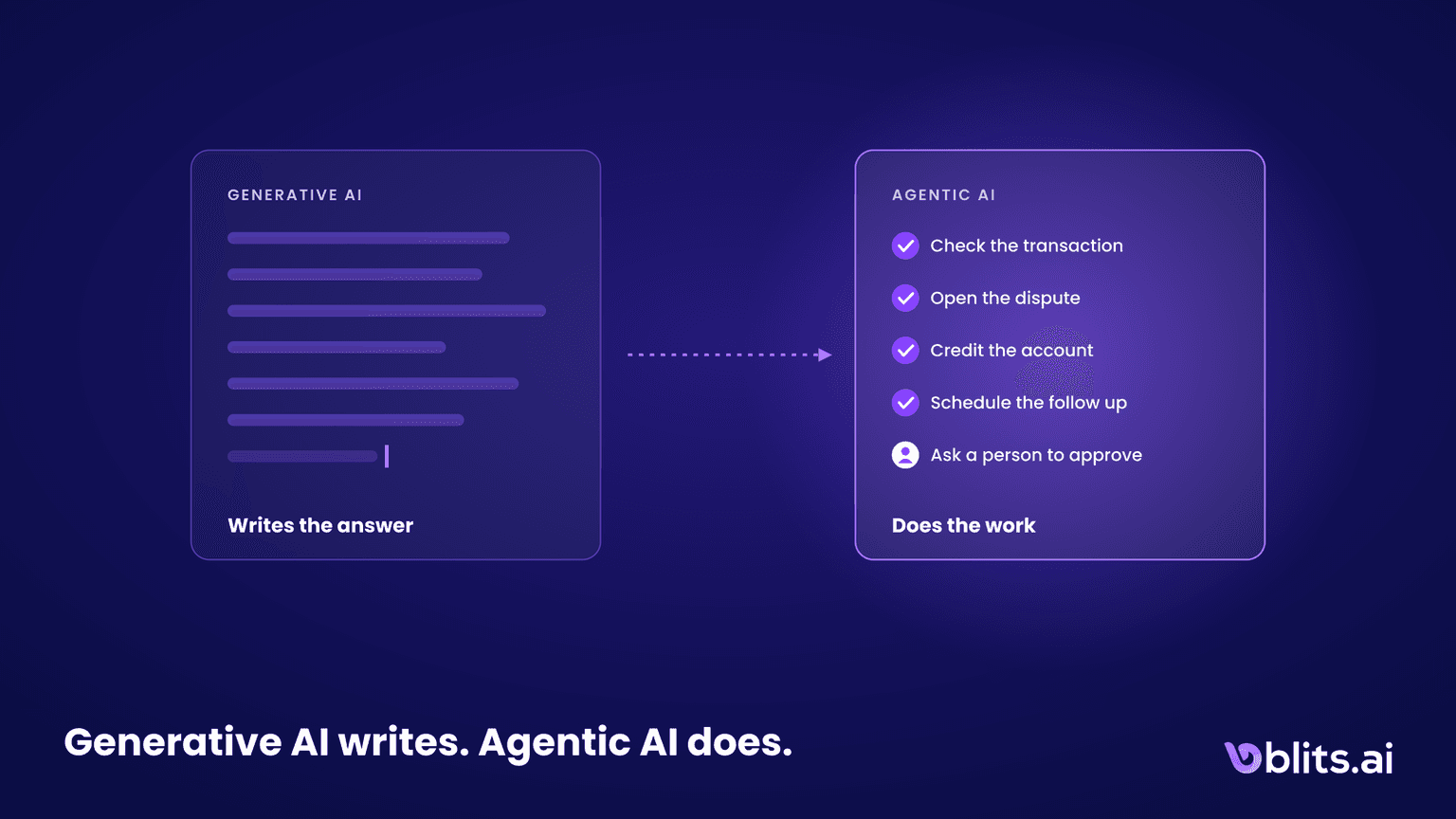
Put agentic AI vs generative AI side by side and the difference is simple: generative AI writes, agentic AI does the work. Generative AI produces content when you ask for it: an answer, a summary, an email, a piece of code. Then it stops and waits. Agentic AI works toward a goal: it plans the steps, uses your systems, checks the result and keeps going until the job is done or a person has to decide. IBM puts it in two lines: generative AI "generally responds to an input and waits for further direction," while agentic AI "focuses on achieving a goal."
Often it's the same model underneath, and almost everything around it changes.
A customer writes to her bank: "There's a payment of 349 euros on my card that I don't recognize."
With generative AI, the bank's assistant writes a friendly, accurate reply. It explains how to dispute a transaction, links to the form and suggests blocking the card. That helps, but the customer still has to do all the work.
With agentic AI, the assistant checks the transaction, sees it's an online purchase from a merchant she's never used, asks her to confirm she didn't make it, blocks the card, opens the dispute, books a provisional credit within the limits the bank allows, orders a new card and schedules a follow up for when the merchant responds. A person approves anything above a threshold. The customer is done in two minutes.
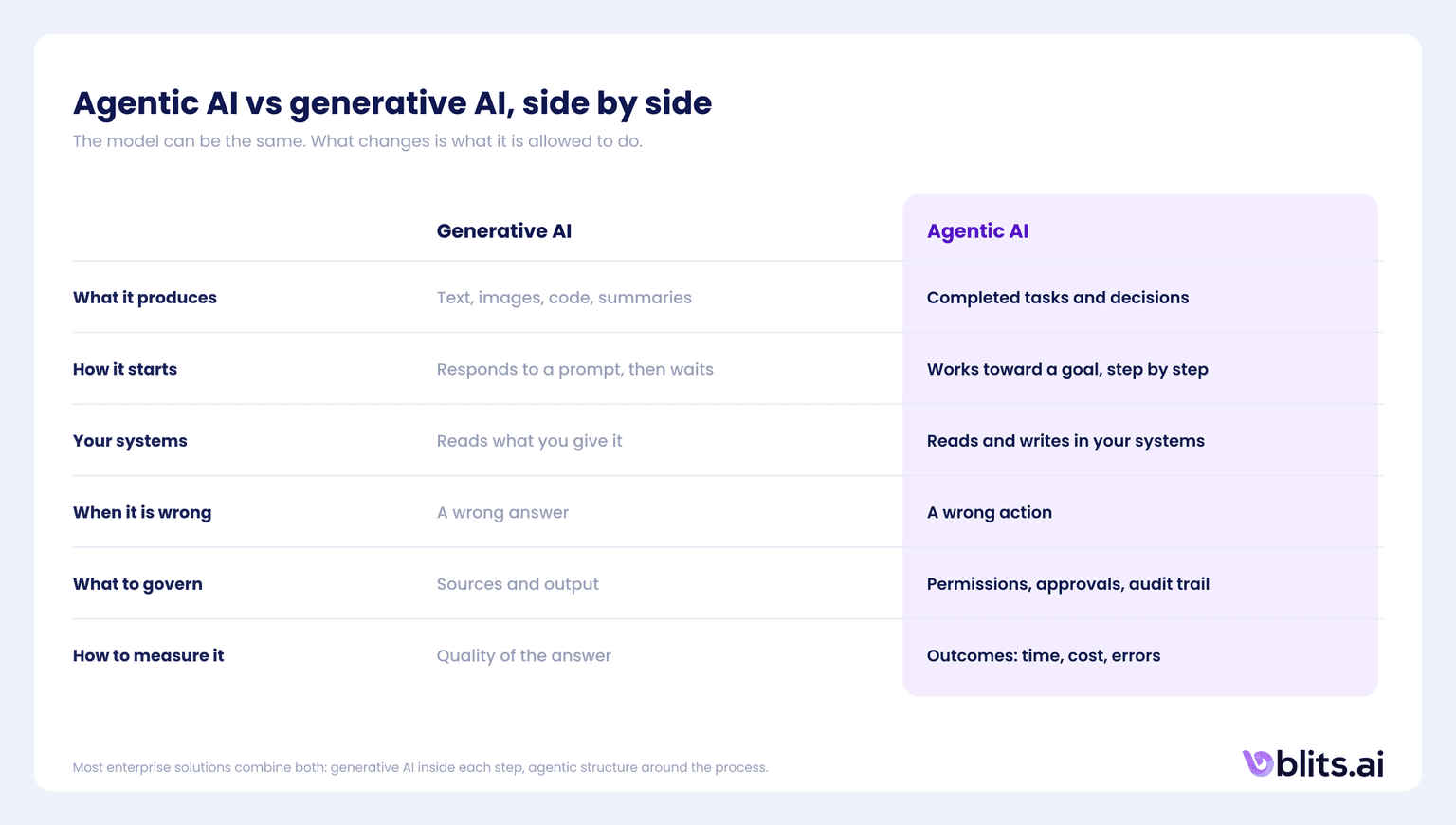
Same question, same model. The difference is that the second one is allowed to act, and an AI that acts can also act wrongly.
When generative AI is wrong, you get a wrong answer. Annoying, sometimes embarrassing, occasionally costly. When agentic AI is wrong, you get a wrong action: money moved, a card blocked, a claim rejected, a customer record changed. That changes the whole conversation about risk.
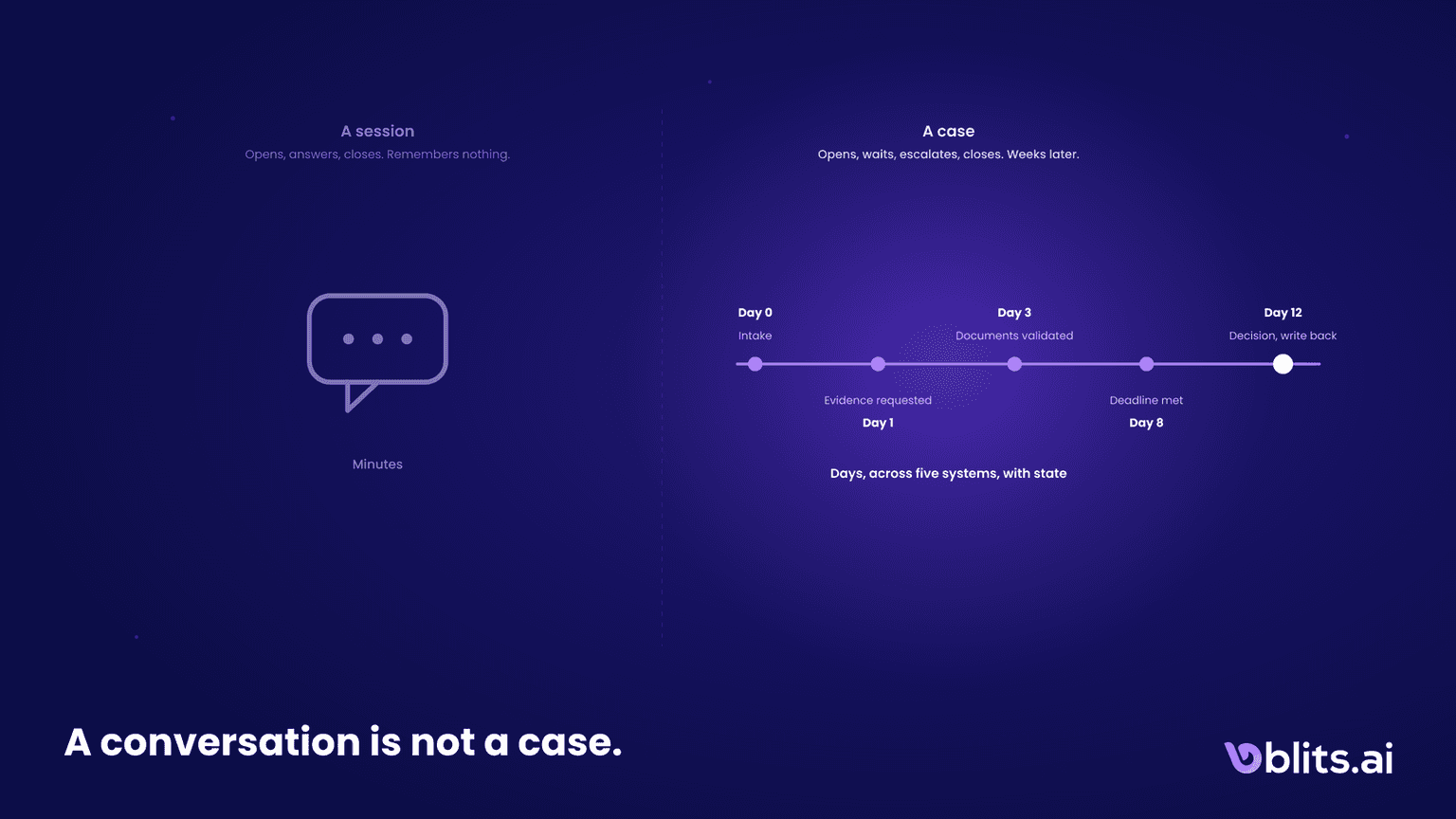
That is why agentic AI needs things a chatbot never needed: permissions per action, approvals for consequential decisions, a memory that lasts longer than one conversation, and an audit trail that shows exactly what happened and why. I wrote about that difference in A Conversation Is Not a Case: a chatbot handles a session, an agent handles a case.
When generative AI is wrong, you get a wrong answer. When agentic AI is wrong, you get a wrong action.
Few organizations get past the experiments.
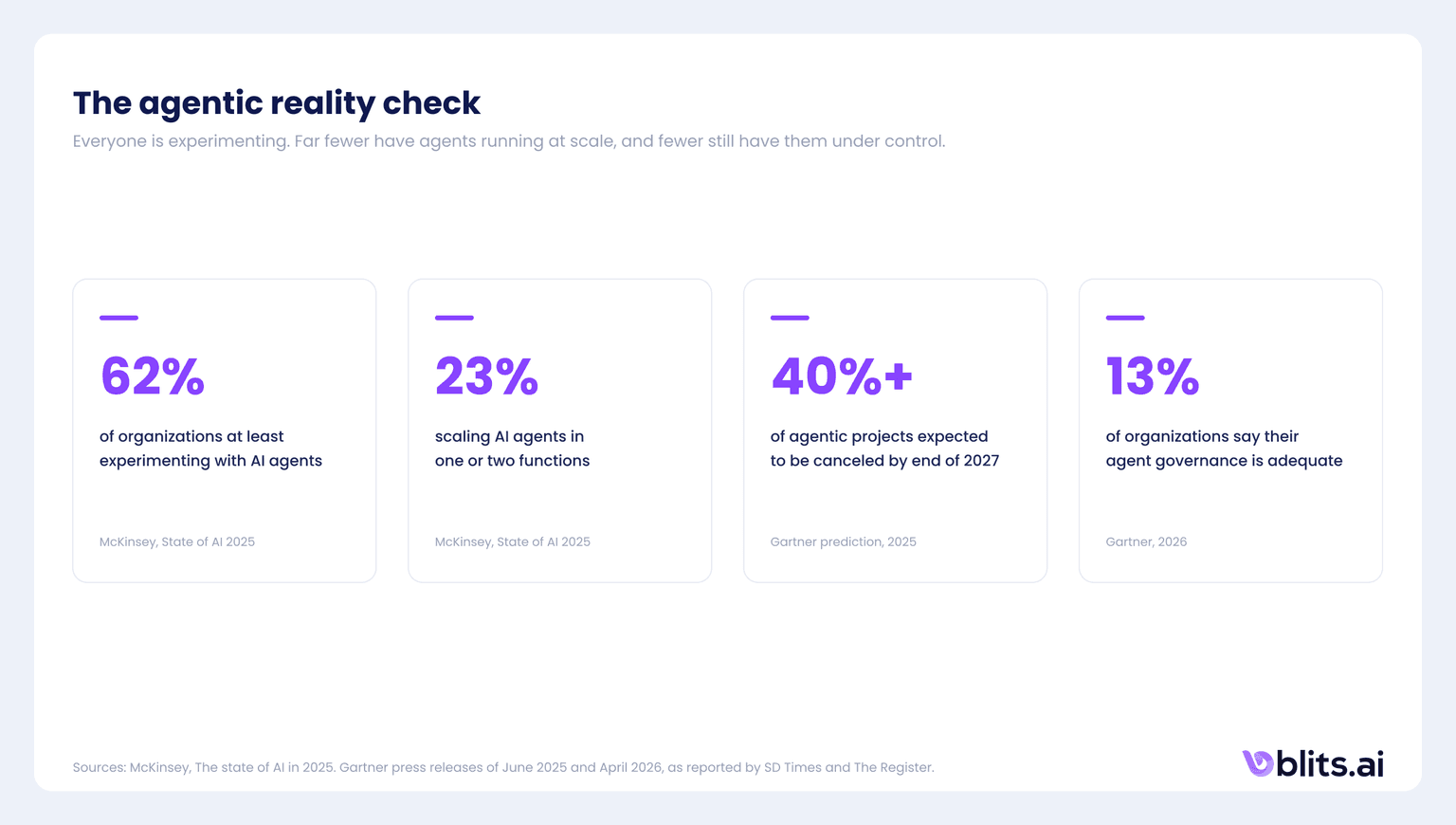
McKinsey found that 62 percent of organizations are at least experimenting with AI agents, while 23 percent are scaling them in one or two functions. Deloitte's research shows that just 11 percent are actively using agentic systems in production. And Gartner predicts that by the end of 2027, more than 40 percent of agentic AI projects will be canceled, because of escalating costs, unclear business value and inadequate risk controls.
Gartner had another line in that same release that I enjoyed: of the thousands of vendors selling "agentic AI," it estimates only about 130 are real. The rest are doing what Gartner calls agent washing, putting a new label on an old chatbot. Is your vendor one of the 130? Ask them to show you an agent that acts in a real system, with real permissions, and an audit log. Don't accept a slide, ask for the log.
The public record tells a different story from the surveys, because the organizations that publish are the ones that made it work. In our AI Use Case Library, 61 percent of the 1,705 public deployments we track belong to use cases where the AI finishes the job instead of handing it back to a person. Among the deployments documented in 2025, it was 62 percent.
One of my favorite examples is BNY. In its quarterly update for early 2026, the bank reported about 220 enterprise AI solutions in production and about 140 digital employees. Forrester described how BNY built that digital workforce: AI agents with logins, email addresses and human managers, each one scoped, monitored and fully auditable. That is an operating model, not a demo.
What makes it work is least privilege access, a named human manager for every agent and a log of every action. That is dull, and it is also the difference between the 23 percent and the 40 percent.
Gartner expects the average Fortune 500 company to run more than 150,000 AI agents by 2028. In the same research, only 13 percent of organizations said they have the right governance in place. That is 150,000 agents and almost nobody ready to manage them.
That's why I keep repeating the same message to every bank we work with: governance is the product, not the paperwork that comes after it. Guardrails, a model inventory, a human on every consequential decision and an audit trail. Configure it once, and every agent you add inherits it.
Both. Use generative AI where the output is content: drafting, summarizing, searching your knowledge, answering questions. Use agentic AI where the output is a completed task across your systems: a dispute, an onboarding, a claim, a KYC refresh. The best solutions combine them: generative AI does the reading and writing inside each step, and agentic structure runs the process around it.
My advice: don't start with the question "generative or agentic?" Start with "what job should be done, and who decides at the end?" The answer tells you how much autonomy the AI needs, and how much governance it needs to earn it.
You can read how our agents work, or ask for a demo and I'll show you an agent with its log.