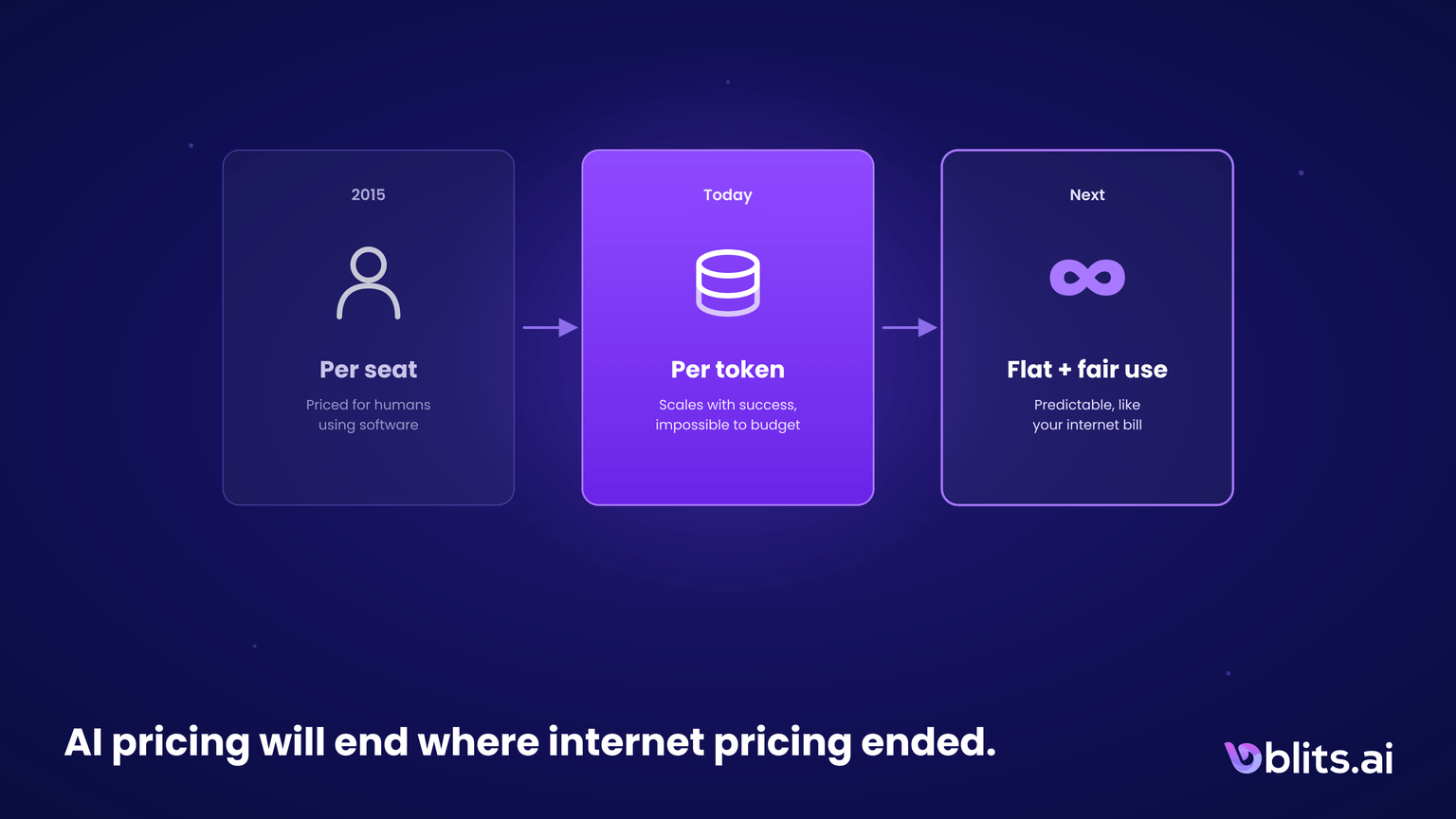
The best conversation I had at VivaTech this year wasn't about a model, a demo or a use case. It was with an executive from a global brand, standing next to the coffee, about a question that sounds boring and is anything but: how is any of this actually going to be priced?
Not the vendor pitch version of that question. The CFO version. His company, like every large company right now, is signing AI contracts denominated in units nobody in the building can forecast. We ended up agreeing on two things within five minutes. The SaaS license model served the last decade well, but it is not obvious it fits a world of agents that consume tokens continuously. And token pricing has a structural flaw you feel the moment usage scales: the cost scales with it, in a way no one can budget for.
That conversation has been rattling around my head ever since, because I have some version of it every month now. So here's my attempt to write it down properly, including where I think it ends: in the same place your internet bill ended.
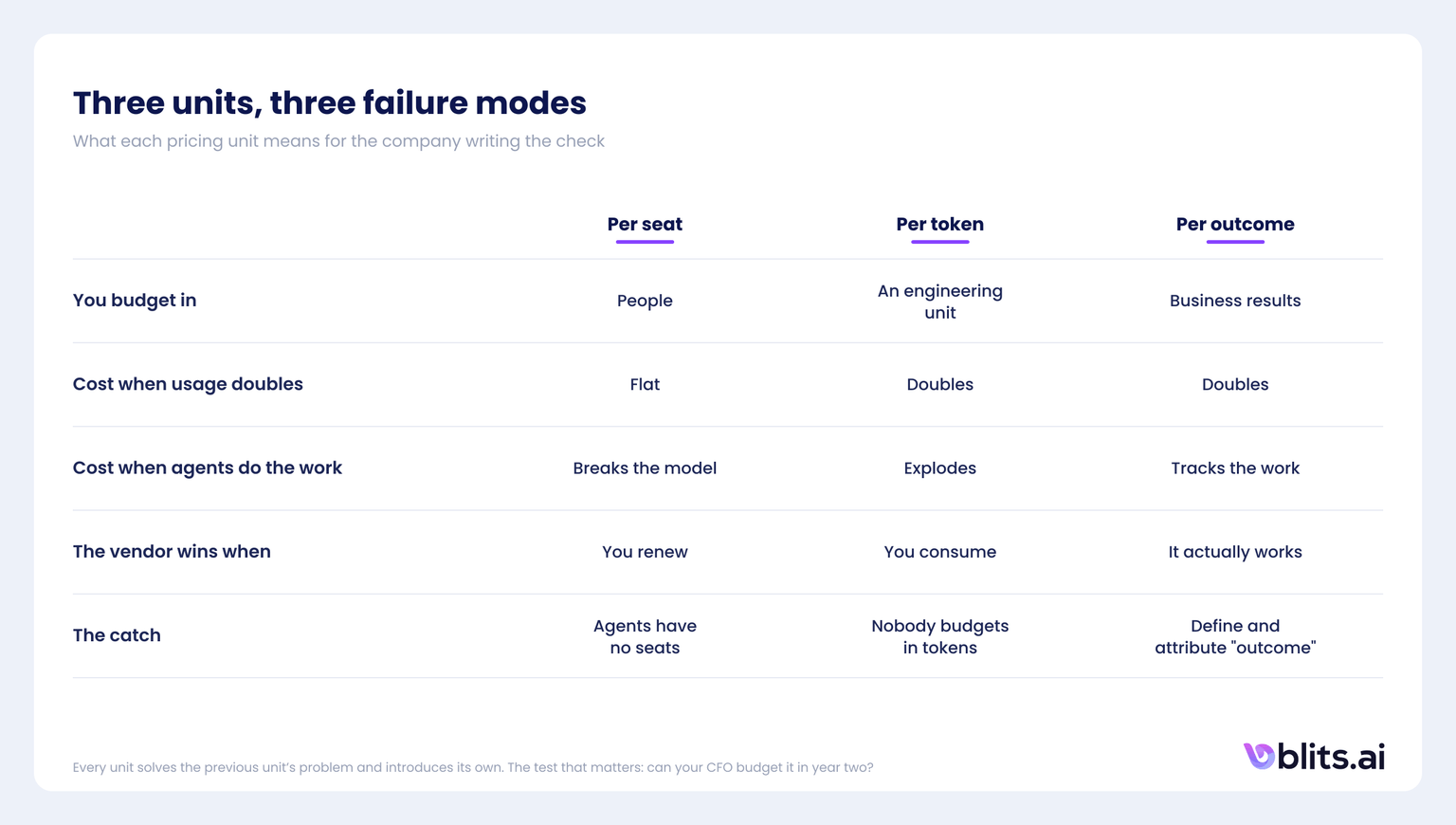
Per seat pricing worked because the unit matched reality. Software was a tool a person used, so you paid per person. Everyone could count seats, forecast seats, and cut seats. The unit was legible to finance, which is an underrated property: the most important feature of any pricing model is that the person approving the budget understands what they're buying.
Agents break the seat in both directions at once. Buy one seat and run a thousand agents behind it, and the vendor is subsidizing your automation. Replace twenty human seats with two agents, and the vendor's revenue model just evaporated, which is precisely why no vendor will sit still while that happens. The seat assumed a human in a chair. There is no chair anymore.
The API world's answer is the token: pay for exactly what you consume, perfectly fair, perfectly granular. As an engineering unit it's honest. As a business unit it's a disaster.
First, nobody outside the engineering team knows what a token is, let alone how many their customer service department will need in Q3. Second, the bill is a function of success. The better your assistant performs, the more customers use it, the more you pay: growth and cost arrive in the same envelope. Third, the unit itself is unstable. A reasoning model can burn many times the tokens of a fast model on the same question, by design, because it thinks before it speaks. An agent that loops through tools multiplies that again. Your finance team is being asked to budget a number that depends on model choice, prompt design, customer mood and the phase of the moon.
A CFO can budget people, conversations and outcomes. Nobody budgets in tokens.
The vendor pitch says the underlying cost of intelligence is collapsing. On paper, it is. Andreessen Horowitz calls it LLMflation: at equal quality, the cost of LLM inference has been dropping roughly tenfold every year, and running a GPT-3 class model today costs about a thousand times less than it did in 2021.
Now look at the last twelve months on an actual invoice. Nobody buys equal quality. Everyone buys the newest frontier model, and the newest frontier models are getting more expensive, not less: Google's newest Gemini Pro tier launched above the tier it replaces, with input up sixty percent and output up twenty. The new generation also thinks by default, burning a multiple of the tokens per answer that last year's models did, so your cost per answer can rise even while the price per token falls. And the escape route closes behind you: last year's cheap models are being retired by the dozen, 62 model versions with a shutdown date this year alone, so you migrate to the pricier successor whether you asked to or not.
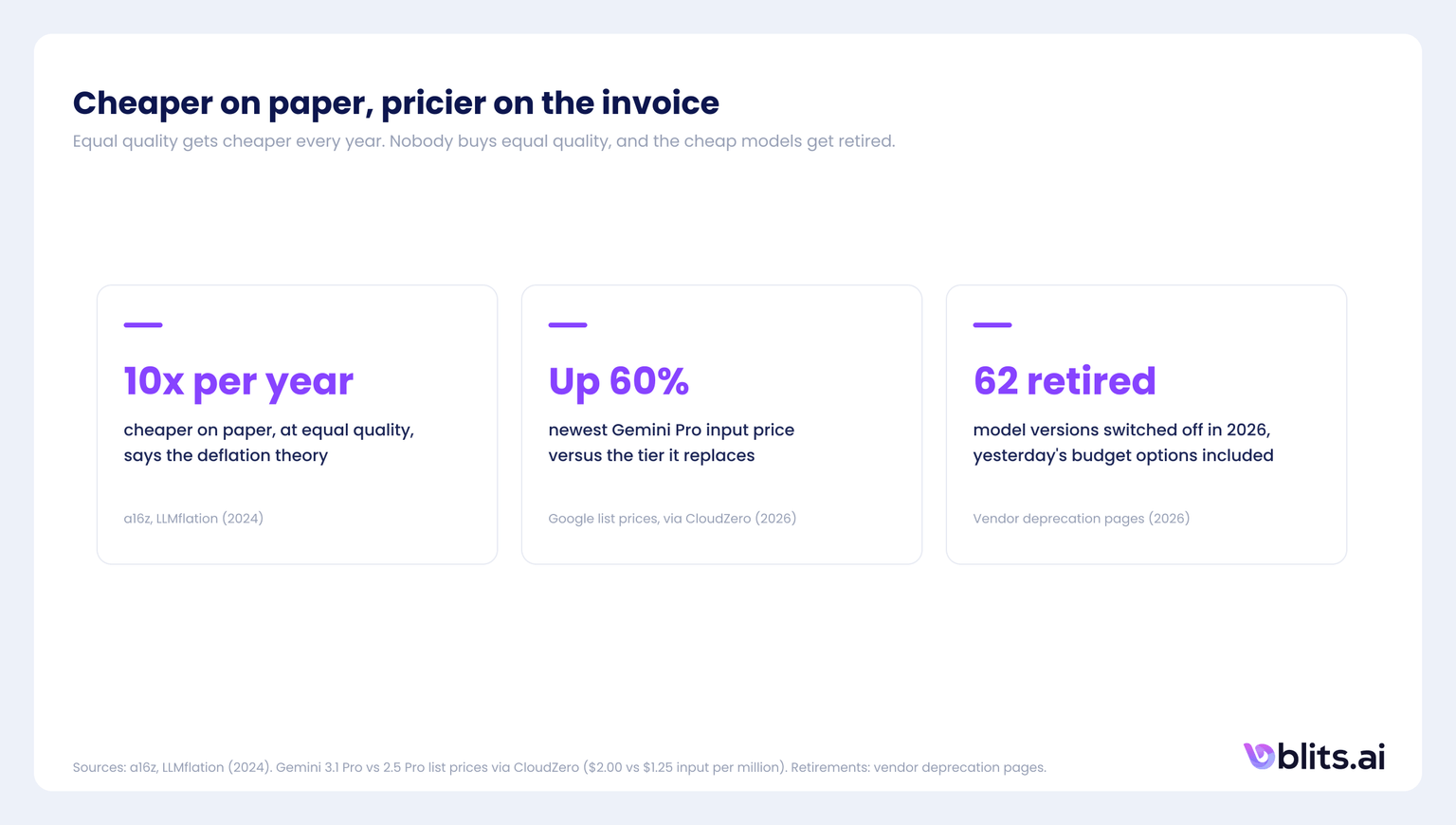
So both things are true at once, and your contract needs to survive both. The deflation is real at constant quality, but an invoice doesn't buy constant quality, which means the deflation has to be engineered rather than assumed: route every question to the cheapest model that passes the test suite, reserve the expensive thinkers for the questions that genuinely need them, and re evaluate the whole stack every time the market moves. On a market where comparable models differ up to 38 times in price on a single day, that routing pays for itself many times over. And when a vendor's underlying cost does drop, the uncomfortable question stands: where does that money go?
To the credit of the industry, nobody is pretending the old model still works. The experiments are happening in the open, and they're instructive.
Intercom prices its Fin agent at $0.99 per resolution: you pay when the AI actually resolves a customer conversation. That's a real attempt to price the outcome instead of the input, and I respect it. Note what it doesn't solve: resolutions scale with adoption too, so the bill still grows with success. It's just that now you're at least paying for something the business recognizes as valuable.
Salesforce launched Agentforce at $2 per conversation, and then discovered what every early mover discovers: buyers couldn't model it. What counts as a conversation? What if one customer question triggers eight agent actions? Within a year the pricing was revamped into three parallel models: per conversation, prepaid flex credits, and a classic per user license. Three units, sold side by side, for the same product. I don't quote that to mock it. I quote it because it's the most honest signal in the market: even the biggest SaaS company on earth doesn't know yet what the right unit is.
And then there's the "digital worker" framing: price the agent like an employee, with a monthly salary. It demos beautifully in a board meeting, but look closely and the seat just walked back in wearing a costume. Software that works around the clock, priced per worker, reintroduces exactly the arbitrage the seat model died of.
Every one of these experiments solves the previous model's problem and imports a new one. That's not failure. That's a market searching for a unit, in real time.
We run AI in production for large enterprises, so we don't get to treat this as a thought experiment. Four principles have survived contact with our customers' procurement departments.
Price in units the business already budgets. Conversations, use cases live, documents processed. If a number can't go into next year's budget spreadsheet without a translation layer, it's the wrong number. Tokens are our cost, not the customer's unit, and keeping that translation on our side of the table is part of the job.
A ceiling is a feature. Every agent on our platform runs inside spending policies with hard caps, and the same logic applies to the AI bill itself. Uncapped exposure is not flexibility. It's risk that finance will eventually find, price, and hold against the whole program. The moment agents started spending money on their own, budget controls stopped being a pricing detail and became a governance requirement.
Engineer the unit cost down, continuously. Because the platform is model agnostic, every use case runs on the cheapest model that passes its test suite, and gets re evaluated when prices move. That's how LLMflation becomes your discount instead of your vendor's margin: the routing does the work, and the test suite proves nothing broke.
Align the incentive with the outcome. We've written before about why we're neither a SaaS vendor nor an integrator. Pricing is where that positioning becomes concrete: a model where the vendor earns most when use cases run live in production is the only one where nobody has to watch the meter with suspicion.
If you're negotiating one this quarter, put these on the table:
- In what unit will I budget this in year two? If the answer contains the word tokens, ask again.
- When the model behind my use case is retired and its successor costs more, whose problem is that? By default it's yours. It should be the vendor's, in writing.
- What does the vendor earn when the AI fails? If revenue is identical whether the agent resolves the case or fumbles it, you've learned something about where the risk sits.
We've seen this movie before, and I'm old enough to remember the opening scene. Internet access started metered: guilders per minute over the phone line, then data bundles priced per megabyte in the early DSL years. Every provider swore metering was the only sustainable model, right up until someone offered unlimited access for a fixed monthly fee with a fair use policy. Within a few years the metered internet was dead. Not because bandwidth became free (it didn't), but because the provider was better placed to carry the volatility than the customer, and predictability turned out to be the product people were actually buying. Today nobody pays per megabyte, with one exception: roaming. That's what a pricing unit looks like when it's kept alive for margin instead of logic.
I'm convinced AI pricing ends in the same place: a fixed amount per use case or per capacity tier, a fair use policy for the extremes, and the vendor carrying the volatility. It's the only end state where the CFO can budget, where success stops being punished, and where the vendor is forced to do what we do anyway: keep engineering the unit cost down with routing and right sizing, because every efficiency gain is now the vendor's problem and the vendor's reward. Tokens will still exist the way megabytes still exist, as the vendor's cost accounting. They just won't be your bill.
Nobody pays per megabyte anymore. Soon nobody will pay per token.
The per seat license wasn't handed down on a stone tablet. It was an answer to how software was used in its era, and it lasted exactly as long as the era did. The companies signing AI contracts today shouldn't wait for the market to settle. Demand the flat end state now, or at the very least a cap, a fair use clause, and the deflation on your side of the table.
And if you'd rather have this conversation over coffee than in a comment section, let's talk.