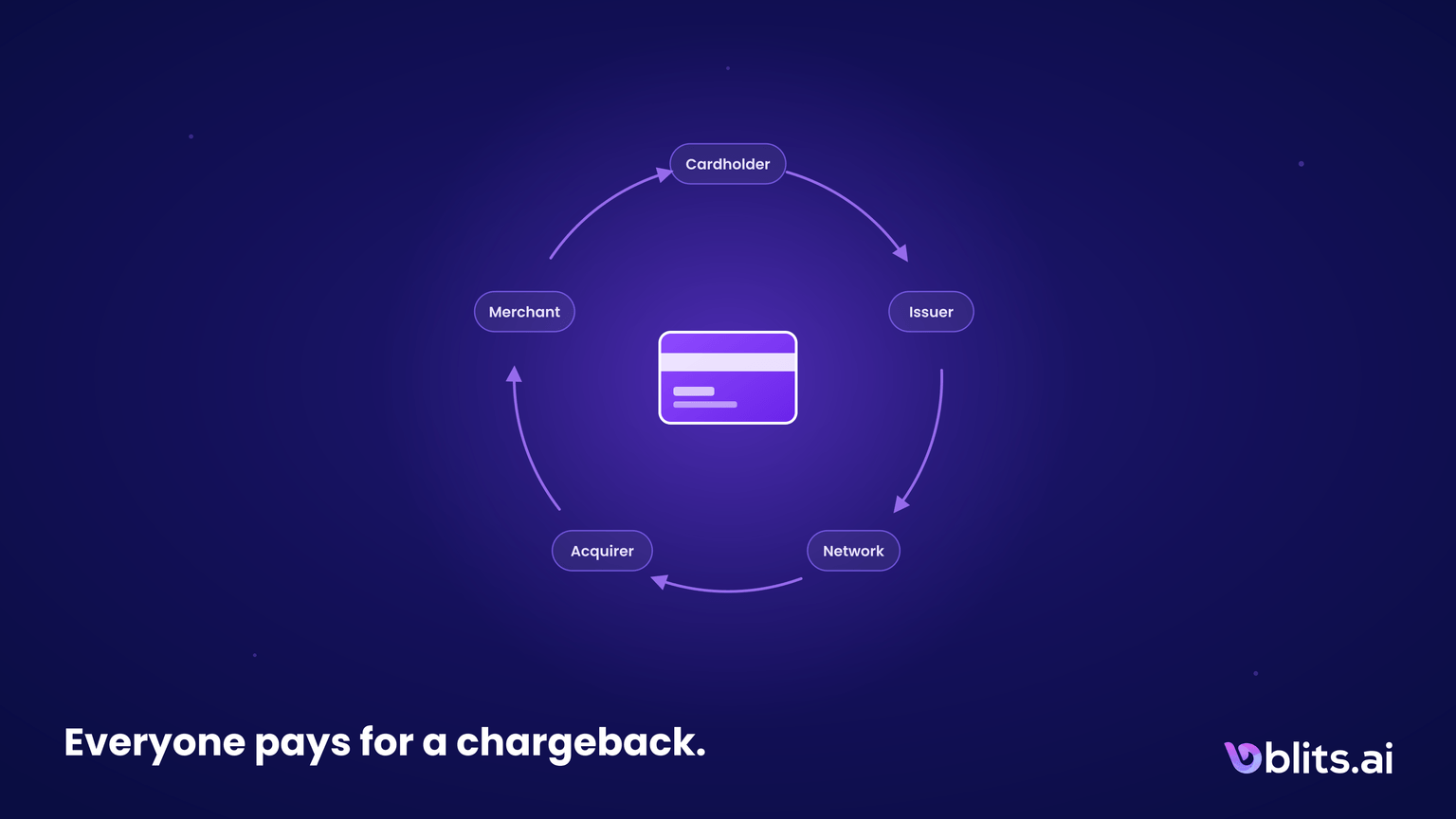
Chargebacks rarely make the agenda of an AI strategy meeting. They should. For card issuers, acquirers and merchants, disputes are a cost line, an operations burden and a customer experience problem at the same time, and the volume keeps growing.
In this article I'll look at why dispute volumes are rising, why most disputes are not fraud at all, and how the dispute lifecycle breaks down into six jobs that AI can take over today. For each job I'll also cover what needs to be governed, because in payments that is where projects succeed or fail.
Key message: most chargebacks are a communication failure. Communication can be automated. Judgment cannot.
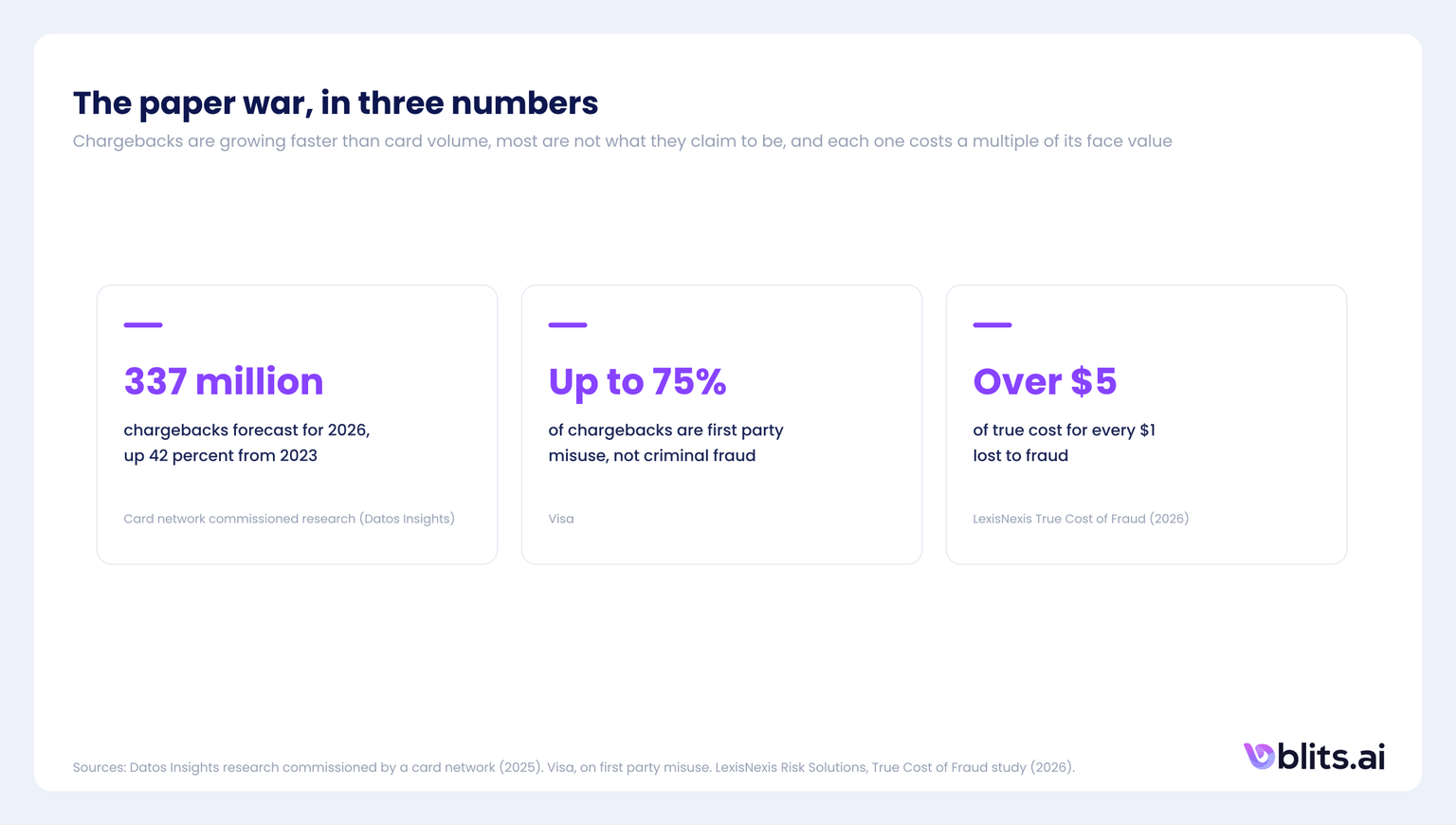
Research commissioned by one of the card networks projects that chargeback volumes will reach 337 million in 2026, up 42 percent from 2023. Visa estimates that up to 75 percent of chargebacks are first party misuse: real customers disputing real purchases, not criminal fraud. And the latest LexisNexis True Cost of Fraud study puts the total cost at more than five dollars for every dollar lost, once fees, labor, lost goods and churn are included.
Every party in the chain pays. The cardholder waits weeks for an answer. The merchant loses the sale, the goods and a fee. Issuers and acquirers staff large back office teams to exchange evidence with each other. Even a dispute that is won leaves everyone worse off than before it started.
If three quarters of disputes are first party misuse, most of the "fraud" pipeline is in fact a communication problem. A merchant descriptor the customer does not recognize. A subscription that renewed after a free trial. A family member who used the card. A refund that took too long, so the customer went to the bank instead of the merchant.
None of these involve a criminal. Yet each one becomes a formal, regulated case that runs for weeks the moment the customer taps "dispute this charge". Banking apps have made that tap very easy. The process behind it has hardly changed.
The card schemes recognize this, and their rules are moving toward evidence. Visa's Compelling Evidence 3.0 allows merchants to counter friendly fraud claims with prior purchase history, device data and delivery proof. That shifts what it takes to win a dispute: less argument, more data.
When you map the full lifecycle, it breaks down into six jobs. Each can be automated today, and each needs its own controls.
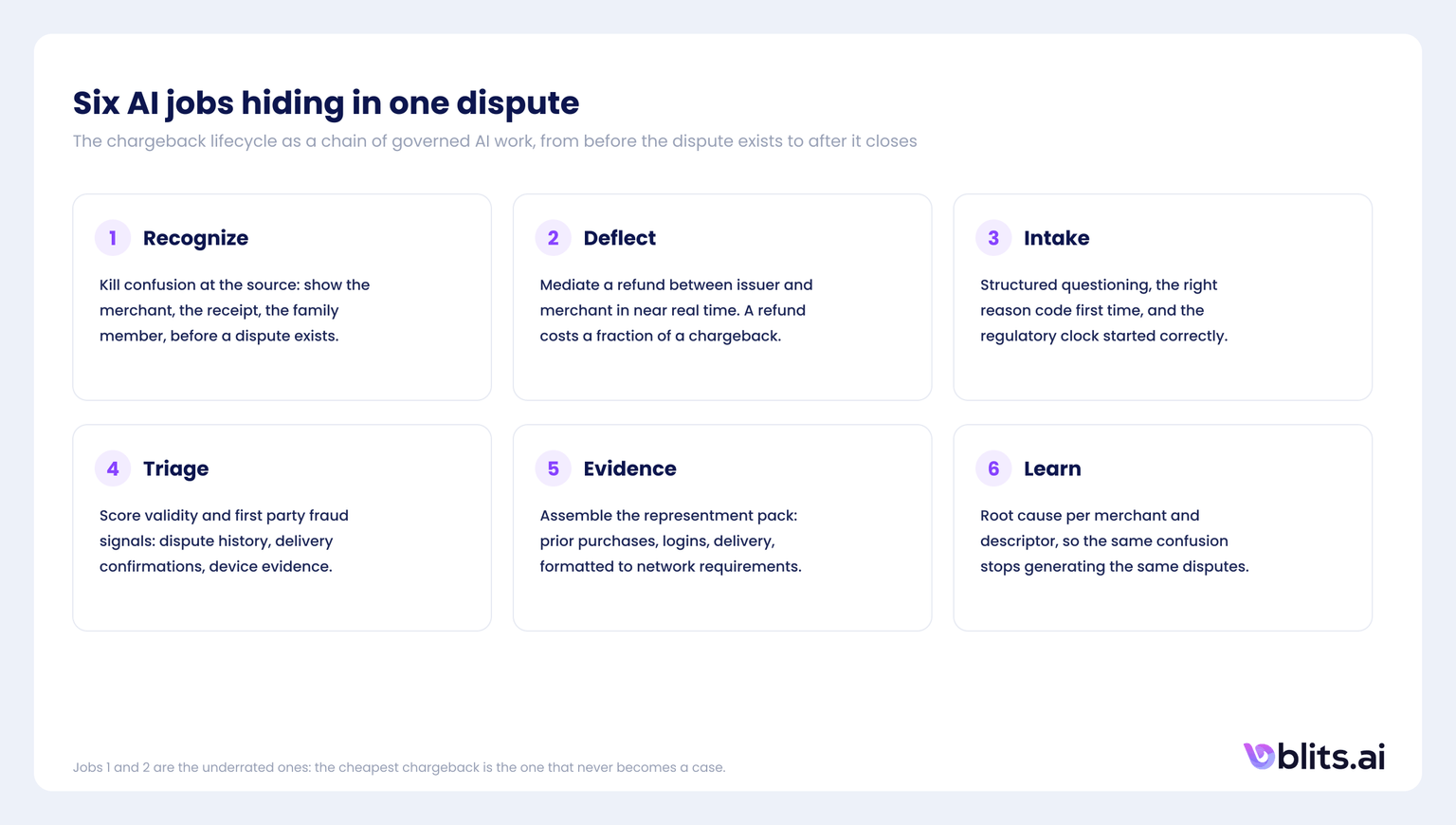
The cheapest chargeback is the one that never becomes a case. When a customer asks "what is this charge?", an assistant resolves the descriptor to a merchant name, shows the receipt and asks whether someone else in the household may have made the purchase. In our view this is the job with the highest return in the whole chain.
What to govern: answers come only from verified transaction and merchant data. The assistant never guesses who a merchant is.
When the customer does want their money back, a refund arranged between issuer and merchant in near real time costs a fraction of a formal dispute. The alert and mediation networks already exist. What is usually missing is the conversation that guides the customer to that outcome.
What to govern: the customer's right to dispute is never obstructed. Deflection offers a better option. It is not a wall.
If a dispute has to be filed, the quality of the intake decides much of the outcome. Structured questions get the reason code right the first time, record exactly what the customer claims and pick up first party signals. A wrong reason code at intake can lose a case months before anyone reviews it.
What to govern: the regulatory clock starts at the right moment, and the reason code logic is versioned so every decision can be traced back.
Not every dispute needs the same treatment. Scoring on dispute history, delivery confirmations and device data separates the clear cases from the ambiguous ones, so investigators spend their time on the cases that need judgment.
What to govern: no automated denials, and monitoring for bias. Which customers get the benefit of the doubt is exactly the kind of question a supervisor will ask.
On the merchant and acquirer side, representment is document work under deadline: prior purchases, logins and delivery confirmations, formatted to each network's requirements.
What to govern: only evidence the scheme accepts, and every document traceable to its source system.
Every closed dispute contains a lesson that is rarely used. Root cause analysis per merchant and per descriptor, fed back into descriptor fixes and merchant coaching, prevents the same confusion from producing the same disputes again.
What to govern: clear ownership for every root cause, so insights turn into changes.
Together these six jobs form a case, not a conversation. A dispute runs for weeks, touches several systems and ends in something an auditor can reconstruct. The same logic applies before a dispute even exists: a proactive confirmation call on a suspicious transaction today prevents a dispute next month.
Disputes run on deadlines that are set outside the organization. In Europe, PSD2 requires a payment service provider to refund an unauthorized transaction no later than the end of the following business day, unless it has reasonable grounds to suspect fraud and reports them to the authorities. In the United States, Regulation Z gives card issuers 30 days to acknowledge a billing error and two complete billing cycles, never more than 90 days, to resolve it. The card schemes add their own deadlines for every stage on top of that.
For AI, this has a clear consequence. Deadlines cannot live in a prompt or depend on someone remembering them. They have to be enforced by the system that runs the case, with escalation when a deadline comes close.
There is one development worth preparing for now. The card networks are introducing agentic payments: AI agents that shop and pay on behalf of a customer. The dispute infrastructure for those payments is not ready yet, and the industry has started to say so.
The reason is straightforward. A purchase made by an agent is, by definition, a purchase the customer did not make personally. The same confusion that drives most chargebacks today will occur far more often. And the consumer AI that makes purchases can also draft and file disputes.
Our expectation is that within two years a double digit share of disputes will be written by software. Manual dispute operations will not scale to that volume. The logical response is to run the six jobs above as governed cases, with automation handling the volume and people making the decisions.
The general governance rules for AI in banking apply here in their strictest form:
- A named person makes the final decision. An AI that denies valid disputes automatically is a compliance incident, not an efficiency gain.
- Deadlines are enforced by the system. Provisional credit and scheme timelines are hard constraints.
- Triage models are monitored. For accuracy, and for how they treat different groups of customers.
- Every step is logged. In a dispute the audit trail is more than compliance. As Compelling Evidence 3.0 shows, it is the evidence itself.
Chargebacks will not disappear. But the share that exists only because nobody explained a charge can shrink considerably, and the remaining disputes can be handled faster and with better evidence. If your team is working on dispute operations, we'd be glad to walk you through how these six jobs run on one governed platform. You can reach us here.