A brief landed on my desk this quarter that I can't show you, but I can tell you what it asked for: six hundred thousand outbound calls a month. By AI. In the customer's own language and dialect, from a local number, at a scale no human sales floor could touch. Average call length three minutes, which works out to 1.8 million voice minutes a month.
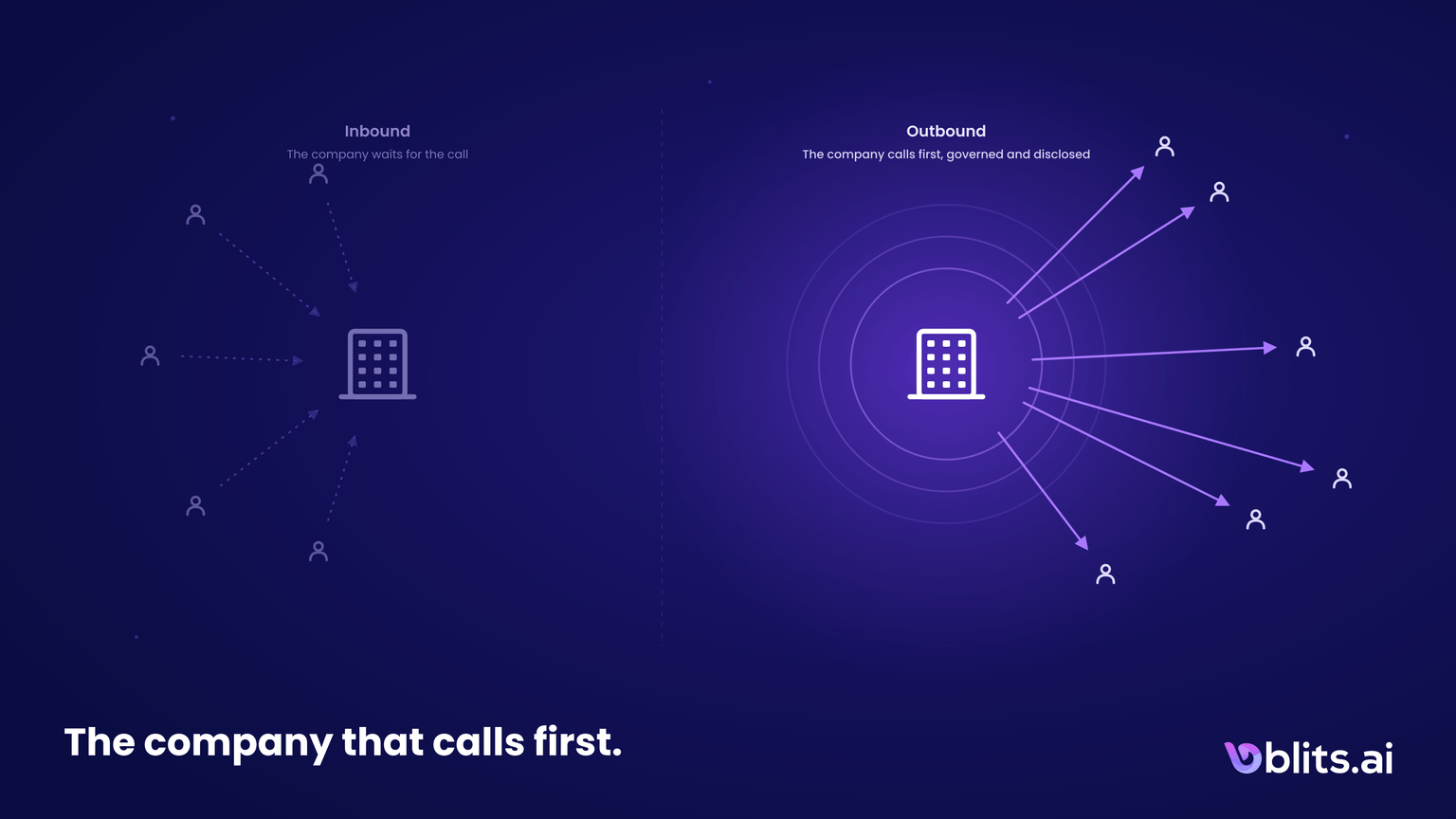
That particular brief happened to come from a financial group. But strip the product names off and nothing about it is banking specific. Swap the accounts and cards for data bundles and it's a telco winning back churners. Swap them for policies and it's an insurer at renewal time. For a utility it's the smart meter appointment, for an airline the disrupted booking, for a dealer network the service that's due. Ten years of enterprise AI has been almost entirely about the other direction: the customer calls, the AI answers. Deflection rates, handle times, self service. That work is real, but it shares one assumption so deep nobody says it out loud: the customer moves first. The most interesting briefs we now get drop that assumption. The company calls first.
Companies used to call their customers. Then the economics collapsed. Gong analyzed 300 million cold calls and found the average rep connects with 5.4 percent of prospects and needs 19 dials for a single real conversation. On the receiving end, Pew found that 80 percent of Americans simply don't answer calls from unknown numbers. Paying a salaried human to lose that lottery all day stopped making sense, so outbound retreated to the one place desperation kept it viable: collections.
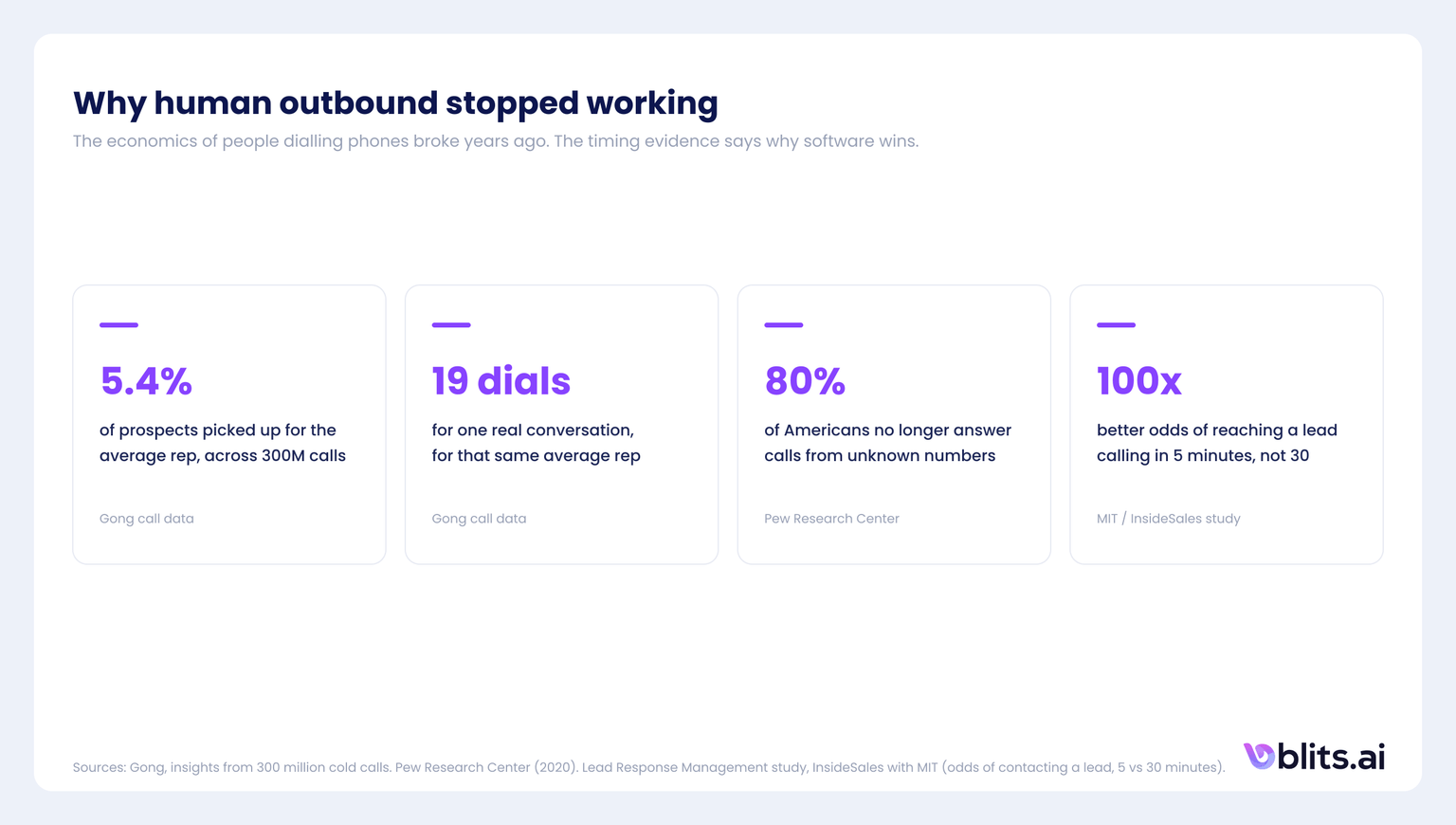
Here's what makes that collapse interesting: the value of the call was never the problem. The timing was. The classic MIT and InsideSales study found the odds of reaching a lead are 100 times better when you call within five minutes instead of thirty, and Harvard Business Review's follow up showed firms that responded within an hour were seven times likelier to qualify the lead than those an hour slower. No human team can sit on every signal and dial within five minutes, around the clock, in four languages. Software can. That's the entire outbound thesis in two sentences: the moment finally has a worker who is always available at it.
This isn't theoretical, and the evidence is worth sorting by how much salt it needs.
Company owned numbers first. Insurer ICICI Lombard runs a million inbound and outbound calls a month through bots. DBS, in the most conservatively regulated industry there is, sends 45 million model picked proactive nudges a month to over five million customers, mostly in app today, and the natural next step is that the nudge talks. CommBank has flipped fraud work into outbound: tens of thousands of proactive alerts a day, and scam calls diverted into decoy bots. In B2B software, Salesforce reports its own SDR agent worked 43,000 dormant leads into $1.7 million of new pipeline in its first year.
Then the vendor cases, impressive but self reported, so treat them as direction rather than gospel: a lender using voice AI for collections reports delinquency cut from 35 to 17 percent with 88 percent of calls fully bot handled; a Concentrix program reports 150,000 extra calls handled without extra advisors and $4.45 million in promises to pay in its first month; a16z backed Salient has processed over a billion dollars in transactions for auto lenders. Collections is where outbound AI grew up, for the same reason human outbound retreated there: the economics forgive experimentation. What's changing is the direction of travel, from chasing money that's late to offering value on time. The shape repeats in every sector we talk to: the telco win back call, the policy renewal, the abandoned application, the missed delivery, the healthcare no show, the subscription about to lapse. Different products, same four steps.
And one cautionary tale, because the hype half of this market is real too: TechCrunch documented an AI SDR startup claiming customers it didn't have, with churn its own employees put at 70 to 80 percent. Volume without quality burns the very thing outbound depends on. Which brings me to the part I actually want to talk about.
An outbound AI call is not an inbound assistant pointed the other way. It's a different discipline, and the brief on my desk understood that better than most vendor decks I've seen. Its four step journey is worth showing in full, because every serious outbound program converges on the same shape, whatever the industry.
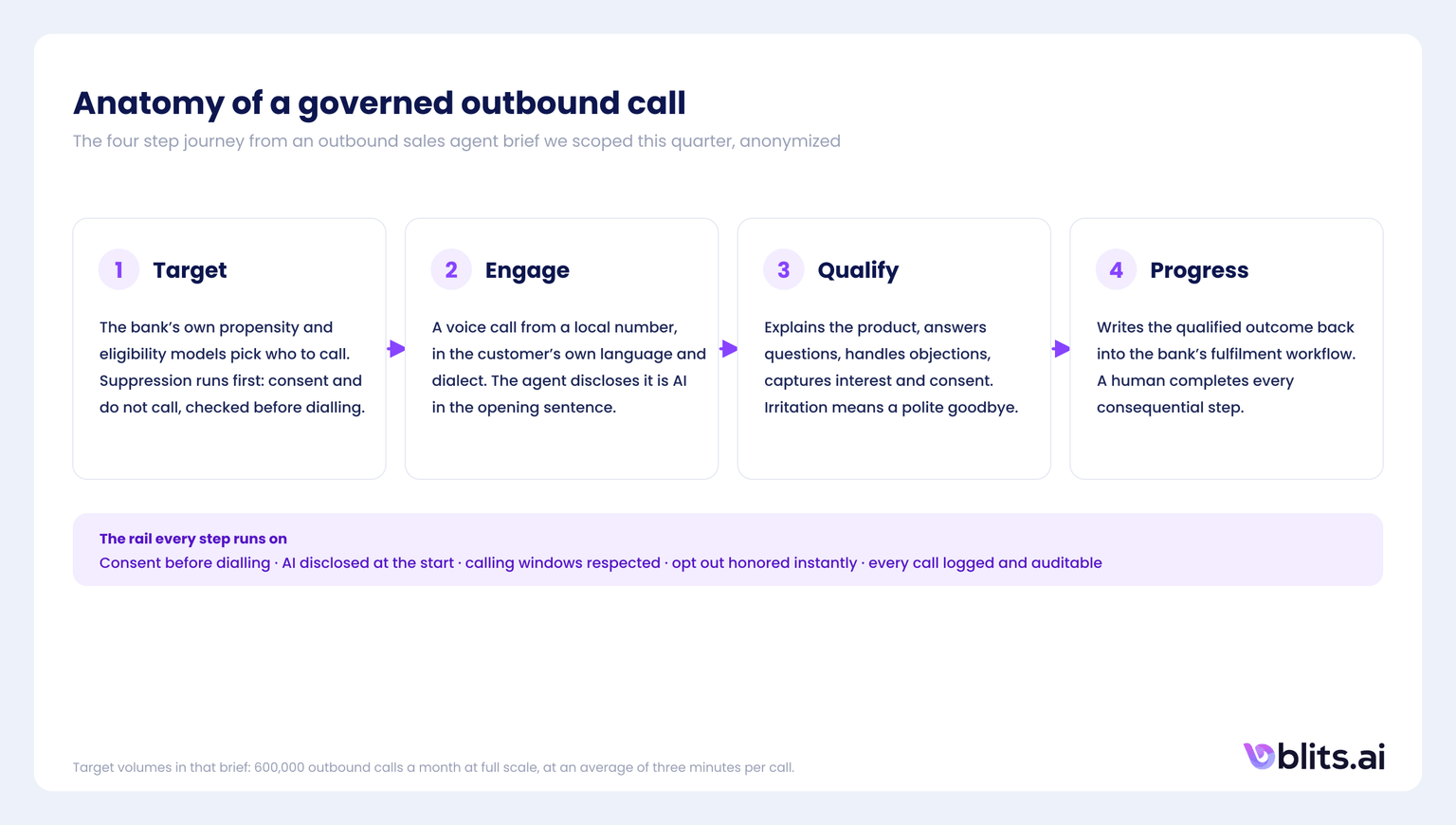
The details are where the program lives or dies. The company's own propensity and eligibility models decide who gets called and about what, so the agent never invents a target. Consent and do not call flags are enforced as hard suppression before dialling, not as a policy document: a number that shouldn't be called physically can't be. The call comes from a local number, opens in the customer's language, and discloses it's AI in the first sentence. Objections get answered, irritation gets a polite goodbye, and interest gets written back into the company's fulfilment workflow, where a human completes every consequential step: the approval, the contract, the actual money movement.
None of that is optional anymore, because the regulators moved first, and not just for banks. The FCC ruled in February 2024 that AI generated voices in outbound calls fall under the TCPA, which makes calling without prior express written consent illegal in the US, whoever you are. The EU AI Act's Article 50 transparency obligation applies since August 2026: people must be told they're talking to AI from the start of the first interaction, in every industry. The UK's ICO is blunt that for automated calls, general marketing consent is not enough. The pattern across all of them is the four governance rules we keep writing about: guardrails, an inventory, a human on consequential decisions, an audit trail. Outbound doesn't get an exemption. Outbound gets the strictest version.
In outbound, the scarcest resource is not phone lines or voice minutes. It's the customer's patience, and you spend it every time you call with nothing to say.
And measurement is where outbound is honest in a way inbound rarely is. The funnel is unforgiving: engagements initiated, connection rate, opportunity rate, conversion rate, each stage reported per product. The brief we scoped benchmarks conversion at 7 to 15 percent, and the only way to defend a number like that is to instrument every stage and let the client see it. A deflection percentage can hide a lot of sins. A conversion rate can't.
One more number, and it cuts the other way. Gartner expects that by 2030, 75 percent of B2B buyers will prefer sales experiences with human interaction over AI. Put that next to the 80 percent who won't answer unknown numbers and the lesson is not "don't do outbound AI." The lesson is that the permission to call is earned by relevance and destroyed by volume. An AI that calls because the customer's contract lapses next week, discloses itself, says something genuinely useful in the customer's own dialect and takes no for an answer builds the relationship. The same AI pointed at a purchased list is just spam that scaled, and it poisons the channel for everyone, which is precisely what the voice quality and dialect work exists to prevent: sounding like your brand, not like a robocall.
Three questions for anyone planning this, board version:
- What triggers a call? If the answer isn't grounded in your own customer data and propensity models, you're building spam.
- What happens when the customer says stop? Opt out honored instantly, suppression permanent, and show me the log.
- Who completes the sale? If the AI can sign the contract or move the money end to end without a named human, your regulator will find the gap before you do.
My prediction, and I'll happily be graded on it: within three years, the enterprises that do this well will place more AI calls than they receive, because service becomes proactive by default: the fraud alert that calls you, the renewal that calls you, the abandoned application that calls you five minutes later while intent is still warm. Our banking use case map gained its first outbound rows this summer, and every industry map we draw will grow the same column.
The company that waits for the call already lost the moment to the company that makes it. If outbound is on your roadmap, or a brief like the one above is on your desk, let's talk.