Today we're introducing a new product on the Blits.ai platform: Blits.ai Financial Wellbeing, an AI money assistant that banks offer to their own customers, running on the bank's own data, inside the bank's own walls.
We're taking it to the startup pitch competition at CES Unveiled Amsterdam on September 14, ahead of CES 2027 in Las Vegas. Our pitch sums the product up in one line: the first AI money assistant a bank runs on its own data, nudging millions toward healthier finances, without ever giving financial advice. We treat that last clause as a design requirement, and much of this article explains how we meet it.
Buy now, pay later services and consumer credit have taken nearly all the effort out of short term borrowing. Paying it back is another matter. Debt builds up month after month without anyone noticing, savings never get started, and financial stress only becomes visible once it has already added up.
Banks hold the data that could show these patterns early. Every installment plan, every subscription and every salary deposit sits in the transaction history. A standard banking app, though, shows that history as a list of transactions and gives no picture of financial health. No bank can put a human coach next to millions of retail customers either.
Those who feel this most usually don't have a private banker. They are everyday customers who lack the time, the confidence or the overview to manage money well, and this product is meant for them.
Key message: Banks have the data. What they lack is a way to translate transactions into behavior, and behavior into one next step a customer can actually take.
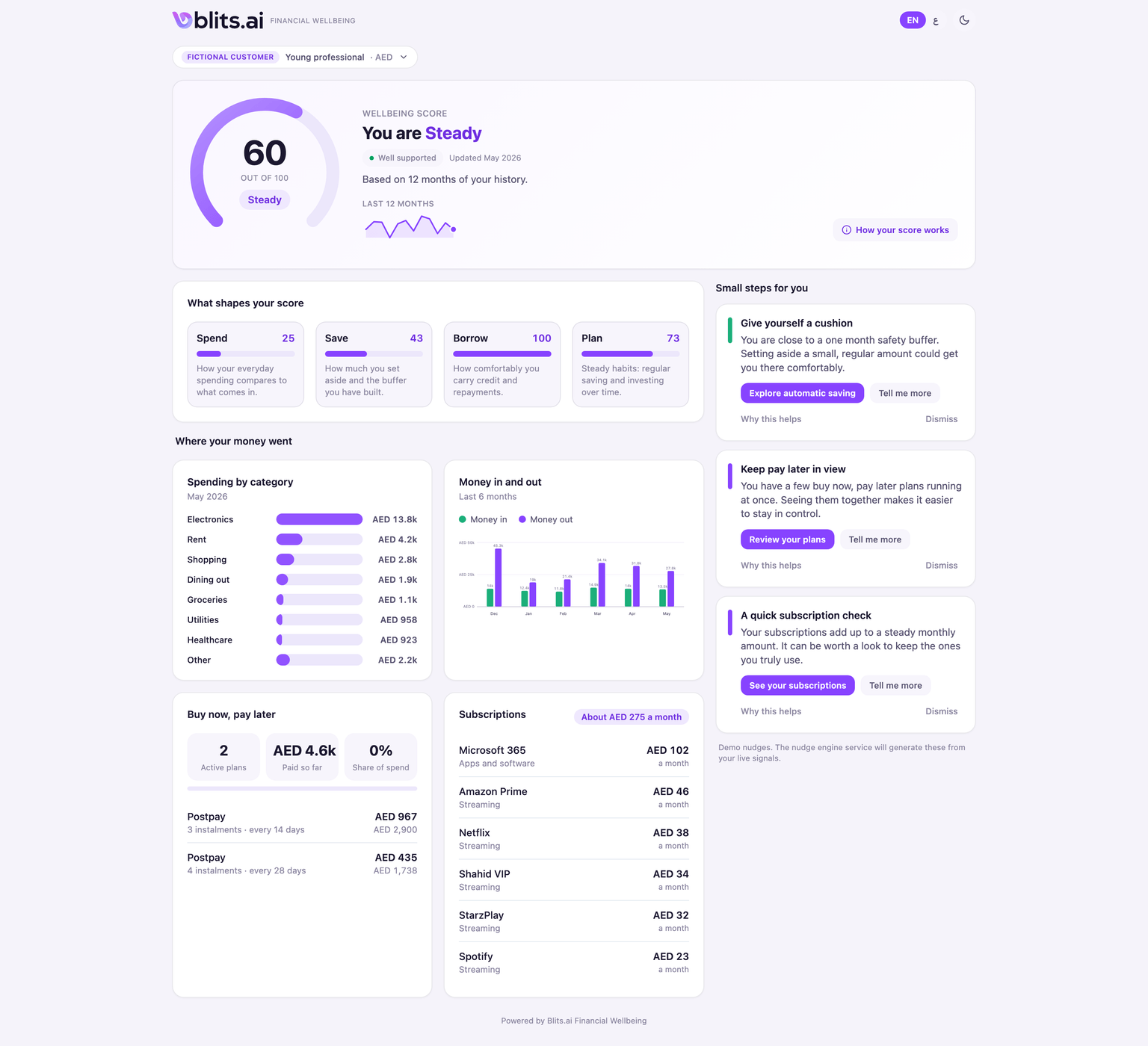
Financial Wellbeing turns twelve months of transaction history into a wellbeing score built on four pillars: Spend, Save, Borrow and Plan. The score comes with a plain language state such as "Steady" or "Building", so nobody is confronted with a number to be ashamed of, and with a trend line that shows which direction things are going.
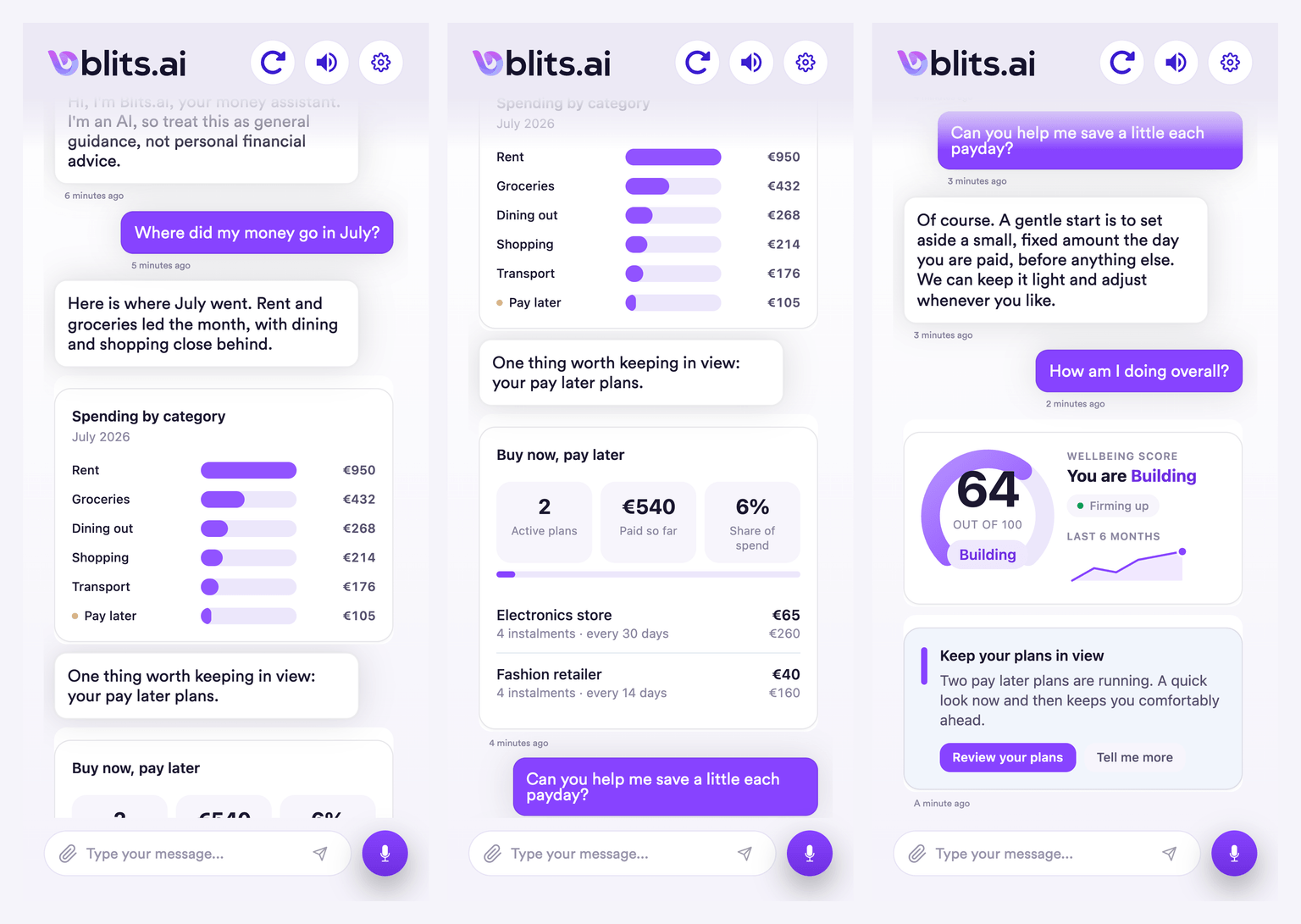
Around the score, the assistant answers the questions people actually ask: where did my money go in July, can you help me save a little each payday, how am I doing overall. Answers come back as short text plus rich cards: spending by category, money in and out, active buy now, pay later plans, and the subscriptions that add up each month without anyone paying attention.
Then there are the nudges, and here we were strict with ourselves. A customer gets a few small steps at a time, never a daily guilt feed. Each nudge explains why it helps and can be dismissed. The nudge engine also runs with randomized holdout measurement: a slice of customers doesn't get the nudge, so the bank can see the actual difference in behavior instead of taking our word for it. We've written before about measuring AI with proper KPIs; this product has that discipline built into its core.
Connect a general purpose AI model to someone's bank account and you have three ways to cause harm: wrong answers, leaked data, and the big one in a regulated industry, accidental financial advice. "Which stocks should I buy" is the first question every visitor asks in a demo. The assistant declines it, every time, and explains what it can do instead.
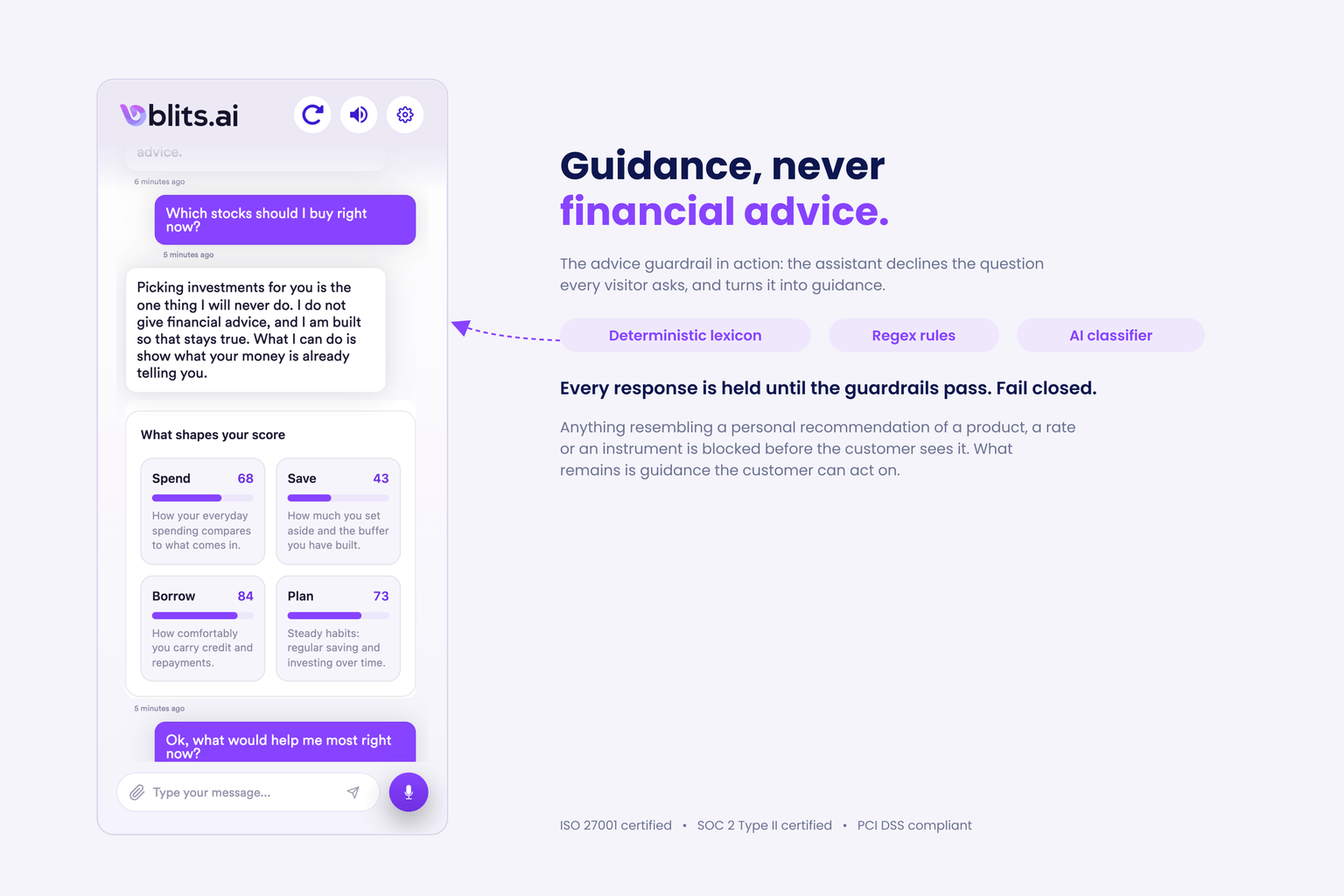
A system prompt that asks the model nicely would not hold that line. We use several layers instead, per language: a deterministic lexicon, regex rules and an AI classifier, because "should I buy Bitcoin" comes in many forms and several alphabets. Every response is held until the guardrails pass. If a check fails or even times out, the response is blocked, which is what we mean by fail closed. Anything resembling a personal recommendation of a product, a rate or an instrument never reaches the customer. What remains is guidance. The assistant shows what your money is already telling you and which options people in your situation consider.
For banks preparing for the EU AI Act and its cousins, this architecture is the difference between a compliance review that takes a quarter and one that takes a meeting.
The architecture starts from one non negotiable: customer data never leaves the bank.
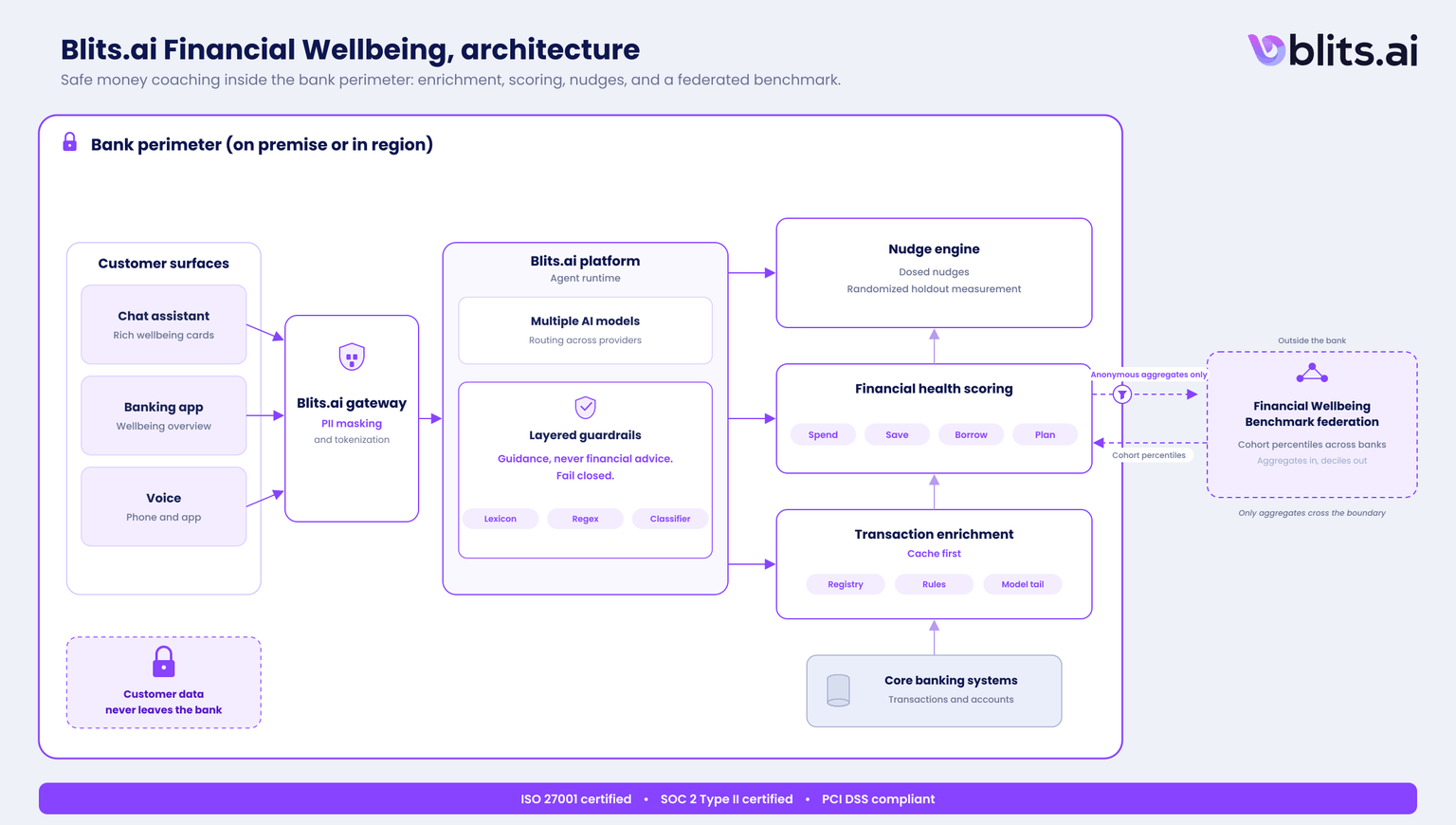
Everything runs inside the bank perimeter, on premise or in region: the gateway that masks and tokenizes PII before any model sees a prompt, the agent runtime with its model routing and guardrails, transaction enrichment that works cache first (a registry and rules handle the bulk, a model handles only the tail), the scoring service and the nudge engine. The only data that ever crosses the boundary is the anonymous aggregates used for the benchmark.
That benchmark deserves its own sentence. Financial health is only meaningful relative to a population, so the product includes a federated wellbeing benchmark: each participating bank contributes anonymized aggregates and receives cohort percentiles (deciles) back. No customer record ever moves, and every bank gets an answer to what its board actually wants to know, namely whether its customers are getting healthier and how that compares with other banks.
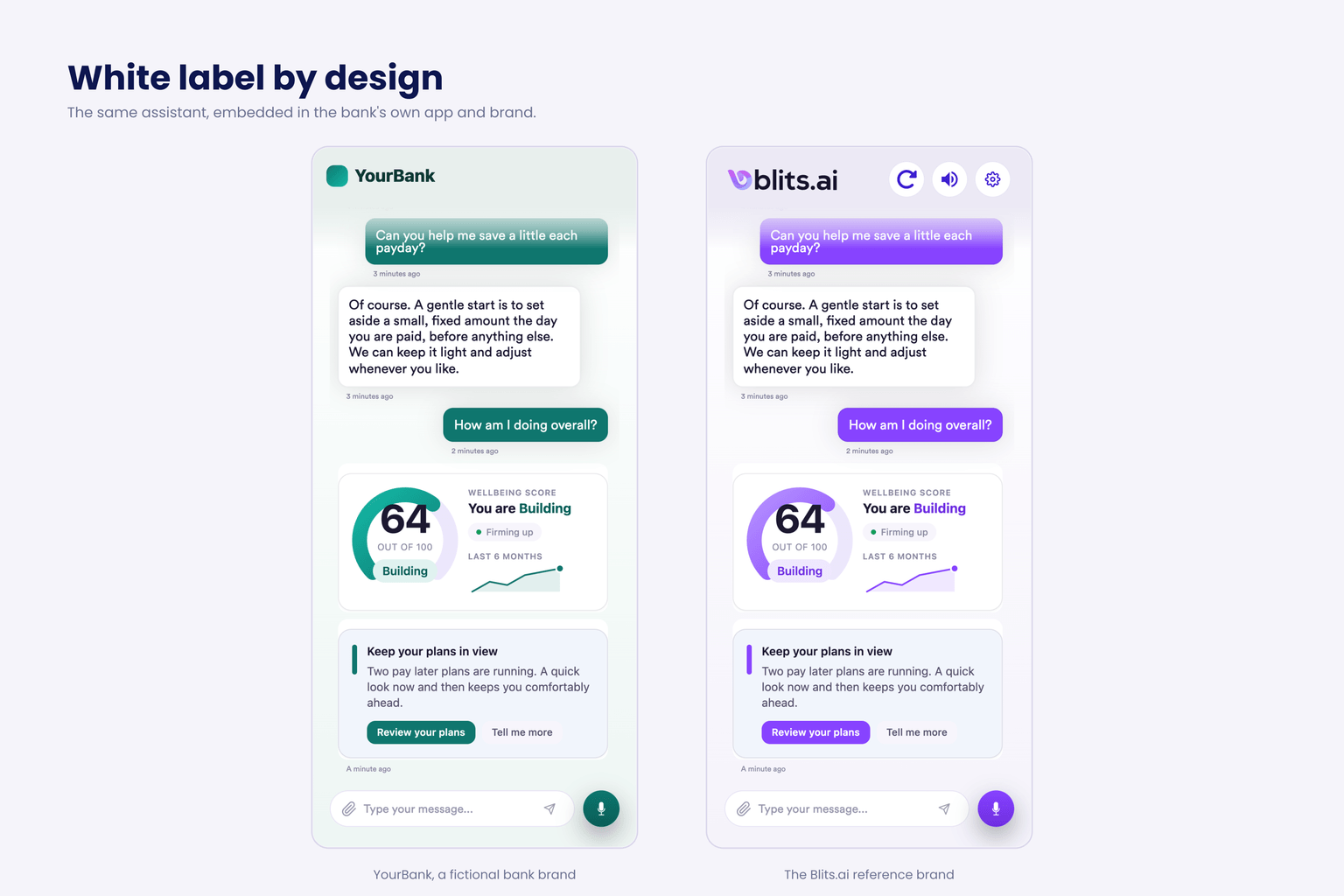
And because banks own the customer relationship, the whole experience ships white label: the same assistant, the same score, the same nudges, in the bank's app, brand and tone, across chat, voice and in app surfaces.
Financial Wellbeing is a new product. It comes from an existing company and it is well past the prototype stage, as the newest addition to the Blits.ai enterprise AI platform, which already reaches a quarter of all Middle East bank accounts every day, carries more than fifty enterprise AI use cases for banks (financial wellbeing has been a row on our banking map for a while), includes a strategic partnership with Mastercard, and is certified to ISO 27001, ISO 42001, SOC 2 Type II and PCI DSS. The guardrails, the model routing, the test suite and the on premise deployment story were already in production before this product existed, and it builds directly on them.
That's also why the go to market is simple: licensed to banks, B2B2C. The bank brings the customers and the trust. We bring the AI, the guardrails and the benchmark. The customer gets a money coach that was previously reserved for people who could afford one.
For banks considering this, the path is deliberately short:
- Connect and enrich. Transactions and accounts, inside your perimeter. The cache first enrichment means no bulk data science project before day one.
- Score and observe. The wellbeing score runs silently first, so you see the distribution across your portfolio before a single customer does.
- Launch surfaces and nudges. Your app, your brand, your compliance sign off on every guardrail policy, with holdout measurement on from the first nudge.
- Benchmark. Join the federation and get cohort percentiles that tell you what "better" actually means.
Financial stress is one of the few problems where a bank can help millions of people and strengthen its own franchise at the same time. Banks already have the data and the trust of their customers. What they were missing was a way to turn one into the other without crossing the advice line, and that is what we built. If you want to see it with your own transaction categories, let's talk.
Updated on 12 October 2026.