Most teams still treat text-to-speech (TTS) as a final output step. It is not. It is a core product layer.
If your assistant can reason well but sounds robotic, slow, or culturally off, users will not trust it. Voice is where AI gets judged in real life.
In this article I will break down what TTS engines are, what model options exist today, which providers matter, and why speed, quality, region, and dialect should be treated as first-class architecture decisions.
A text-to-speech engine converts written text into synthetic speech. Modern engines no longer just "read words"; they model prosody, pacing, emphasis, and pronunciation so output sounds more human.
You see TTS everywhere:
- Voice assistants and conversational banking
- Contact center automation and IVR modernization
- E-learning and accessibility solutions
- In-car assistants and infotainment systems
- Real-time translation and multilingual customer support
- Media, gaming, and dynamic content generation
In practical terms, TTS is often the final mile between model intelligence and human experience. That final mile decides whether the interaction feels natural or not.
There is no single "best TTS model." There are model families, each with a different trade-off profile.
These are managed models from major providers. They are fast to integrate, continuously improved, and usually offer broad language coverage. For many teams, this is the best first production path.
Some organizations need strict brand voice control, regulated wording style, or persona-specific output. In those cases, teams tune prompts, lexicons, and post-processing pipelines, or train custom voices with specialized vendors.
Voice cloning can deliver strong personalization, but it introduces governance questions immediately: permissions, consent, identity misuse risk, and legal boundaries. Technically powerful, operationally sensitive.
Newer systems combine language reasoning and speech generation more tightly, reducing handoffs between separate modules. This can improve naturalness and reduce latency in certain real-time scenarios.
At the same time, not every LLM includes native TTS, and even when it does, language quality can vary a lot by market and dialect. A model that performs well in English does not automatically perform well in Arabic, Turkish, or mixed-language conversations.
Many enterprise setups are hybrid by design: one engine for low-latency live calls, another for premium voice quality, and a fallback provider for reliability or regional compliance.
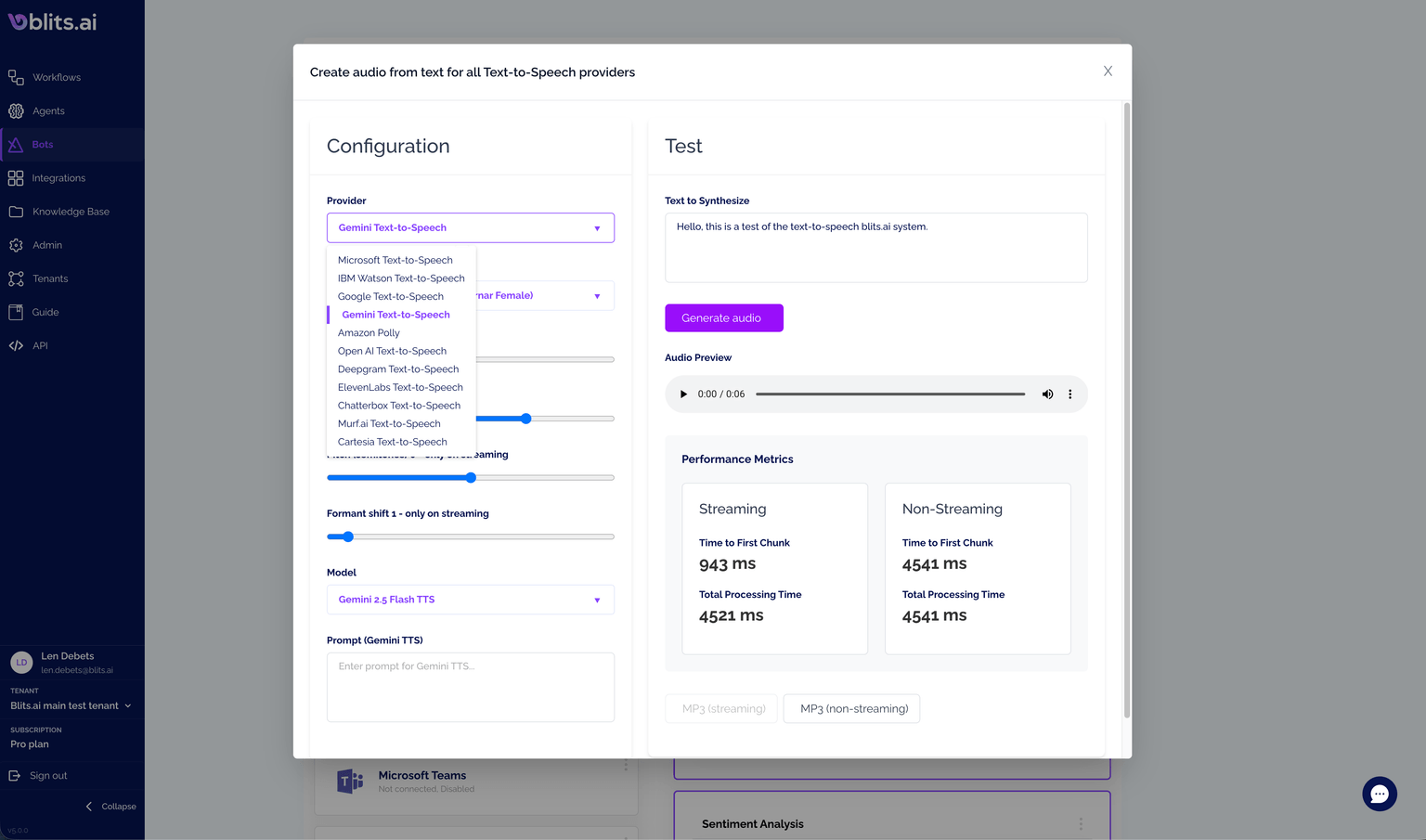
In our current TTS integration landscape we work across Google, Microsoft, Amazon, IBM, OpenAI, Gemini, ElevenLabs, Deepgram, Murf, Cartesia, and Resemble. The market is mature enough that every provider can produce "good" output in a demo. The difference shows up when you move from a demo to production.
The hyperscalers, such as Google, Microsoft, Amazon, and IBM, are usually the safest choice for governance-heavy organizations. They are strong on enterprise controls, regional deployment options, and operational reliability. In our testing context this often translates into predictable performance and easier compliance discussions, but sometimes a less distinctive voice identity for brand-led use cases.
Then there are the fast-moving model providers such as OpenAI and Gemini. We currently validate models like tts-1, tts-1-hd, gpt-4o-mini-tts, gemini-2.5-flash-tts, gemini-2.5-flash-lite-preview-tts, and gemini-2.5-pro-tts. Their main advantage is speed of innovation and a strong quality/latency balance. The trade-off is operational: model families evolve quickly, so teams need disciplined versioning, regular regression checks, and clear fallback paths.
Voice-specialist providers, especially ElevenLabs, Resemble, and in certain scenarios Murf, often stand out when naturalness and brand voice are the top priority. In our validated set this includes options such as eleven_flash_v2_5, eleven_multilingual_v2, eleven_turbo_v2_5, and eleven_v3, as well as Murf's Gen2 and Falcon. These providers can deliver impressive voice character and multilingual experiences, but procurement, licensing, and deployment constraints can become the deciding factor in enterprise environments.
For real-time conversational systems, latency-focused providers like Deepgram (aura) and Cartesia (Sonic2, Sonic3) are increasingly relevant. They are designed for responsive interaction loops, where milliseconds matter. The practical question is not only speed, but whether language coverage, long-form stability, and regional requirements match your target markets.
There is also a serious open-source track that many enterprise teams should consider. Running TTS locally can be a major advantage when data cannot leave your network, when you need predictable per-minute costs, or when you want full control over deployment and model behavior. For English, there are now strong open-source options with surprisingly high quality, such as Coqui XTTS v2, Piper, and StyleTTS2. The challenge starts when you move beyond English: multilingual quality and dialect consistency can still be uneven, and production hardening often requires extra engineering around voice selection, pronunciation control, and model tuning.
That is why the strategic decision is not "who is best overall." The right question is: which provider-model combination is best for this specific language, channel, region, and latency target today, and how quickly can we switch when that answer changes tomorrow.
In practice, this means choosing a complete voice stack, not a single model: speech-to-text, language model, and text-to-speech must be selected and tested together for the target language experience.
From our work on Saudi Arabic voice experiences, and similar projects across Gulf, Egyptian, and Levantine Arabic dialects, one lesson keeps repeating: voice quality is a system property, not a single model property.
In voice conversations, delay kills trust. If responses come back late, users interrupt, repeat, or abandon the flow. Good TTS is not only about waveform quality; it is about response time under real traffic conditions.
A voice can be technically clear but still feel synthetic. Users notice rhythm, emphasis, and pronunciation errors immediately, especially in repeated operational flows like banking or support journeys.
For enterprise deployments, region matters as much as model quality. Data residency, cloud constraints, and procurement realities often narrow the viable choices. A "best model" that cannot run in your allowed environment is not best for your business.
Dialect consistency is decisive in Arabic deployments. This applies not only to Saudi Arabic, but also to other dialect families where users immediately hear when a system mixes styles. Mixing Modern Standard Arabic and local dialects reduces recognition quality upstream and makes generated speech sound less natural downstream.
When all components in the voice pipeline align on the same dialect, user experience improves quickly: better understanding, better response quality, and fewer conversational breakdowns.
In short: the strongest voice systems optimize for the full pipeline, not only for one model benchmark.
At Blits, voice is built as an orchestration layer, not a lock-in layer. You can connect multiple TTS engines, switch between models, and measure performance per use case.
That creates concrete business value:
- Faster experimentation: compare engines per language, channel, and use case.
- Better outcomes: optimize for latency, quality, and dialect fit instead of brand popularity.
- Vendor resilience: avoid being blocked by one provider's pricing or policy changes.
- Compliance flexibility: route workloads to providers that fit regional requirements.
- Continuous optimization: benchmark and improve over time as models evolve.
This is especially relevant for large organizations where voice quality must be consistent across markets while still adapting locally.
The next wave in AI is not only better text reasoning. It is real-time, multimodal interaction where voice becomes a primary interface.
What to expect next:
- More real-time speech generation with lower end-to-end latency
- Better emotional control and speaking style transfer
- Stronger dialect and code-switching support
- Tighter integration between LLM reasoning and speech output
- More enterprise controls for safety, governance, and auditing
Why this matters: voice is the most human interface we have. If AI is going to operate in customer service, healthcare, finance, public services, and education at scale, the voice layer must be fast, trustworthy, culturally correct, and operationally controllable.
Teams that treat TTS as a strategic infrastructure component today will ship more natural AI products tomorrow.